


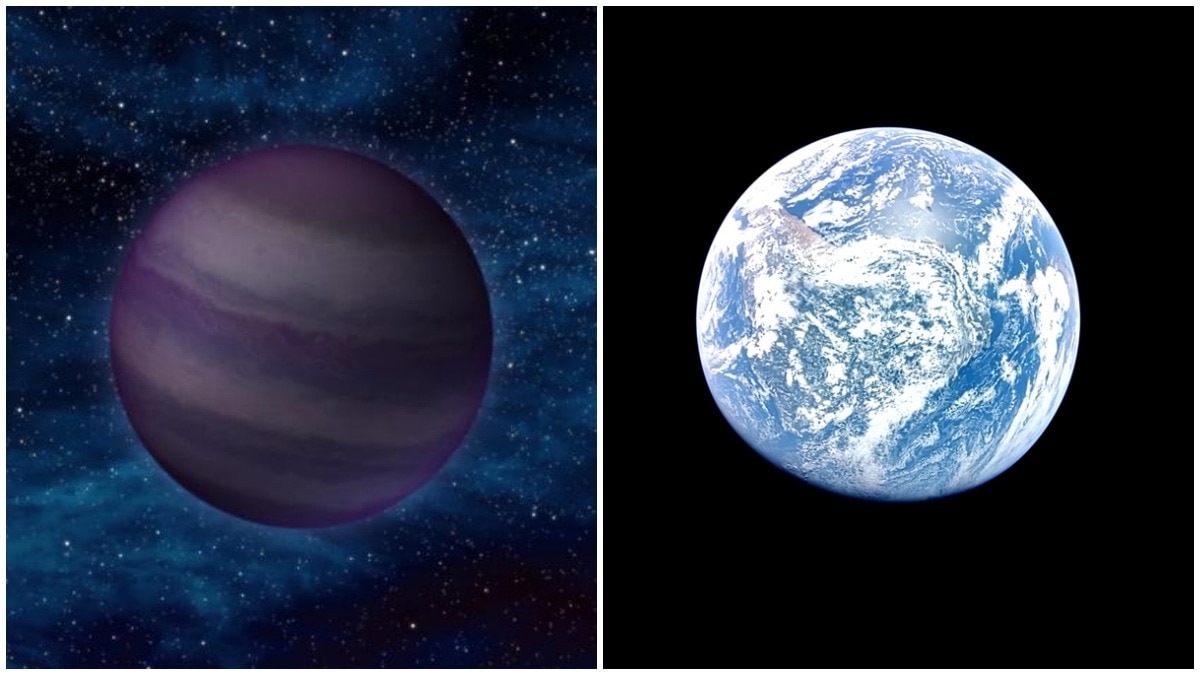
New Delhi: Astronomers have discovered changing water clouds and complex atmospheric activity on one of the coldest known objects beyond our solar system, revealing that a world more than seven light-years away may feature weather patterns remarkably similar to those found on Earth and Jupiter.
Using NASA's James Webb Space Telescope, a research team led by University of Arizona Steward Observatory assistant astronomer Brittany Miles observed the object known as WISE 0855 for 11 hours, recording its spectrum every 15 minutes. These observations deliver the most detailed time-series portrait of the object's atmosphere to date and offer the initial direct confirmation that water clouds on another celestial body can alter in thickness over time.
Published in The Astrophysical Journal, the findings uncover two distinct atmospheric processes taking place at the same time: high-altitude water clouds shifting in density as the object rotates, and deep chemical gases moving upward toward the surface via convection. Miles noted that prior to the space telescope, researchers relied solely on photometry, which blended the individual effects of clouds, temperature, and chemistry together.
WISE 0855 is classified as a brown dwarf, a category of objects too massive to be standard planets yet too small to sustain the nuclear fusion reactions that power stars. Situated roughly 7.5 light-years from Earth, it possesses about twice the mass of Jupiter and a comparable physical size. With an approximate temperature of 265 Kelvin, or minus 8 degrees Celsius, it remains colder than Earth's average surface temperature.
As the brown dwarf rotates, distinct regions featuring varying temperatures and cloud coverage rotate into view. The sensitive instruments aboard the space telescope successfully captured these fluctuations, enabling scientists to differentiate between cloud variations and signals generated by atmospheric gases.
Furthermore, the observatory identified shifting signals tied to carbon monoxide and phosphine. These chemical gases are transported upward from deeper, warmer layers through convection, a mechanism also documented in the atmosphere of Jupiter. This phenomenon, referred to as disequilibrium chemistry, takes place when atmospheric gases circulate faster than chemical reactions can re-establish equilibrium.
This discovery assists researchers in gaining a deeper comprehension of the atmospheres surrounding giant planets located outside our solar system. Although brown dwarfs do not fall under the classification of true planets, they share critical atmospheric mechanisms with gas giants like Jupiter.
Examining these objects provides a valuable opportunity to evaluate models concerning cloud formation, atmospheric circulation, and chemistry under extreme conditions that cannot be easily replicated on Earth. Scientists intend to conduct additional observations with the telescope to further analyze the rotation of WISE 0855 and the three-dimensional dynamics of its atmosphere.
The results indicate that the physical principles governing clouds and weather may extend across a diverse array of worlds, spanning from Jupiter to distant giant exoplanets, demonstrating that weather in deep space can closely mirror processes familiar to scientists.