


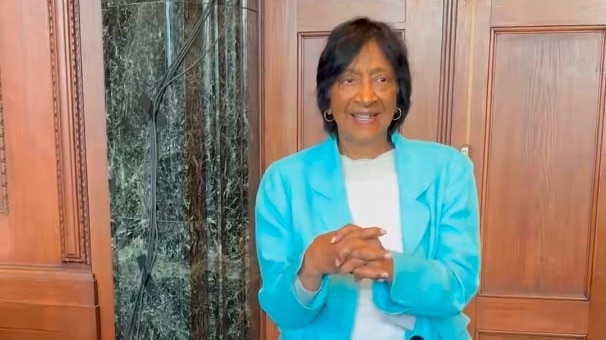
New Delhi: Navaneethem Pillay initially struggled to believe the news when she was announced as a Nobel Peace Prize winner, reacting among cheering colleagues with a combination of humility, disbelief, and sharp wit. Surrounded by supporters, the 85-year-old South African human rights defender joked that she might split the prize with US President Donald Trump if the room gave her a louder round of applause.
Addressing her colleagues briefly after the announcement, Pillay quipped that a bit more applause might convince her to share the distinction with Trump, before admitting she wanted to double-check that the news was real. Trump has frequently asserted that he merits the Nobel Peace Prize, pointing to his stated role in resolving global conflicts and brokering various peace agreements.
Pillay, a former United Nations human rights chief, received the Nobel Peace Prize in recognition of her lifelong career as an intrepid global advocate for justice. Her distinguished legal background includes serving on the International Criminal Court and breaking barriers as South Africa's first non-white female High Court judge. Upon reacting to the honor, Pillay remarked that an award only holds true meaning if the general public believes the recipient has truly earned it.
She formally dedicated the accolade to all survivors of international crimes. Reflecting on comments praising her personal courage following the announcement, Pillay questioned why telling the truth should be viewed as courageous, explaining that her judicial philosophy has always centered on interpreting the law, analyzing the facts, and delivering impartial rulings.
She cautioned that humanity is currently navigating a period where human rights, and the International Criminal Court in particular, face mounting assaults, urging the global community to steadfastly protect the rule of law. The veteran jurist has forged a formidable career spanning decades, moving from domestic South African courts to international tribunals including the International Tribunal for Rwanda and the International Criminal Court.
Pillay achieved international visibility for her forthright criticism of government crackdowns on popular uprisings throughout the Arab world, encompassing nations like Libya and Syria. Her extensive international portfolio also features serving as an ad hoc judge in the legal proceedings initiated by The Gambia against Israel.
From 2021 to 2025, she led a United Nations Human Rights Council commission of inquiry tasked with investigating the underlying causes of the Israeli-Palestinian conflict. That independent panel concluded that genocide had taken and continued to take place in Gaza, a finding that drew severe criticism from Israel.
Presently, Pillay serves as an ad hoc judge at the International Court of Justice, participating in a high-profile case determining whether Myanmar's military campaign against the Rohingya population violated the 1948 UN Genocide Convention, with a final judgment anticipated in the near future.