


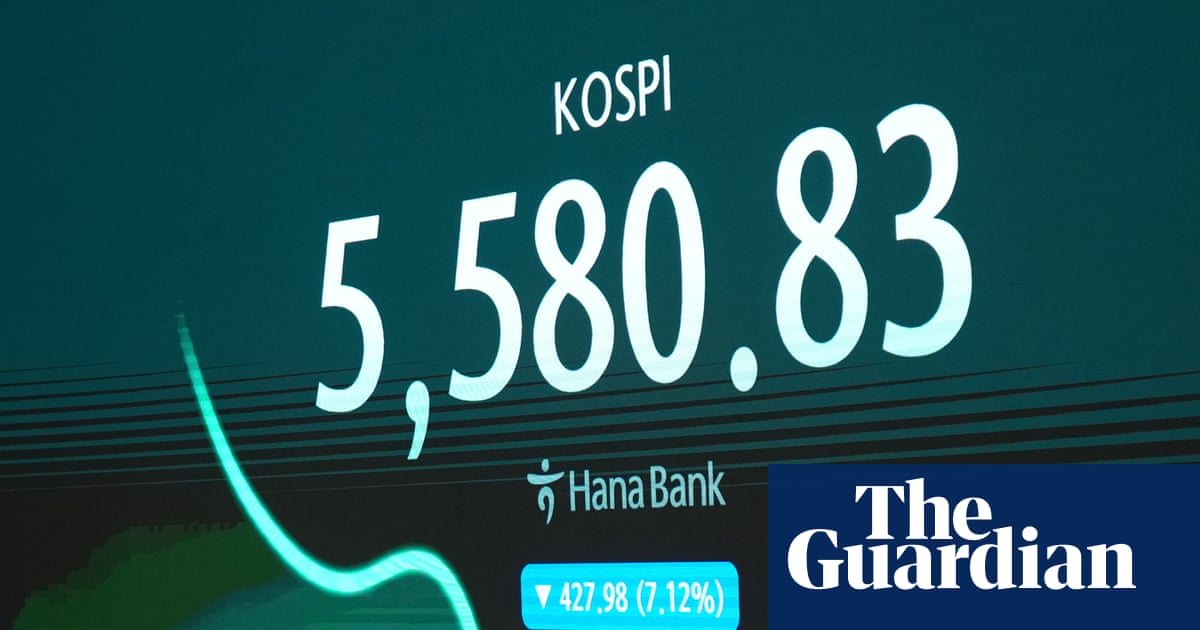
An accelerating decline in artificial intelligence-linked equities has impacted global financial markets, driven by anxieties over climbing inflation and prospective interest rate increases that have unnerved traders concerned about heavy debt burdens within the technology sector.
South Korea’s Kospi 200 index, heavily weighted toward memory chip producers, dropped over 8% overnight to reach a six-month closing low, prompting trading halts via circuit breakers at multiple intervals. Prominent semiconductor firms SK Hynix and Samsung Electronics experienced severe declines of nearly 11% and 9.5%, respectively, pulling the benchmark down by 8.1%.
In Japan, the Nikkei 225 index fell 4.9% following steep losses for memory chip manufacturer Kioxia, which dropped 11%, and tech investor SoftBank, which fell 10% due to its prominent financial stake in OpenAI backer networks. These declines followed negative momentum on Wall Street, where the Nasdaq Composite decreased 1.9% and the S&P 500 declined 1.1% in its most challenging session since July.
The market downturn follows the release of US economic data indicating that inflation accelerated to 3.7% in September, representing the quickest consumer price index increase since May's three-year high of 4.2%. The higher figures have startled investors who now anticipate additional monetary tightening from the US Federal Reserve, with some market participants pricing in a potential rate hike before the end of the month.
Analysts at Deutsche Bank noted that the past 24 hours delivered extraordinary market turbulence driven by a strong consumer price report combined with mounting skepticism regarding the sustainability of the artificial intelligence trade. Observers emphasized that the price increases were not isolated to volatile fuel markets influenced by geopolitical tensions, but rather reflected broad-based consumer price growth across multiple sectors.
The widespread correction aligns with recent warnings issued by the International Monetary Fund, which cautioned that a potential collapse in AI-related equity valuations could jeopardize global financial stability. The organization highlighted that Asian markets and the United States would face the highest exposure to such a correction, while the UK and eurozone might experience greater insulation, though domestic investors holding US assets would still sustain losses.
Additional fallout reached mainland China, where Shanghai's CSI 300 index decreased by as much as 2.4% to reach its lowest point since August 2025. Meanwhile, Taiwan Semiconductor Manufacturing Company dropped 2% despite announcing its sixth consecutive quarter of profitable operations.
European equities also trended downward during early trading sessions, with the Europe Stoxx 600 dropping 0.4% and regional indices across the UK, France, Spain, and Germany posting modest losses. Across the Atlantic, US stock futures signaled continued downward pressure on technology shares, with Nasdaq 100 futures indicating a 1% drop.