


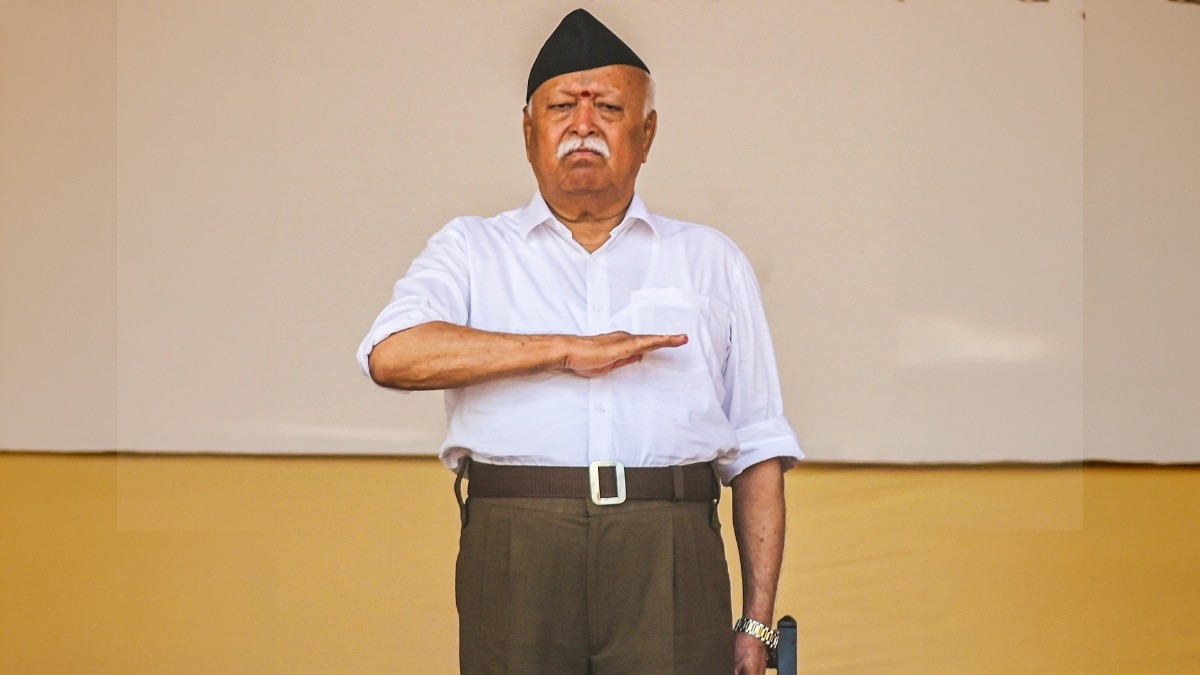
New Delhi: Protests are a democratic right, but what happens when they become political tools? RSS chief Mohan Bhagwat, in his annual Vijayadashami speech, appealed to people to agitate for solutions, not division. He warned of forces seeking to take advantage of internal fault lines.
Protests can bring people together around a grievance, but what happens when the agitation itself becomes a source of division? RSS chief Mohan Bhagwat addressed this question in his Vijayadashami speech in Nagpur on Tuesday, saying that movements were inevitable in a democracy but should focus on resolving problems rather than deepening social divisions.
His remarks come as India has seen protests over the NEET-UG paper leak and, more recently, demonstrations over the Special Intensive Revision of electoral rolls, with the Opposition demanding the resignation of Chief Election Commissioner Gyanesh Kumar. Problems will remain, and there will be agitations because of these problems, Bhagwat noted, adding that agitations in a democracy should be for solutions.
The RSS chief said the responsibility for ensuring that protests did not create hostility or divisions rested with all sides, including groups leading agitations, the government and administration, and political leaders. Whatever the intensity of emotions, actions must remain within the limits of the Constitution, the law, and civilised public conduct.
Bhagwat also spoke about the West, alleging that forces seeking to weaken India were using various means to create instability and influence developments within the country. He referred to attempts at regime change in other countries and warned that similar forces could exploit internal divisions in India, arguing that social discord and hostility could serve the interests of those seeking to undermine the nation.
Bhagwat cautioned against allowing electoral considerations and the pursuit of popularity to influence how people respond to public grievances, noting that the lure of votes and political gains must not overpower judgment and goodwill. He added that actions by protesters and those in authority should not create discord or hostility within society.
He also argued that movements could become instruments of political mobilisation when they were driven by objectives other than resolving the problems that prompted them. When a movement is driven by other objectives, it fuels hostility towards individuals, groups, or ideologies, and forces seeking to weaken India take advantage of this.
Bhagwat said protests were not the only way to address public problems and emphasised the role of collective action and dialogue within society, stating that solutions emerge through the efforts of society and through dialogue. As an example, he cited initiatives by RSS volunteers to improve schools through community participation across multiple states with encouraging results.
Bhagwat argued that society itself had a responsibility to address problems rather than leave the task entirely to political leaders or the government, reminding the public that they too must contribute to running the country. By stressing that grievances were inevitable in a democracy, Bhagwat placed the onus on protesters, political leaders, and the administration to ensure that dissent led to solutions rather than deepening social divisions.