


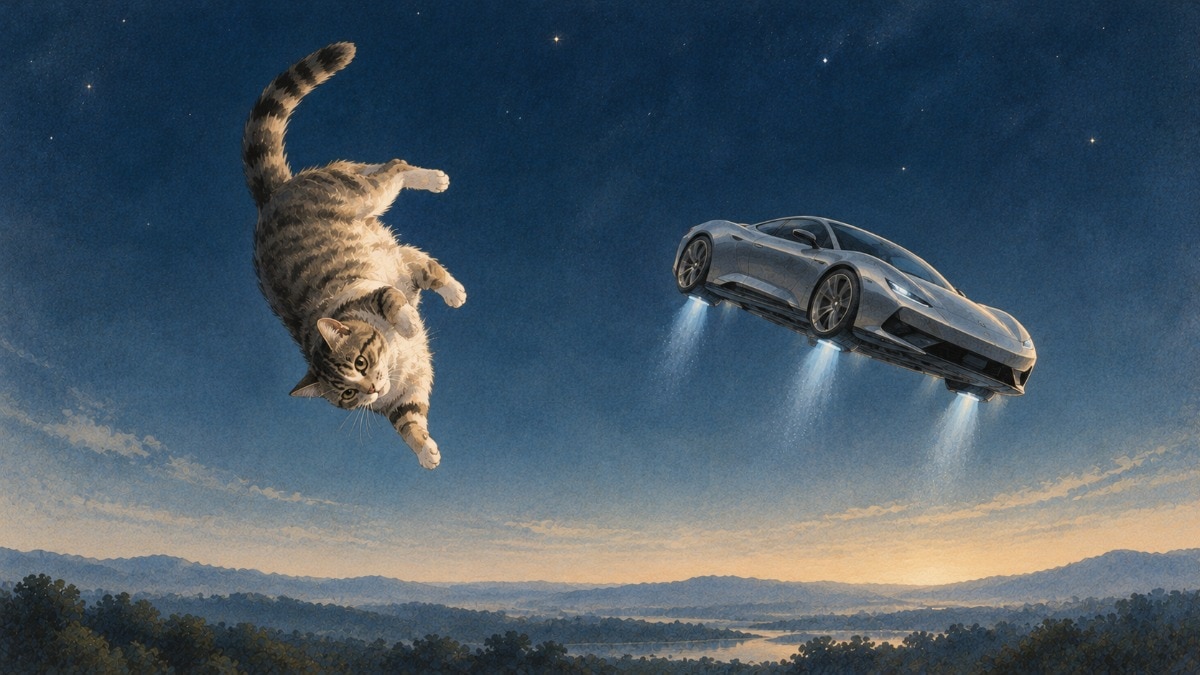
A feline falling from a surface obeys the laws of motion with remarkable grace, executing a slow, liquid twist that consistently results in a soft landing on its feet. Now, a very different machine has attempted that same aerial feat. Tesla's upcoming Roadster, equipped with rocket-style thrusters developed alongside SpaceX, has demonstrated the ability to lift off, spin mid-air, and come down intact. However, both an animal and a car face a fundamental physics challenge when attempting to turn themselves around in the air without a road or ground to push against.
The special skill that allows a feline to orient itself is known as the righting reflex, an automatic movement documented scientifically since French researcher Etienne-Jules Marey photographed a falling cat in 1894. The puzzle lies in the conservation of angular momentum, which states that an object starting with no spin should maintain that state unless an external force acts upon it. A falling feline starts with virtually no spin and receives no mid-air shove, yet it manages to twist upright. A flying vehicle faces the mirror-image dilemma of leaving the ground and needing to rotate and land correctly without ground resistance.
The animal achieves this rotation entirely by altering its shape, relying on the moment of inertia, which dictates how resistant an object is to turning based on how its mass is distributed relative to its center. By tucking its front limbs close to its body, the front half becomes easy to pivot, while stretching its hind legs outward makes the rear half much more stubborn to turn. By twisting its two halves in opposite directions sequentially—much like wringing a wet towel—and then swapping the configuration of its limbs, the animal can incrementally rotate its entire body without violating any physical laws.