


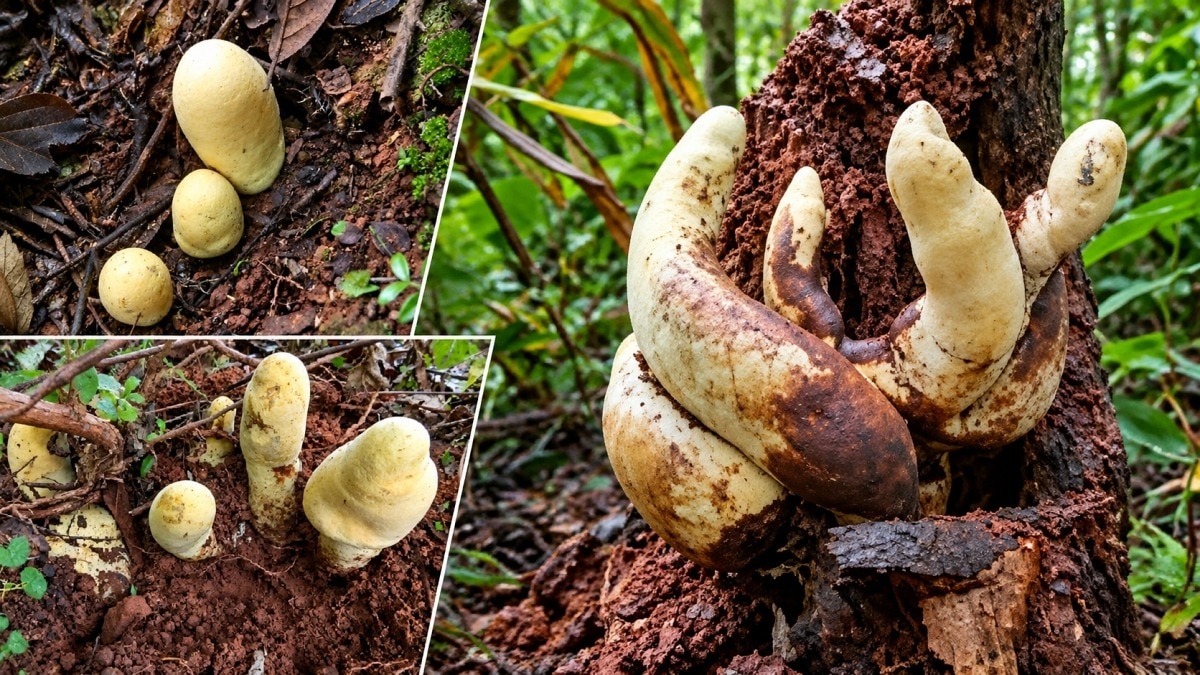
New Delhi, Oct 14, 2026 13:02 ISTScientists in China have discovered a giant fungus capable of growing up to 50 centimetres tall and weighing 2.2 kg, revealing a previously unknown fungal lineage whose evolutionary origins date back around 65 million years.
Named Dianjunus rex, the species was discovered in forests across China's southwestern Yunnan province. Researchers say it produces the largest known fruiting bodies among fungi belonging to the phylum Ascomycota, challenging existing understanding of how large these structures can grow.
The discovery, published in Frontiers in Fungal Biology, also establishes a new fungal genus and family, Dianjunaceae. Researchers encountered the unusual whitish fungal structures during fieldwork in temperate coniferous forests near Damaidi and Yipinglang, as well as tropical rainforest near Nanbang. The structures, known as stromata, emerged from the ground around woody roots of Chinese cork oak trees.
Scientists collected specimens, grew spores in laboratory conditions and analysed the fungus's physical characteristics and genetic material. Their findings confirmed that it represented a species, genus and family previously unknown to science. The researchers named the fungus Dianjunus rex, combining a reference to its enormous size with the ancient Dian kingdom of Yunnan.
Ascomycota is the largest fungal phylum, containing more than 64,000 known species. Unlike familiar mushrooms, these fungi release spores from microscopic, sac-like structures within or on their fruiting bodies.
A molecular-clock analysis of the fungus's DNA, compared with hundreds of fungi of known evolutionary age, suggested that the Dianjunaceae family originated around 65 million years ago, approximately one million years after the Cretaceous-Paleogene mass extinction that wiped out the non-avian dinosaurs.
Researchers suggest that the extensive changes in forests following the extinction may have created new opportunities for fungi that decompose woody material. The fungus's exceptional height could also help it disperse spores more effectively through dense forest vegetation, though producing such a large structure requires considerable energy.
Scientists believe the discovery highlights how much fungal biodiversity remains undocumented in East Asian forests, particularly in regions where difficult terrain and the seasonal appearance of fruiting bodies complicate field research.