


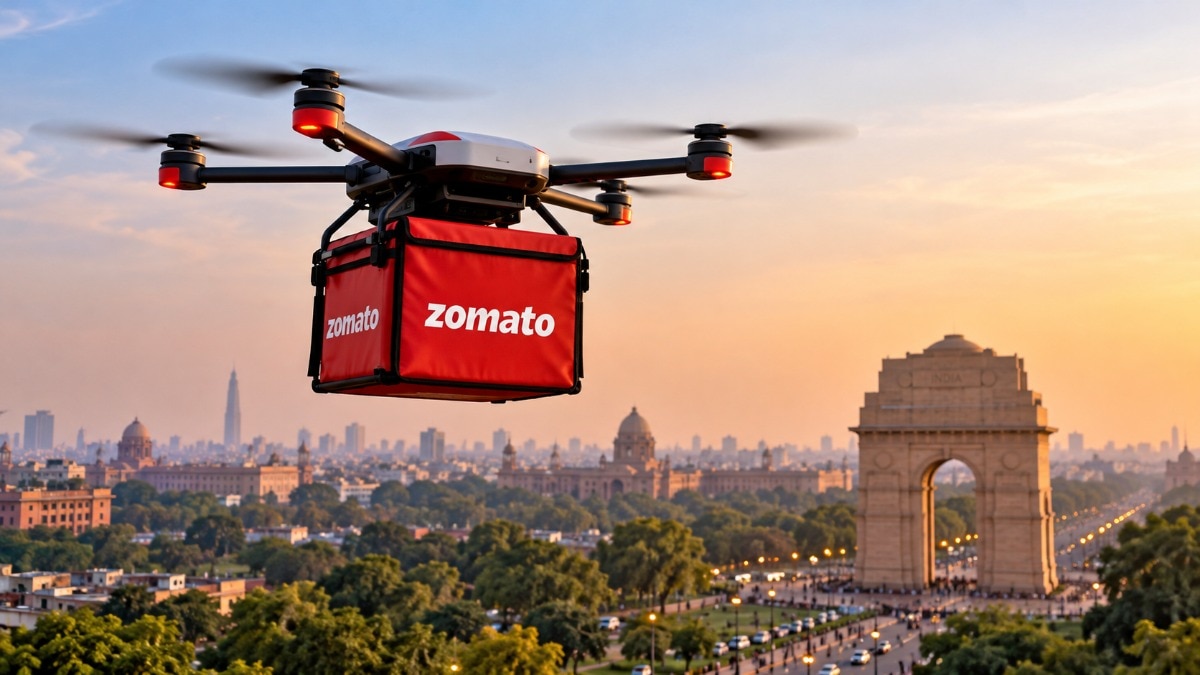
Zomato and its quick-commerce counterpart Blinkit stand among the largest logistics and delivery enterprises in India. The enterprise depends heavily on a vast labor force to transport meals, household groceries, and other daily necessities directly to consumers. Based on internal corporate data, approximately 3.1 million individuals served as delivery contractors for Zomato and Blinkit during the fiscal years spanning 2025 to 2026, with expectations for that workforce to expand further in subsequent years. However, questions remain regarding how the business might operate if it eventually encounters difficulties recruiting sufficient personnel to fulfill these orders. Zomato founder Deepinder Goyal suggested that the enterprise might pivot toward autonomous aerial drones should such a labor deficit materialize.
Goyal expressed this perspective while replying to a social media user on the platform X, who questioned whether the vast majority of the population might end up working as delivery agents over the next decade and a half. In his response, Goyal stated that he hopes such a scenario does not occur, emphasizing that the economy requires higher-quality employment opportunities. He added that the organization will look toward utilizing drones when human labor is no longer sufficient for the workload. These comments surface amid broader ongoing conversations concerning the nature of gig labor in India and how emerging technological innovations could transform the logistics of food and essential goods distribution.
Although Goyal brought up drones as a potential remedy for future labor shortages, he stopped short of revealing any definitive timelines or official rollouts for aerial delivery services at Zomato. Furthermore, Goyal pointed out that Eternal, the parent organization of Zomato, currently sustains the livelihoods of well over one percent of the entire Indian population when factoring in staff members, warehouse personnel, and their respective households. He also mentioned an ambition to elevate that contribution to five percent by the year 2030.
While aerial food delivery has not yet achieved widespread commercial adoption throughout India, various enterprises have tested the technology for multiple years. Competitor Swiggy collaborated with ANRA Technologies back in 2021 to pilot drone logistics for meals and medical supplies, conducting tests in regions of Uttar Pradesh and Punjab to evaluate how unmanned aircraft might carry goods over extended distances. Swiggy also explored similar trials in 2022 for its rapid commerce subsidiary Instamart across major urban centers, intending to use drones for moving inventory between fulfillment centers and local pick-up stations before human couriers handled the final leg to the consumer. Nevertheless, these trials remained experimental and have not transitioned into standard commercial operations.
Globally, aerial delivery services are already operational in select international markets. In the United States, DoorDash has collaborated with aerial logistics providers such as Wing, Flytrex, and Manna to fulfill orders from participating eateries within designated territories, including parts of Texas and North Carolina. Alphabet subsidiary Wing similarly provides aerial drop-off options in collaboration with major retailers across several American metropolitan areas. Despite these developments, aerial fulfillment continues to face operational constraints, including strict limitations on cargo dimensions and weight, susceptibility to adverse weather conditions, and regulatory boundaries governing safe flight paths.