


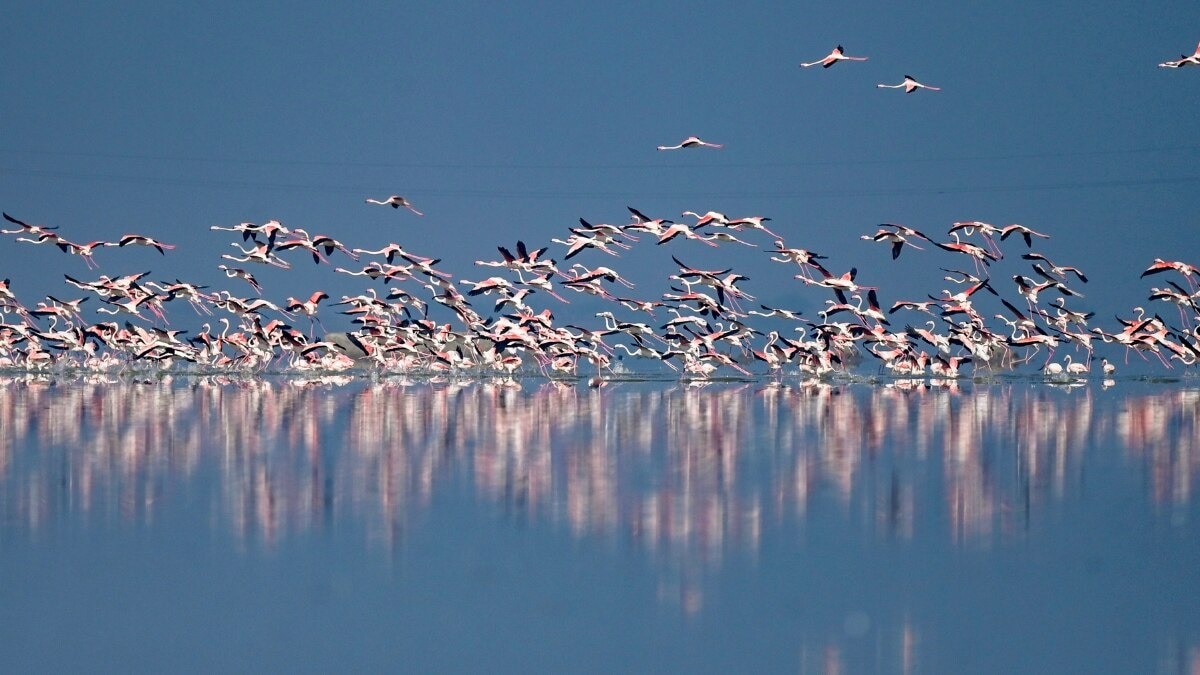
Jaipur: Thousands of flamingo nests found on the drying bed of Rajasthan's Sambhar Lake have raised hopes that the wetland could be a successful breeding ground for the migratory birds outside Gujarat's Rann of Kutch.
Wildlife photographer and conservationist Gaurav Dadhich has claimed to have documented chicks hatching at the site for the first time, though flamingo breeding at Sambhar is yet to be formally established through scientific documentation.
Dadhich stated that he documented successful breeding at the lake in August, when more than 4,000 mud nests were discovered in an area that typically remains submerged under water.
The discovery is significant because the Rann of Kutch in Gujarat has long been recognized as the principal breeding ground for flamingos in India, whereas Sambhar Lake has primarily been regarded as a feeding and resting habitat. Sambhar stands as one of India's most critical inland saltwater wetlands.
According to Dadhich, the nesting colony contained approximately 3,000 to 3,500 nests belonging to Lesser Flamingos and around 500 nests of Greater Flamingos. He observed evidence of successful reproduction involving more than 230 flamingos, including chicks, and recorded these developments for a documentary project.
While flamingos have been observed nesting at Sambhar for years, successful breeding had never been conclusively established until August, when Dadhich documented the nesting process. He is currently preparing a comprehensive account of his findings.
This phenomenon followed a period of comparatively low rainfall, which resulted in a sharp reduction in the lake's water levels. Heavy rainfall in the previous year had filled large portions of Sambhar Lake and attracted substantial numbers of migratory flamingos, while this year's receding water exposed vast areas of the lakebed and revealed thousands of cone-shaped mud structures.
Dadhich noted that the nests were constructed in a remote sector rarely accessed by people. Eggshells discovered on several structures confirmed that eggs had been laid, demonstrating that flamingos selectively choose sites based on soil composition, water retention, and food availability for their young.
Forest officer Rahul Jhanjhadia noted that deficient rainfall had considerably lowered water levels and that the arrival of migratory birds was currently running below usual seasonal levels. In response, the forest department has initiated preparations for the migratory bird season, including preventive measures against botulism outbreaks that have affected wildlife at the lake in past years.
A stakeholder meeting was convened in Sambhar on October 8, bringing together representatives from the municipality, Sambhar Salts, as well as the electricity and animal husbandry departments. An educational workshop was also held as part of these preparations.
Jhanjhadia confirmed that officials have received instructions to carry out a monthly bird census from October through February to identify and monitor incoming migratory species. Additionally, the forest department plans to step up surveillance throughout the migration season to ensure that tourism and birdwatching activities do not disturb the wildlife or harm their natural habitat.