


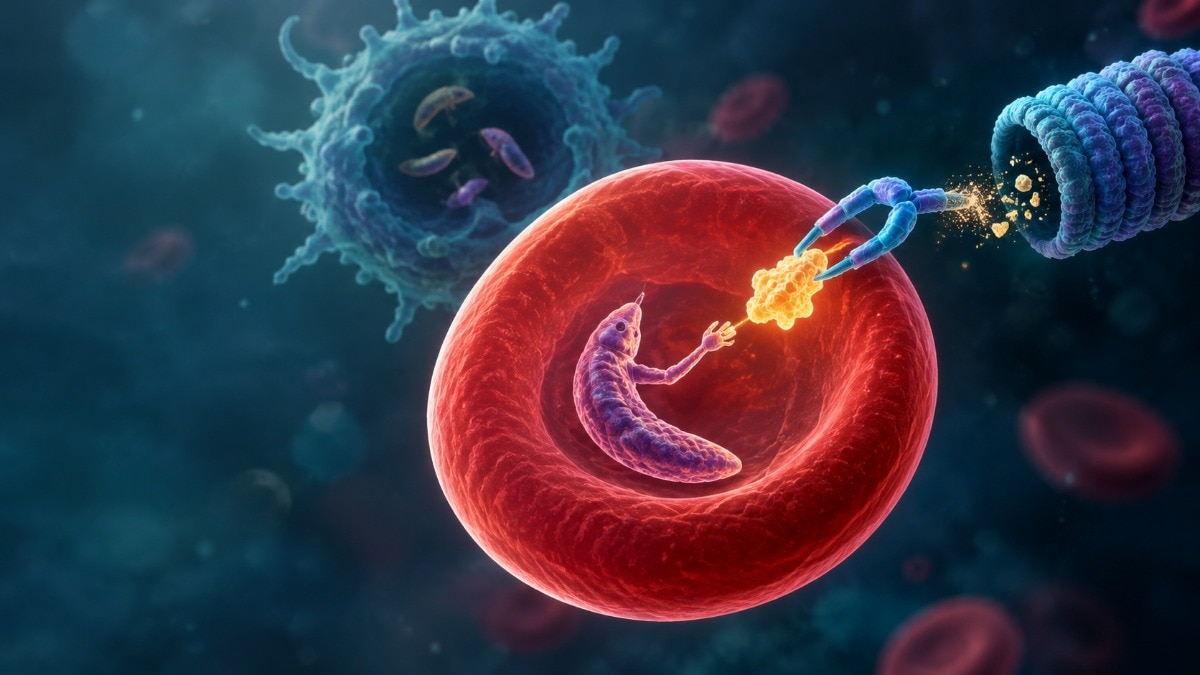
New Delhi: As the parasites responsible for malaria and kala-azar continue to develop resistance against conventional medications, researchers are exploring alternative therapeutic avenues. Rather than focusing directly on the pathogens, a team at Jawaharlal Nehru University in Delhi investigated whether targeting a specific human protein could disrupt the infections. The findings, published in Communications Biology, demonstrate that eliminating a human protein called p38-MAPK hinders both the malaria parasite and the visceral leishmaniasis pathogen in laboratory cell cultures.
Led by Professor Shailja Singh and Professor Anand Ranganathan, the research builds upon previous investigations into host-directed therapies. While standard treatments frequently lose effectiveness as parasites mutate, this methodology focuses on human cellular machinery that pathogens rely on. According to the research team, pathogens can readily alter their own proteins to evade drugs, but they cannot easily modify the essential human proteins they depend upon for survival.
The p38-MAPK protein functions as a cellular stress sensor, relaying signals from the cell surface inward and helping manage immune system communication. Both the malaria parasite, which inhabits red blood cells, and the kala-azar parasite, which hides inside immune cells known as macrophages, appear to exploit this human protein during infection.
To investigate the protein's role, the researchers utilized a molecule known as a PROTAC, or proteolysis-targeting chimaera, which was originally developed by researchers at the Institute for Research in Biomedicine in Barcelona. Designated as NR-7h, this molecule acts by binding both to the target protein and to an enzyme that labels unwanted proteins for disposal, prompting the cell's natural shredding mechanism to clear out the target. The approach eliminated roughly half of the p38-MAPK in human macrophages and red blood cells without harming a related protein, ERK1/2.
Laboratory tests involving infected cells treated with NR-7h showed that parasite levels dropped by up to 16-fold. Interestingly, simply inhibiting the protein's activity with a standard drug yielded no such effect, whereas completely removing the protein altered the cellular immune response. In treated infected cells, genes responsible for generating immune alarm signals such as TNF-alpha and IL-12 increased significantly, while IL-10, a calming signal often exploited by parasites, decreased.
Although the research remains in the laboratory stage and has not yet been tested on animals or human patients, the findings point toward a potential new strategy for treating persistent tropical diseases by making the host cellular environment uninhabitable for the parasites.