


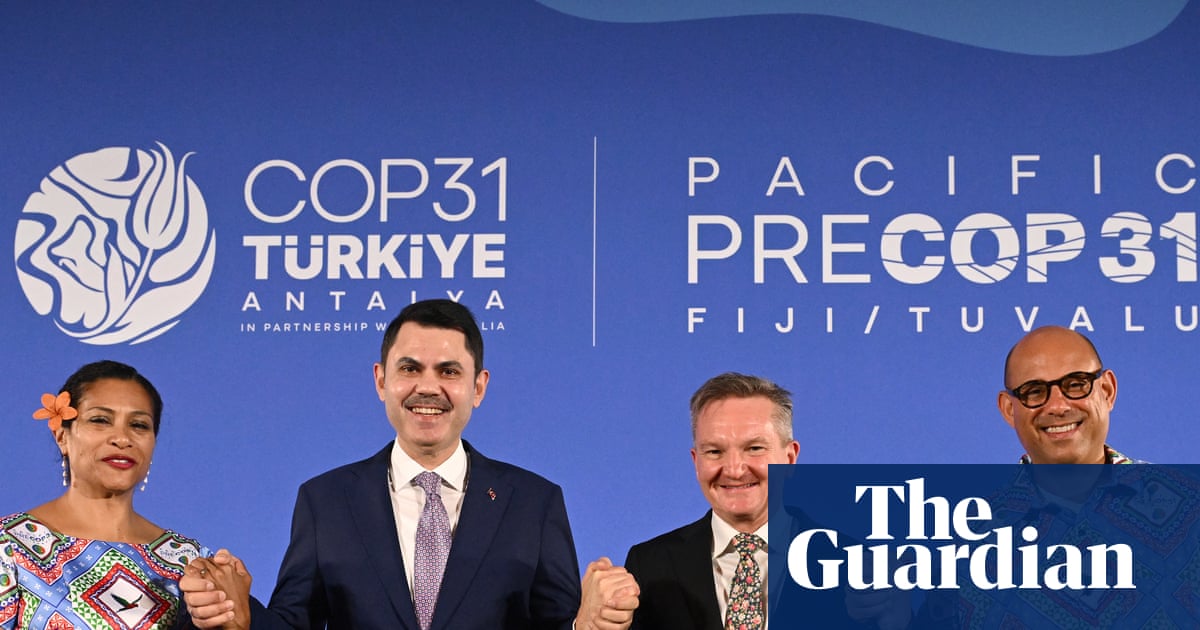
Wealthy nations should allocate substantially more financial resources toward addressing the climate emergency than the five percent of gross domestic product pledged by Nato members for defense, according to the host of the next United Nations climate summit. Murat Kurum, the climate change minister for Turkey and Cop31 president-designate, argued that the climate issue is inherently a security issue itself. He warned that failing to invest funds in pre-disaster mitigation ultimately leaves governments spending vastly more money on disaster recovery.
Kurum made the remarks during a gathering of national leaders, ministers, and civil society representatives in Fiji designed to prepare for the Cop31 summit, which is scheduled to take place in the Turkish city of Antalya in November. Australia, holding a newly established role as president of negotiations for Cop31, pushed to host the preparatory meeting in the Pacific region to draw international attention to vulnerable island nations.
Geopolitical tensions, a historic energy crisis, and an unpredictable political climate meant that only a small group of national leaders joined Australian Prime Minister Anthony Albanese in Nadi, with most coming from Pacific nations. However, the event drew roughly 30 international ministers, representatives from major emitting economies like China and Saudi Arabia, heads of global agencies, and thousands of other attendees.
As part of the summit, a delegation traveled to the low-lying atoll nation of Tuvalu, where approximately 10,000 residents face accelerating threats from rising sea levels, storm surges, and intense extreme weather. Visitors toured a land reclamation project and listened to local accounts of living on territory situated mostly just two meters above sea level.
Pacific leaders used the preparatory summit to reiterate core demands that the international community keep global heating below the 1.5C threshold, ensure climate finance becomes easily accessible to impoverished and vulnerable populations, and prioritize ocean health. Australian Climate Change and Energy Minister Chris Bowen noted that only a fraction of global climate finance currently reaches small island developing states, stressing that such disparities must change.
Despite the urgency, Kurum hedged on whether nations should attempt to replicate previous agreements committing to transition away from fossil fuels when they gather in Turkey. Suggesting that the world is already experiencing a transition, he implied that addressing fossil fuel usage could potentially be handled indirectly through alternative measures rather than repeating contested language.
Both Turkey and Australia backed a multi-country statement in Fiji supporting a global shift away from fossil fuels, echoing previous agreements. However, both host governments faced criticism for continuing to support new coal and gas projects. Bowen argued that the most effective way to eliminate fossil fuel dependence is to rapidly scale up renewable energy generation until fossil fuel power plants become obsolete.