


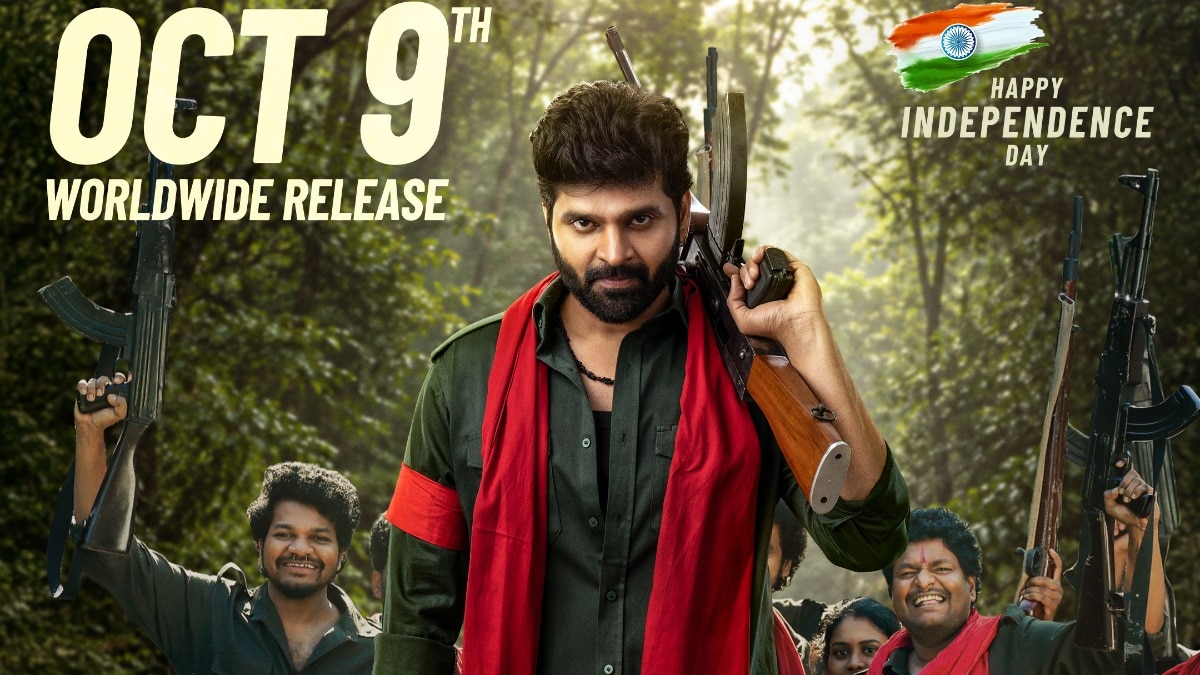
Sree Vishnu continues to build a reputation as an actor drawn to unconventional scripts that step outside traditional commercial boundaries, particularly within the comedy genre. Unfortunately, his latest project, Comrade Kalyan directed by Janakiram Marella, serves as another example where a compelling premise fails to translate into a consistently engaging cinematic experience. By attempting an unusual crossover between lighthearted comedy and a Naxalite backdrop, the movie relies heavily on predictable gags, exaggerated characterisations, and recycled humor rather than exploring the sharper satirical potential of its subject matter.
Set against the backdrop of Madugula in 1992, the narrative centers on Kalyan, played by Sree Vishnu, an ardent admirer of revolutionary actor R Narayana Murthy who leases a local theater specifically to screen his films. Kalyan's quiet village life takes an unexpected turn when Sithara, portrayed by Mahima Nambiar, rescues his mother from a dangerous situation, prompting Kalyan to fall in love with her. A cascading series of coincidences eventually pulls him away from his ordinary routines and deep into a forest, where he finds himself leading a faction of insurgents plotting against a government minister.
On paper, the setup holds genuine promise, but the execution falters by demanding that audiences overlook vast stretches of implausibility without providing a steady stream of clever jokes. While the narrative occasionally hits the mark—such as an amusing Telugu-to-English love letter sequence and strong comedic contributions from Satya as Dubai Babu—too many punchlines can be anticipated long before they are delivered. A few sharp observations briefly surface, such as a clever visual of a captured minister serving tea to his captors while his own driver watches from afar, hinting at a nuanced subversion of power dynamics that the rest of the film regrettably leaves unexplored.
The first half remains passable, aided by supporting turns from Shine Tom Chacko as a police officer and Radikaa Sarathkumar as a card-playing mother, though Mahima Nambiar's Odia background adds little narrative value beyond a handful of brief sketches. However, the second half transforms into an endurance test as Kalyan enters the forest setting. Once the characters are relocated, organic comedic opportunities dwindle, and the screenplay struggles to maintain momentum. The introduction of Vennela Kishore to handle confusion-based humor surrounding the minister's kidnapping provides temporary relief, yet the material feels overly familiar and fails to leave a lasting impression.
A central flaw lies in how the film treats its political backdrop, reducing both the police force and the Naxalites to overly gullible caricatures in order to facilitate easy laughs. Upendra Limaye's recurring subplot becomes increasingly tiresome, and even Satya's reliable screen presence cannot salvage material that has completely run out of steam by the final act. The climax further complicates matters by abruptly abandoning the comedic tone in favor of a heavy-handed, serious message that feels jarring for a project marketed around Sree Vishnu's lighthearted strengths.
On a technical level, the film features solid production values, complemented by Sai Sriram's evocative cinematography, which captures the distinct atmosphere of both the village and the forest settings, alongside serviceable music by Vijay Bulganni. Sree Vishnu handles his role with natural ease, and individual actors perform capably despite underwritten character arcs. Ultimately, Comrade Kalyan presents an intriguing concept and offers sporadic moments of amusement, but its failure to maintain narrative conviction leaves it as another missed opportunity in regional satirical cinema.