


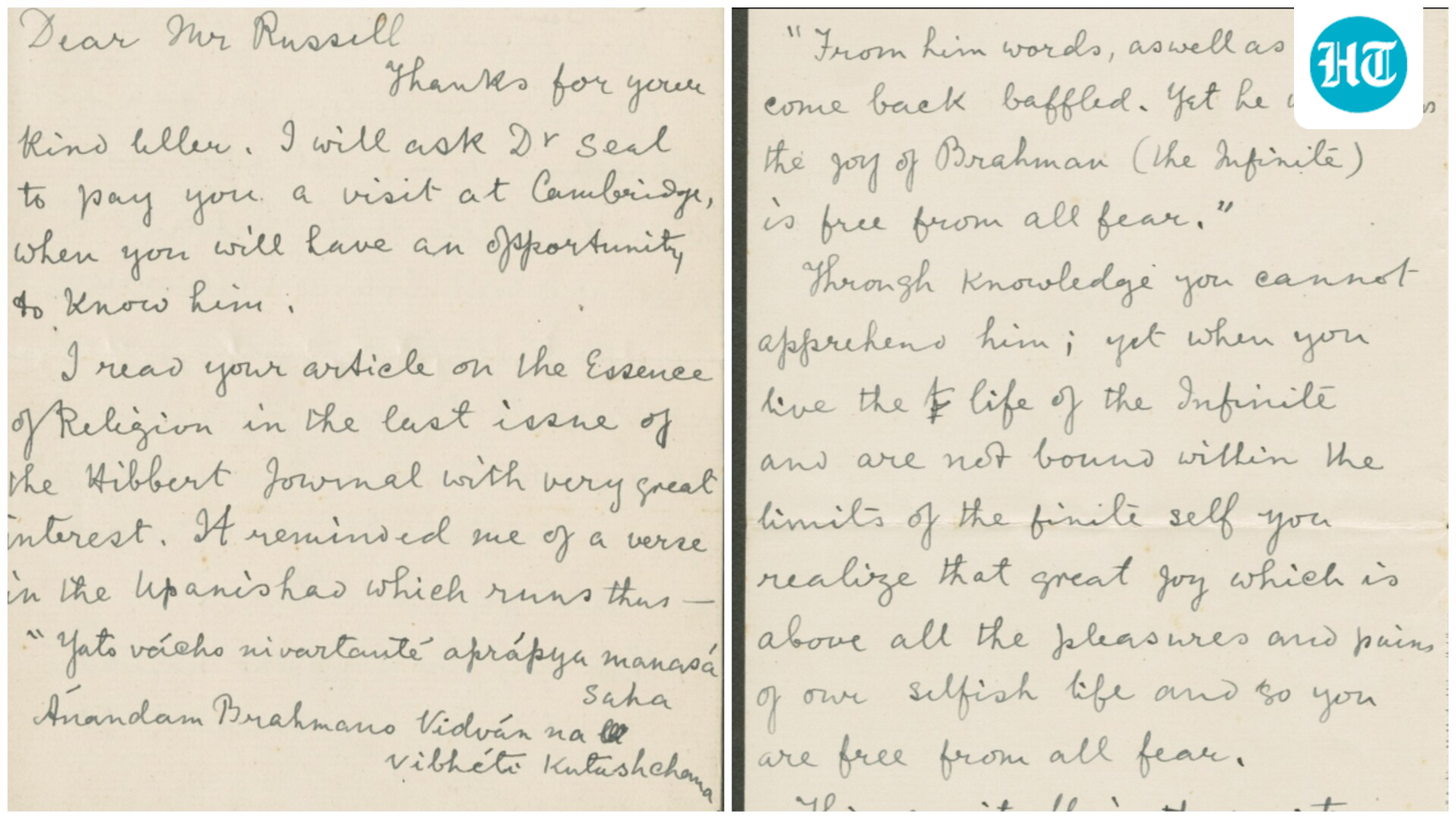
A century-old letter written by Rabindranath Tagore to English philosopher and mathematician Bertrand Russell sheds light on an intellectual correspondence between two towering thinkers. Preserved in the Bertrand Russell Archives at McMaster University, the letter is dated October 13, 1912, and bridges ideas on philosophy, literature, and religion.
In the missive, penned from South Kensington, Tagore thanks Russell for a previous letter and mentions plans to have a scholar named Dr. Seal visit Russell at Cambridge. While the exact identity of Dr. Seal is not explicitly detailed, historians note it likely refers to Brajendranath Seal, a close reformer, educational administrator, and thinker associated with Tagore.
Tagore then discusses reading Russell's article on the essence of religion published in the Hibbert Journal. He tells Russell that the piece profoundly resonated with him, immediately bringing to mind a specific verse from the Upanishad.
Tagore translates the ancient verse in the letter, capturing the idea that words and the mind return baffled from the Infinite, yet the individual who grasps the joy of Brahman remains entirely free from fear. He elaborates on this realization, explaining that the Infinite cannot be captured merely through intellectual knowledge, but is instead experienced by transcending the limitations of the finite self and embracing universal love and freedom.
Both intellectuals went on to receive the Nobel Prize in Literature in subsequent decades. Tagore became the first non-European and first Asian laureate in 1913, recognized for his translated poetry collection Gitanjali. Decades later, in 1950, Bertrand Russell was awarded the same prize in acknowledgment of his extensive writings championing humanitarian ideals and freedom of thought.