


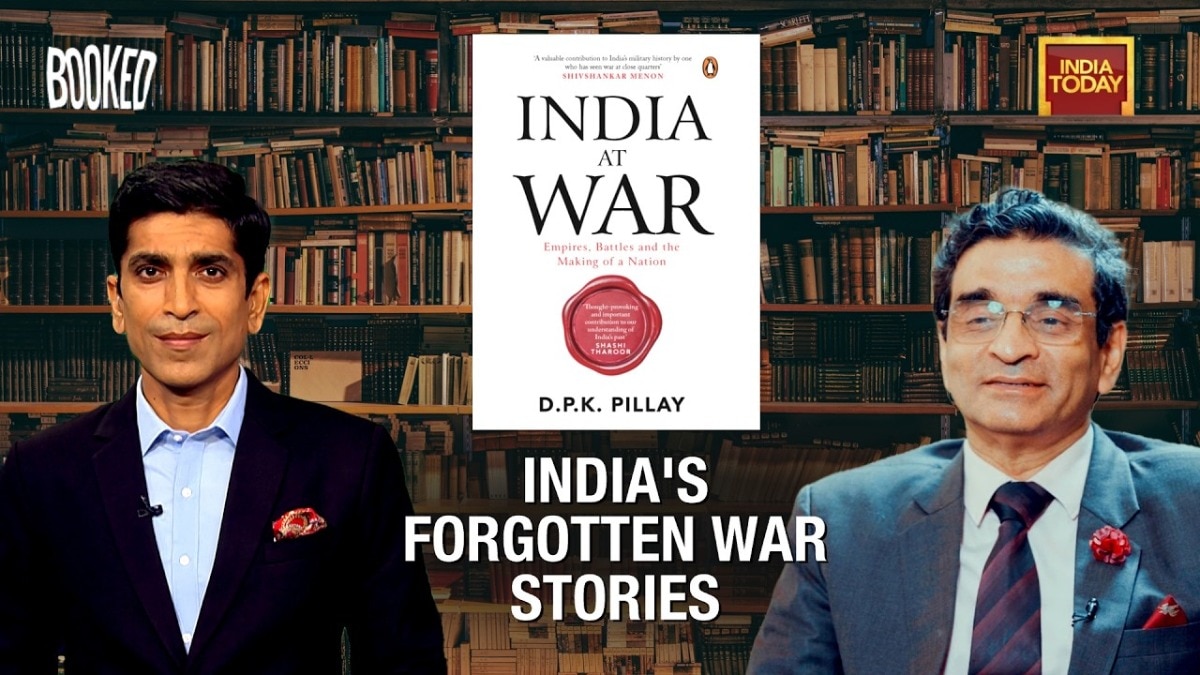
New Delhi: India’s history is full of battles, soldiers and civilisations that have shaped the country’s story, yet many of those foundational events remain overlooked in public memory. That central question drives India at War, a book authored by decorated Indian Army veteran Col D.P.K. Pillay. During an appearance on the program Booked with Pranay Upadhyaya, Pillay elaborated on why he felt compelled to document various lesser-known chapters from India's military and historical past.
The genesis of the book partly stems from Pillay's tenure with the National Security Council while reviewing the 70th anniversary of the accession of Jammu and Kashmir. Sifting through archival documents brought him face to face with historical material previously unknown even to him as a soldier, spanning the events of Kashmir's accession and the subsequent military campaign.
Pillay's historical investigation, however, stretches much further back in time. He notes that many Indians grow up more familiar with Greek and Roman history than with the achievements of the Cholas, the Ahoms, or the Vijayanagara Empire. His international travel through countries like Japan, Korea, and Cambodia revealed deep-rooted evidence of ancient Indian cultural reach, encompassing local deities, Buddhism, mathematics, and traditional martial arts.
According to Pillay, these elements constitute missing volumes within the broader national narrative. He highlights historical accomplishments in science, astronomy, architecture, and metallurgy, pointing to the sophistication of ancient Indian steel, architectural precision, and monuments such as the Kailash temple at Ellora as areas deserving heightened academic focus.
The discussion also tackles how a nation builds internal confidence. Pillay contends that celebrating the past is insufficient; instead, the country requires rigorous scholarship, world-class institutions, and an active pursuit of high standards rather than settling for mediocrity.
This standard of excellence extends to how Pillay views modern and historical military personnel. He references the ancient concept of the sixty-four kalas, a diverse array of skills ranging from weaponry and communication to grammar and music that ancient warriors were expected to master. The broader takeaway for modern defense, he suggests, is the mental agility required for future soldiers navigating changing battlefields transformed by artificial intelligence and autonomous systems.
Shifting toward strategic outlooks, Pillay suggests that India's historical resilience stemmed largely from a preserved sense of identity, emphasizing that national mindset and confidence are paramount. He points out that geopolitical borders are not permanent, concluding that the nation's ultimate trajectory is constrained more by imagination than by history itself.
At the same time, Pillay expresses strong optimism regarding India's younger population. He characterizes today's youth as creative, technologically adept, and ready to challenge existing boundaries, qualities he views as indispensable as the country navigates a rapidly shifting global landscape.