


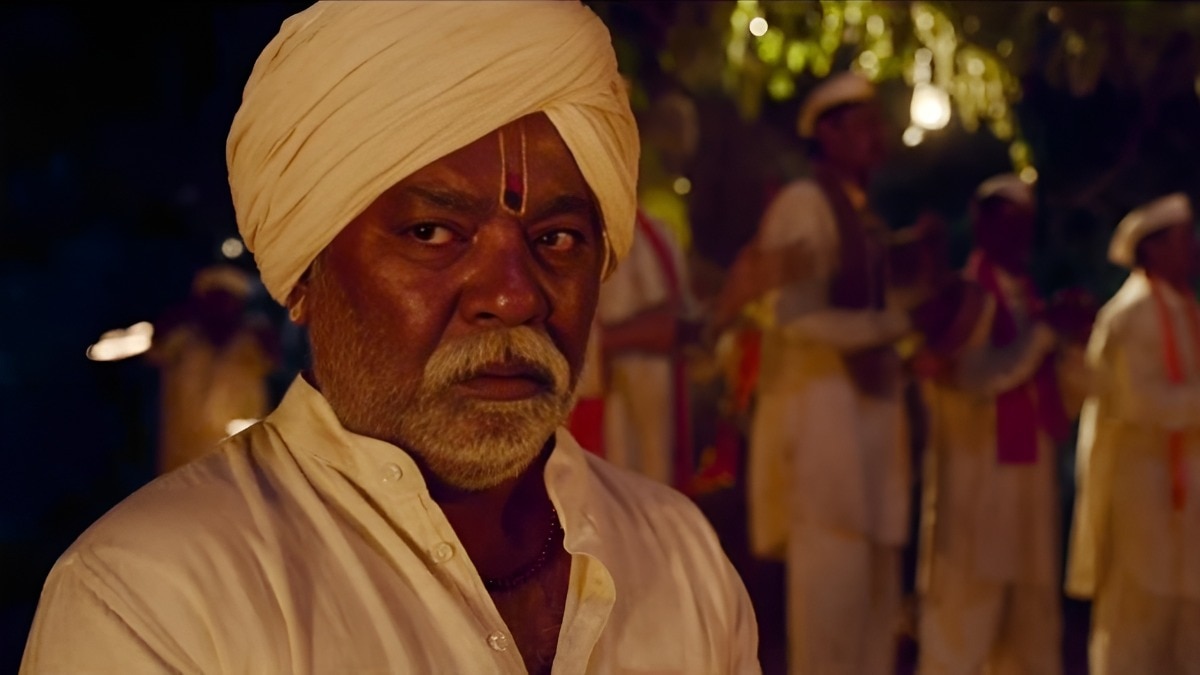
A wedding should normally be a joyful occasion, but in the Marathi film Gondhal, the celebrations are deeply intertwined with secrets, jealousy, and intense power struggles. Set against the backdrop of a traditional Maharashtrian Jagran Gondhal, the story brings together various villagers whose personal lives threaten to unravel as the night progresses. Using the ritual, its rhythmic beats, and the underlying promise of divine intervention as a framework, the film examines human behavior when people believe they are unobserved, while highlighting how easily authority is mistaken for genuine respect.
The narrative opens with an unbroken, roughly 25-minute continuous shot introducing Bhivaba, played by Kishor Kadam, an aging gondhali performer, and his young grandson Vishnu, portrayed by Dhruv Thoke. As the pair walks toward the wedding venue by the light of a lantern, the boy asks questions about their family's sacred lamp, his missing mother, and the meaning of the gondhal. Bhivaba responds with patience, keeping his own backstory largely concealed. Vishnu's inquiries explain the cultural belief that Lord Khanderaya visits the ceremony to clear obstacles from the lives of newlyweds. This straightforward premise evolves into something much more complex as the plot advances, mapping out the village hierarchy and the dominance of the affluent Patil household.
The wedding itself proves far from simple. The bride, Suman, played by Ishita Deshmukh, carries a closely guarded secret, while Sarjerao, the village chief's arrogant son portrayed by Nishad Bhoir, is accustomed to having his own way. The groom, Anandrao or Aandya, played by Yogesh Sohoni, initially projects a simple demeanor. Each character plays a distinct role in the unfolding events, though the film takes its time revealing their true intentions. As the ritual continues through the night with singing and percussion, the surrounding community gathers to pray, yet the chief's mistreatment of those around him illustrates how authority easily slips into exploitation.
The cast delivers notable performances that anchor the unfolding drama. Kishor Kadam provides an emotional center through a restrained, natural portrayal of Bhivaba. Ishita Deshmukh stands out as Suman, capturing the frustration and vulnerability of a woman striving to make her own choices in a patriarchal society where decisions are usually made for her. Yogesh Sohoni adds an appealing innocence to Anandrao, a man who defies traditional rural standards of masculinity, while Nishad Bhoir and Suresh Vishwakarma effectively portray the arrogant Sarjerao and the intimidating village chief, Patil.
The musical score by Ilaiyaraaja excels during the live gondhal sequences, where the energy of the performers, crowd reactions, and the immersive ceremony bind the music and narrative together. However, the background score is less impactful at times, and the film performs best when relying directly on the natural sounds of the ritual itself. Despite its compelling atmosphere, the movie suffers from certain screenwriting weaknesses. Some plot developments feel forced to serve the narrative rather than growing naturally from the characters, making specific decisions difficult to believe and diminishing their emotional resonance. Furthermore, while the extended ritual sequences establish the cultural setting, their repetition slows the pacing considerably, suggesting that a tighter edit might have maintained the tension more effectively.
Ultimately, Gondhal earns recognition for centering its drama around a traditional Maharashtrian folk ritual that exposes the hidden desires, fears, and hierarchies of a rural community. While the screenplay occasionally loses its grip and leaves certain themes underdeveloped, the strong acting, folk music performances, and distinct identity make it an intriguing watch for audiences patient enough to settle into a slow-moving rural drama.