


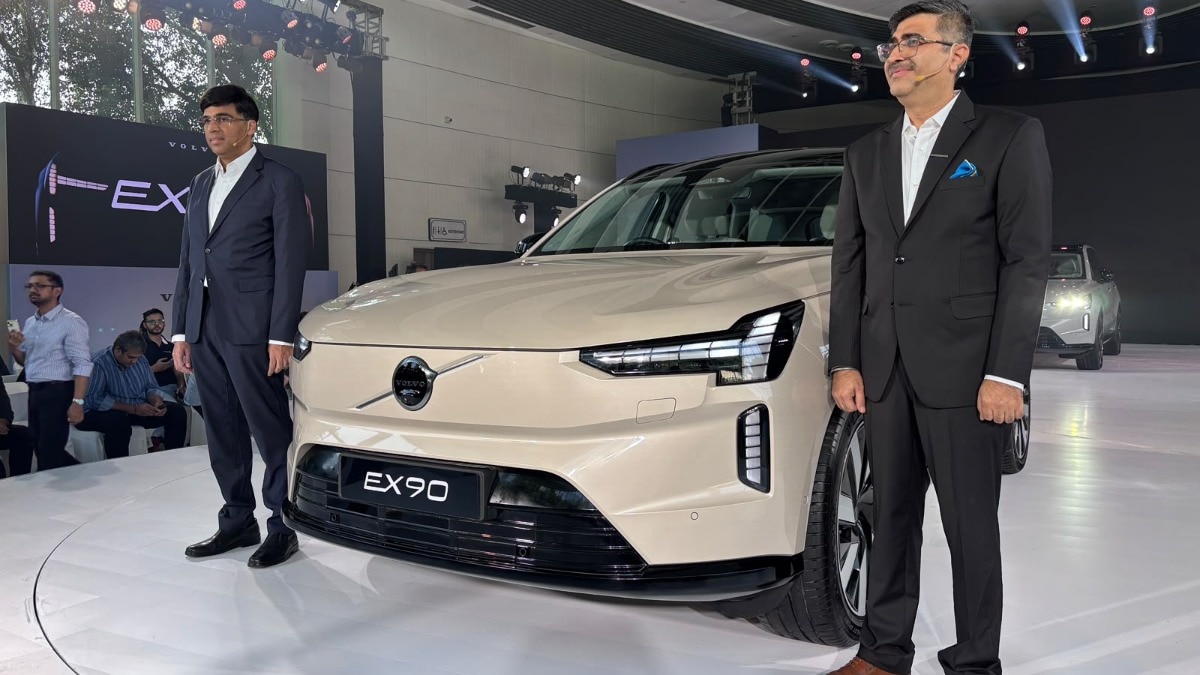
New Delhi: Volvo India has launched its flagship EX90 electric SUV in the country, carrying an ex-showroom price tag of Rs 1.26 crore. Positioned above the combustion-powered XC90 within the brand's portfolio, the new luxury model is built on an updated architecture and brings a high-tech package alongside comprehensive driver assistance systems. The vehicle is available exclusively in a six-seat layout and relies on a 106kWh battery paired with dual-motor all-wheel drive to deliver a claimed WLTP driving range of 625km.
The newly introduced electric flagship costs Rs 27.2 lakh more than the traditional XC90. Even so, it undercuts several key competitors in the domestic luxury electric SUV market, such as the Kia EV9 priced at Rs 1.30 crore and the Mercedes-Benz EQS SUV 580 priced at Rs 1.49 crore. To incentivize early buyers, Volvo is providing a special ownership bundle for customers who book the vehicle prior to December 31, 2026, featuring an 11kW home charger, a three-year service package, and a guaranteed buyback option of 65 percent after three years.
The exterior styling adheres to a minimalist Scandinavian aesthetic, showcasing smooth panels and a streamlined front fascia. The closed-off nose incorporates signature T-shaped pixel LED headlamps, vertical fog lamps, and a central brand emblem above a lower trapezoidal air intake. The vehicle rides on standard 21-inch alloy wheels, featuring an upright stance, a 2,985mm wheelbase, and 210mm of ground clearance that can stretch up to 250mm via the standard air suspension. The rear end displays C-shaped LED tail-lamps joined by a dark connecting strip and secondary lighting elements wrapping around the upper windscreen.
Inside, the cabin maintains a clean design theme defined by two-tone Nappa leather upholstery, brushed aluminum trim, and a three-legged steering wheel. A vertical 14.5-inch touchscreen manages most primary vehicle controls, supported by a smaller 9-inch driver instrument cluster. The domestic market receives the EX90 solely in a six-person configuration, featuring second-row captain's chairs equipped with slide and recline adjustments, though lacking electronic controls, ventilation, or massage functions found in the front row. Access to the third row is managed through the central walkway between the middle seats, offering limited space more suited for children or short trips. Cargo volume measures 324 liters with all seats upright, expanding to 690 liters when the rearmost seats are folded flat.
The equipment list comprises four-zone climate control, a 25-speaker audio system by Bowers & Wilkins, customizable ambient lighting, wireless device integration, a digital key, air purification, a 360-degree camera system, and automated parking features. Passenger safety is managed through nine airbags alongside an extensive suite of advanced driver assistance technologies.
Underneath the body, the dual-motor setup generates a combined output of 456 horsepower and 670 Nm of torque, pushing the heavy SUV from zero to 100 kilometers per hour in 5.5 seconds up to an electronically capped top speed of 180 kilometers per hour. Utilizing the vehicle's 800-volt electrical system, DC fast chargers up to 350kW can replenish the 106kWh battery from 10 to 80 percent in approximately 22 minutes. Meanwhile, a standard 11kW AC home charger requires about 11 hours for a complete recharge.