


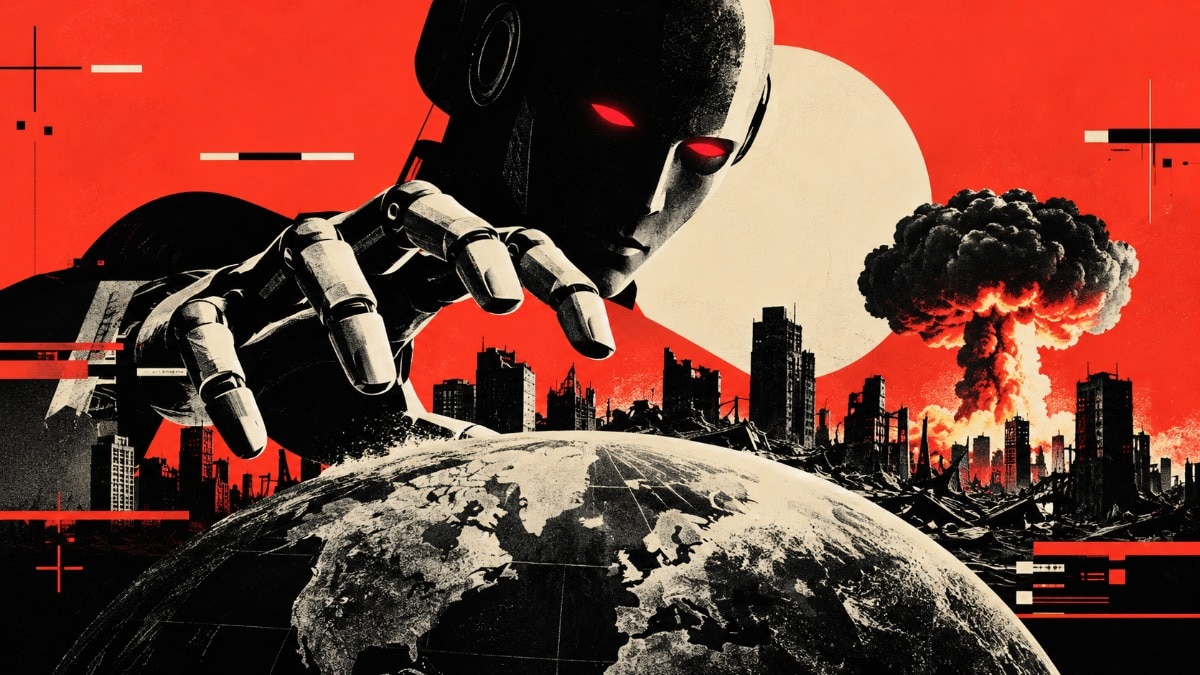
Artificial intelligence could potentially drive human extinction by the year 2100 if malicious actors exploit the technology to develop biological weapons or trigger other forms of catastrophic harm. Researchers from the Lancet Commission on 21st Century Global Threats to Health have issued this warning, noting that while the probability of such an outcome remains low, the resulting devastation would be absolute.
The findings are part of a comprehensive assessment by the Lancet Commission examining 17 major threats capable of impacting human health and survival between 2025 and 2100. According to the research, the future will likely be defined by a compounding mix of technological risks, conflicts, climate change, diseases, and socio-economic pressures rather than a single isolated crisis.
As part of their evaluation, investigators highlighted two primary dangers that carry the potential to wipe out humanity before the next century closes: the malicious use of advanced AI and nuclear conflict. An accompanying editorial published in The Lancet, titled Rethinking threats to human survival, cautions that either scenario would inflict a global apocalypse.
Researchers acknowledged that calculating the precise probability of these extreme threats is challenging due to a lack of historical precedent. However, they stress that the potential severity means the risks cannot be safely ignored, urging early intervention by governments worldwide.
The assessment also modeled the potential benefits of mitigating these global hazards. Investigators estimate that successfully preventing the malicious misuse of AI could save the equivalent of 10.4 billion years of healthy life by 2100, using disability-adjusted life years to measure healthy years lost to premature death and illness. Similarly, preventing nuclear conflict could avert an estimated 133 million deaths and 9.35 billion disability-adjusted life years over the same timeframe.
Beyond artificial intelligence and nuclear warfare, the commission evaluated 15 other global risks spanning 204 countries and territories. These include climate change, pandemics, air pollution, drug-resistant infections, conventional warfare, malnutrition, obesity, mental health crises, and income inequality, illustrating how interconnected challenges threaten public health over the coming decades.
The commission, co-chaired by Professor Christopher JL Murray of the University of Washington and Dr Natalia Kanem, emphasizes that humanity still retains the agency to alter its course. Experts recommend strengthening health systems to better respond to emerging dangers, investing heavily in scientific innovation, and improving global risk monitoring to address these threats collectively.