


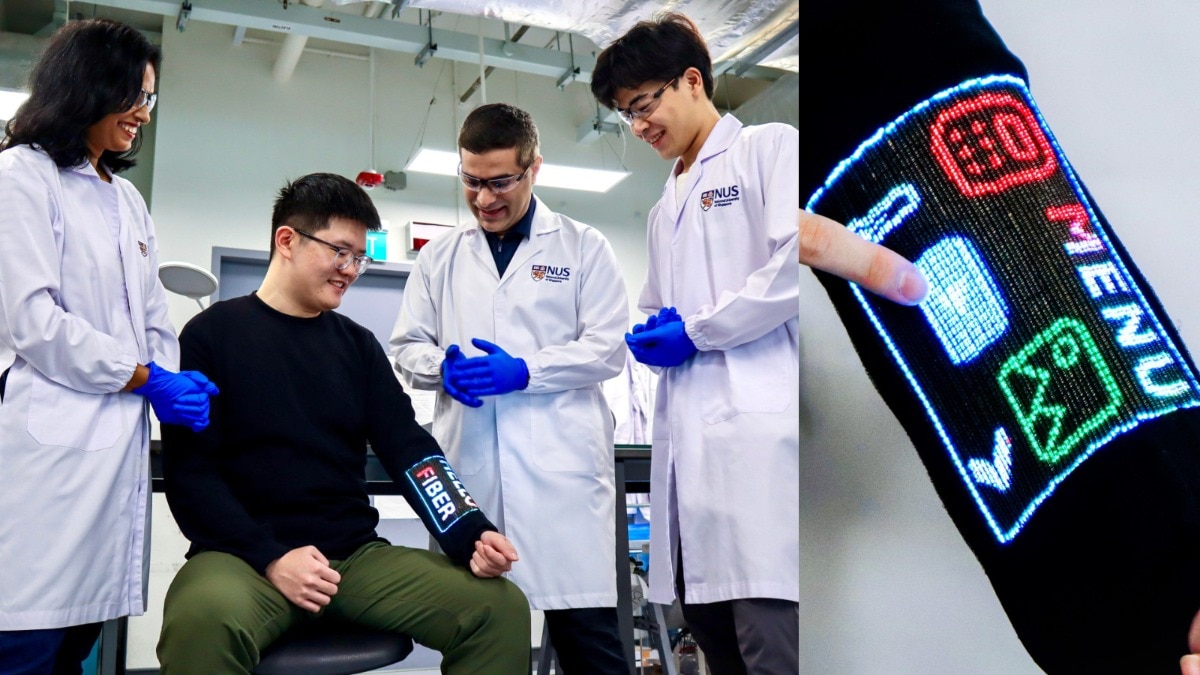
New Delhi: Imagine checking your body temperature, playing a video or using a calculator without reaching for a phone, by simply tapping a sleeve. Scientists at the National University of Singapore have developed a touchscreen that can be woven into clothing, transforming ordinary fabric into a wearable digital interface. The prototype is capable of displaying images and videos, responding to touch, and connecting wirelessly to other devices. Remarkably, it retained nearly identical light output and touch response after undergoing 50 machine washes. Indian researcher Swetika Chaturvedi, a research associate at the university, is among the team members who worked on the invention.
Published in the journal Nature, the study details a flexible textile display constructed from specially engineered electronic fibres. The researchers characterize it as the world's first touchscreen integrated directly into a garment. Unlike traditional rigid screens, this technology embeds electronic components inside fibres that blend seamlessly into fabric.
The research team, led by Assistant Professor Tural Khudiyev, incorporated 54-pixel fibres into a sleeve to form a display measuring 168 millimetres by 105 millimetres. The screen features a resolution of 96 by 54 pixels and refreshes at 30 frames per second. Pressing the fibre activates its touch-sensitive layer, enabling the system to detect finger placement and illuminate the appropriate pixel.
The prototype extends far beyond static picture displays. It can play videos, run a calculator, show photo galleries, function as a compass, respond to voice commands, and receive images via Bluetooth connectivity. Researchers additionally integrated fibres containing a microphone, speaker, and sensors designed to measure temperature, movement, ambient brightness, and magnetic direction.
A temperature sensor positioned underneath the arm can track body temperature and project the reading directly onto the sleeve. This functionality could prove valuable for health monitoring applications when paired with other wearable sensors. Wearable electronics typically struggle with the reality that clothing undergoes constant stretching, bending, and regular washing, which would usually damage delicate electronic displays.
However, the university team noted that their prototype maintained consistent display brightness and touch response following 50 detergent washes, alongside enduring 1,000 bends around a tight radius of five millimetres. The fabric display remains breathable and flexible, operating much like standard textiles. While the technology currently exists as a research prototype rather than a commercial smartphone replacement, the team aims to enhance screen resolution while incorporating advanced sensing capabilities and artificial intelligence in future developments.