


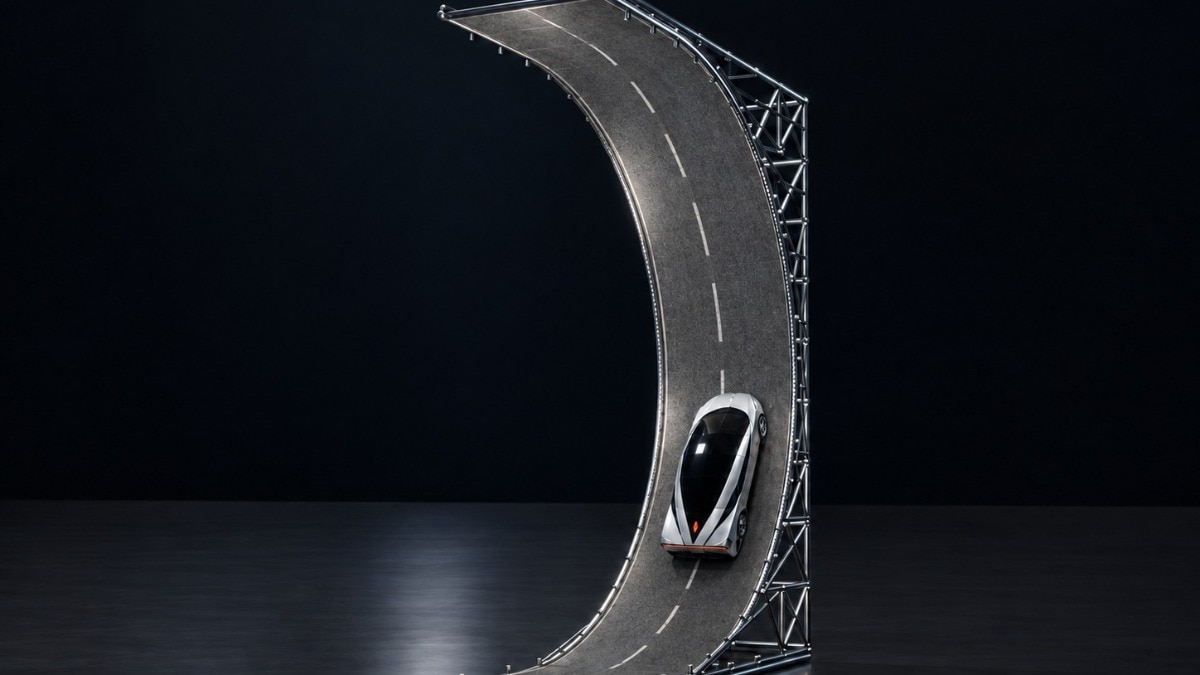
While Bollywood directors like Rohit Shetty have spent years flipping cars using cranes and clever camera edits, Tesla chief executive Elon Musk brought the concept to life during a live nighttime demonstration. The newly unveiled Tesla Roadster drove upside down along a curved ramp, launched through the air, and successfully landed. Tesla introduced multiple variants of the vehicle, including the standard Roadster, Roadster Performance, Roadster Thrust, and the top-tier Roadster Rocket.
The high-end Rocket version incorporates rocket expertise from SpaceX, featuring an ambitious thruster system powered by two large tanks containing 250 kilograms of air compressed at 5,500 psi. According to Tesla, the system functions without special propellants and can recharge its own air tanks. The vehicle relies on three distinct systems to manage movement, steering, lift, and downforce. Four rear nozzles generate cold-gas thrust by blasting air at supersonic speeds without combustion.
Additional thrusters placed around the body of the Rocket variant provide lift and attitude control, allowing the vehicle to maneuver while airborne. Meanwhile, underside fans pull air away from the ground to create suction, pulling the car toward the road with a force equal to twice its weight. Tesla claims the rear thrust can reach 80 kN, which is equivalent to supporting roughly eight tonnes, and states that the Roadster can accelerate from zero to 96 km/h in 0.59 seconds in the Rocket configuration.
Because human reflexes are too slow to manage such rapid maneuvers, an onboard computer relies on numerous sensors to monitor speed, tilt, and height, making micro-corrections to individual thrusters and fans in fractions of a millisecond. Musk described the machine as a demonstration that the future includes flying vehicles, though he acknowledged that the Roadster is not necessarily optimized for safety.
Independent analysts and space agencies note potential limitations to the technology. Calculations by independent observers suggest that continuous full thrust could deplete the compressed air supply within roughly two seconds, while NASA characterizes cold-gas systems as mature and simple but limited in total impulse for sustained operations. Tesla has targeted production for 2028, leaving questions regarding public road approval, pricing, driving range, and actual airborne duration yet to be answered.