


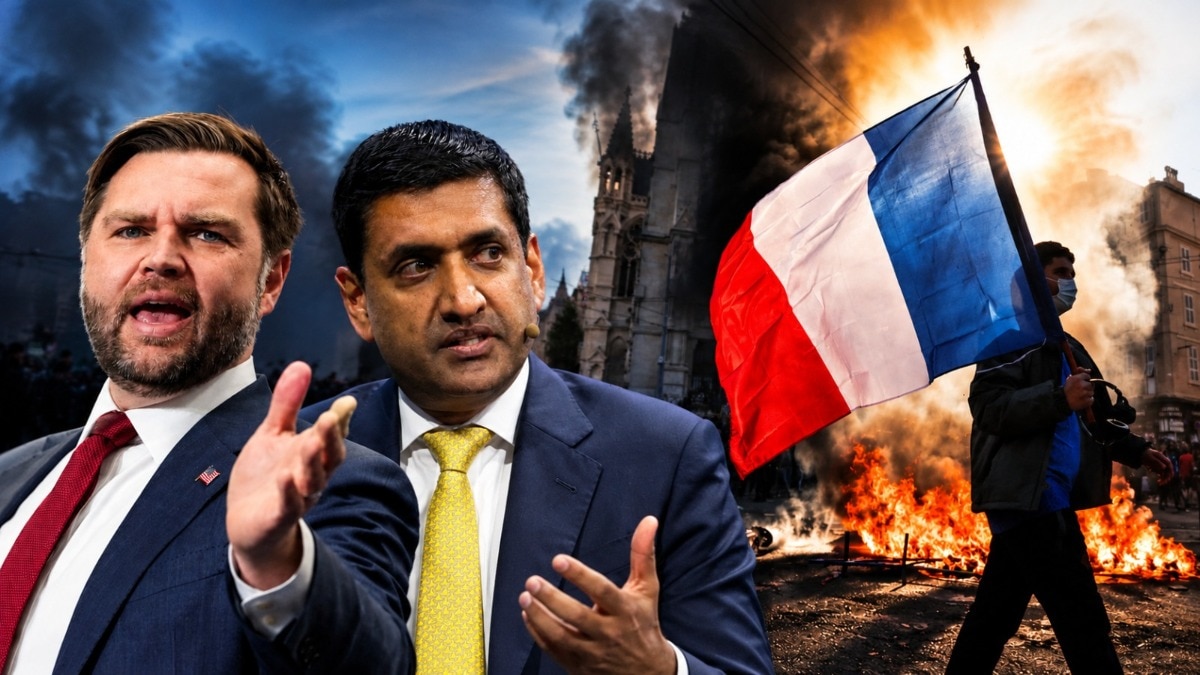
New Delhi: The fires and violent protests in France have turned into a political flashpoint in America's ongoing culture wars, with prominent US politicians offering sharply contrasting explanations for the European unrest as the American midterm elections approach. US Vice President JD Vance described the situation as a warning about immigration and failed assimilation, while Democratic Congressman Ro Khanna countered that the deeper issue is wealth accumulating in the hands of a few.
Vance took to social media to blame Western liberals for having imported the third world into France in the name of diversity and compassion. Highlighting footage of historic buildings in flames during the rioting, the Republican vice president warned American voters about what he believes could happen if Democrats pursue similar immigration policies in the United States. His messaging aligns with the administration's broader emphasis on border enforcement, deportations, and national security, aiming to frame immigration as a central issue of public safety and social stability.
At the same time, this interpretation faces criticism for overlooking the immediate domestic triggers behind the French demonstrations. The unrest in France initially began among high school students over missing teachers, dilapidated school infrastructure, and university admissions grievances, before widening into broader anger over the cost of living. Trade unions have since backed demands for lower prices, better wages, and higher pensions, though the protests have frequently devolved into violent clashes and arson attacks.
Offering a distinct perspective, California Representative Ro Khanna argued that Vance was misreading the moment. Connecting the demonstrations in France to similar youth-led protests in Spain and Albania, Khanna pointed to economic insecurities and the massive accumulation of wealth and power in the hands of a few. He argued that young people across these nations are struggling with housing, education, and employment, and are demanding a future they can believe in.
Khanna called for a significant economic and political transformation in the United States through measures reminiscent of historical economic reforms. Observers note, however, that neither immigration nor economic inequality alone fully captures the complexity of the crisis. The grievances driving the European protests involve a multifaceted mix of local economic pressures, institutional shortcomings, and social tensions that vary widely by region.