


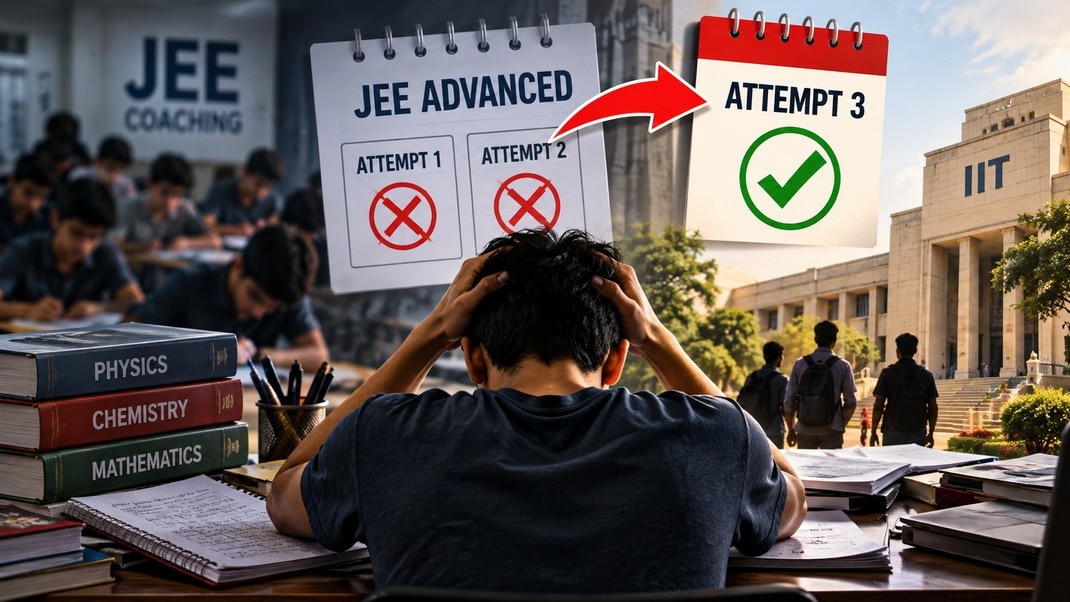
A group of more than 12,000 engineering aspirants has formally requested a revision to the eligibility rules for JEE Advanced, urging key education bodies to permit three examination attempts instead of the current limit of two. In representations submitted to the Union Education Ministry, the IIT Council, and the Joint Admission Board, the candidates cited examination stress, medical emergencies, and family disruptions as factors that can compromise an applicant's performance during their permitted years.
Under current guidelines, candidates are allowed to appear for JEE Advanced twice in two consecutive years, starting from the year they clear their Class 12 examinations, provided they also clear JEE Main and fulfill other criteria. The petitioners have suggested alternative frameworks, proposing either three attempts across three consecutive years or spreading two permissible attempts over a three-year window. They emphasized that the adjustment would offer necessary flexibility without lowering academic standards or guaranteeing admission slots.
A primary argument behind the petition centers on the systemic inequalities faced by students from rural regions, government schools, and smaller towns. These candidates often discover the rigorous preparation demands of the competitive exam at a later stage, meaning they may exhaust their attempts before fully mastering the curriculum. Furthermore, the lack of long-term coaching, financial resources, dependable internet connections, and proper study environments places underprivileged students at a disadvantage.
Advocates for the policy shift stressed that their goal is not to seek simpler questions or lower merit standards, but rather to secure a level playing field. They noted an inconsistency between JEE Main, which allows for improvement over multiple years, and JEE Advanced, which maintains strict consecutive-year limitations. The students began raising these concerns in July, delivering formal submissions to the JEE Advanced chairperson at IIT Delhi in August and following up with discussions later that month and in September. While students indicated that IIT Delhi officials agreed to present the proposals to the Joint Admission Board, formal approval has not yet been confirmed.
The push for extended eligibility has also sparked debate regarding its practical implications. Critics, including IIT Kanpur Director Manindra Agrawal, have questioned whether a third attempt would genuinely improve selection rates or merely encourage students to invest additional years and financial resources without securing an IIT seat. Meanwhile, the aspirants maintain that a broader eligibility window would accommodate high-potential students who experience early setbacks, ensuring that entrance numbers alone do not overshadow equitable access to merit-based competition.