


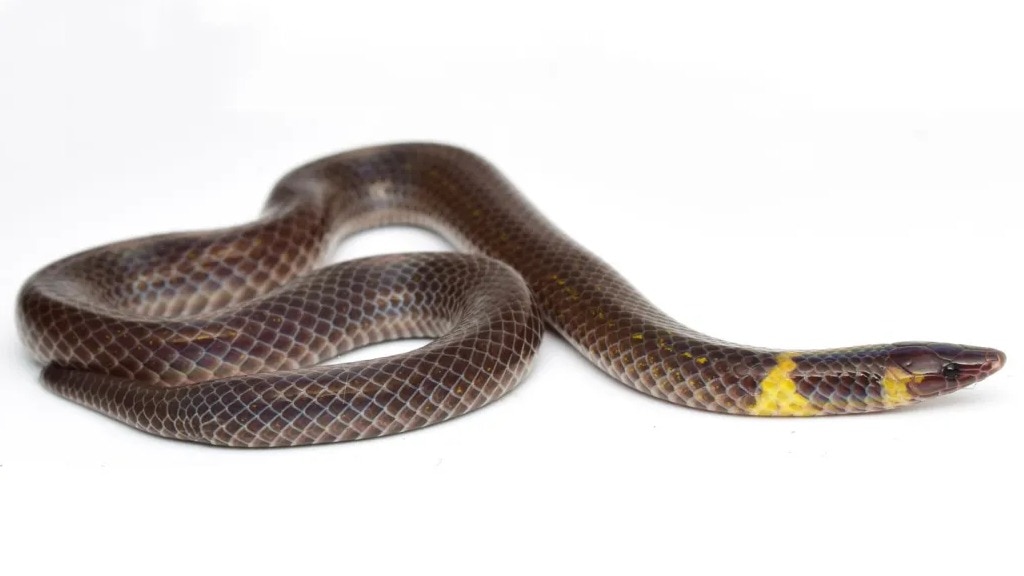
Scientists have filmed three species of tiny Southeast Asian snakes cartwheeling away from danger, revealing how coordinated body movements help them roll at high speed.A Pseudorabdion saravacense snake is pictured. Snakes usually slither away when danger approaches.
But some tiny snakes in Southeast Asian forests have a far more unusual escape trick; they throw their bodies into the air and cartwheel away, rolling forward like a wheel.New video footage has revealed how these snakes perform the remarkable manoeuvre, giving scientists a closer look at a rare behaviour first documented in 2023.The findings, published in the journal Current Biology, show how three species of dwarf reed snakes use their bodies to pull off the acrobatic escape.HOW DO SNAKES CARTWHEEL?The movement begins when a snake curls its body into a 'C' shape, lifting its head and pointing it in the direction it wants to travel. It then forcefully straightens its body, whipping its tail backwards and briefly lifting itself off the ground.
Next, the snake swings its tail forward and over its head. When the tail lands on the ground ahead of the head, the snake completes a roll and can begin another one.Researchers recorded the movement using cameras placed above and beside a 2.2-metre-long track, which helped them study 13 snakes belonging to three Pseudorabdiond species, alongside six related reed snakes from the Calamaria group for comparison.
All 13 Pseudorabdion snakes performed the cartwheeling movement, while none of the six Calamaria snakes did.At their fastest, the cartwheeling snakes reached speeds of 1.7 to 3.7 metres per second, equivalent to around 6 to 13 kmph. An image illustrating the snake's cartweel motion.
WHY DO SNAKES CARTWHEEL AWAY FROM DANGER?The researchers believe cartwheeling helps the snakes escape potential predators by moving rapidly and unpredictably. Additionally, the sudden movement may also startle a threat, giving the snake an opportunity to get away.The behaviour was first scientifically documented in the dwarf reed snake in a 2023 study published in Biotropica.The species lives in Southeast Asian forests, where it often hides beneath fallen leaves and other ground cover.However, scientists still do not know exactly how this unusual ability evolved or why some closely related snakes do not use it.
Researchers are yet to establish whether the cartwheeling species have special physical features or simply coordinate their muscles differently.The new footage provides a detailed look at how the manoeuvre works, but the evolutionary mystery behind this remarkable escape remains open.- Ends