


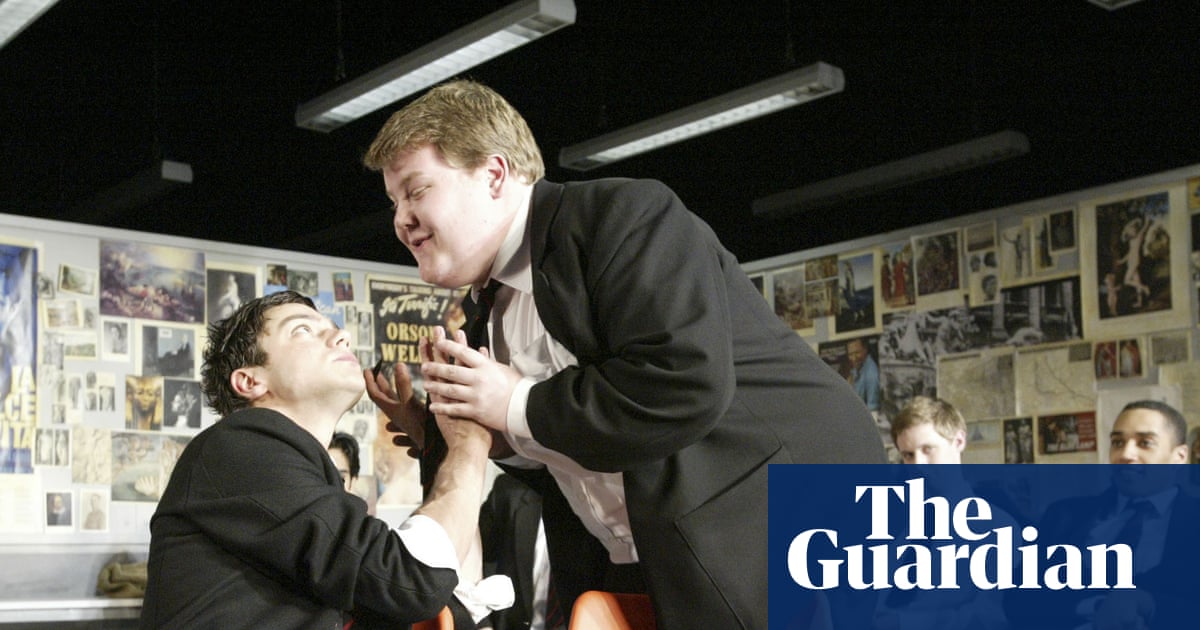
The History Boys is to return to the West End for the first time in two decades, with a warning from its director of an “almost terminal decline” in humanities teaching in state schools.Nicholas Hytner, who directed Alan Bennett’s play at the National Theatre and its 2006 film adaptation, said the themes of education, history and the value of literature for its own sake felt especially relevant amid renewed debate about what schools should teach.“There has been a decline of humanities subjects in state schools, an almost terminal decline of music and drama teaching, history and modern languages have been downgraded,” he said. “But it has obviously been a mistake, both for the individual pupil and our economic future, to neglect the humanities.”The production will open at the Theatre Royal Haymarket on 10 April for a 16-week run, reuniting Hytner with its original designer, Bob Crowley. Bennett will be involved in its development.Alan Bennett has welcomed the return of The History Boys, saying it was one of the happiest plays he had written.
Photograph: Eamonn McCabe/The GuardianThe History Boys received its world premiere at the National Theatre in 2004 before transferring to the West End and Broadway, where it won three Olivier awards and six Tonys. Voted the nation’s favourite play, it launched the careers of James Corden, Russell Tovey and Dominic Cooper.Set in 1980s Sheffield, it follows eight boys at a grammar school preparing for their university entrance exams, as two teachers take opposing approaches to their education.
Poignant and sharply comic, it explores adolescence, sexuality and the competing ideas of learning as a route to achievement or an end in itself.Nicholas Hytner hopes the play will resonate with a generation raised on social media. Photograph: John Phillips/Getty ImagesHytner said he had first asked Bennett whether he wanted to see the play revived: “He’s not usually that keen on revivals of his stuff, but he said he’d love to see it again.”Bennett said: “The History Boys is one of the happiest plays I’ve written.
Or rather, it was one of the happiest of my plays to write. It was also one of the quickest to set down, taking far less than my usual five years.
So, something of a record for me. The play is full of quotes and has itself become eminently quotable.
A joy for any playwright. I welcome its return under Nicholas Hytner.”Its return comes as the government undertakes the first major revision of the national curriculum and GCSEs in more than a decade.
Public consultations opened in September, with a revised curriculum expected in spring 2027 and implementation from 2028.Hytner said: “It feels as if so much of what state education was focused on in the last 20 years is proving to be beside the point, when AI can do so much of what pupils were being prepared to do. Schools could do a lot worse than introduce pupils to creativity, and to delight in other people’s creativity.”He said the play championed the idea that the humanities were “the birthright of anybody who goes through the school system”, rather than subjects whose value depended on their immediate practical application.Hytner hopes it will resonate with a generation raised on social media. “Quite a lot of young people are ambivalent about social media,” he said. “They crave a kind of conversational spontaneity and an ability to concentrate and immerse themselves outside of social media.”skip past newsletter promotionafter newsletter promotionThe production will inevitably change, he added, having evolved between its opening at the National Theatre and the end of its Broadway run in 2006.
Any changes, however, would be made with Bennett’s input.James Corden, Frances de la Tour and Richard Griffiths in the 2004 production. Photograph: Rex/Alastair MuirHytner emphasised the revival would again feature actors at the start of their careers: “I can almost guarantee that none of the new cast will be well-known figures, because that’s the point about them.”He recalled that even the original cast had doubts about one of the play’s most farcical scenes, in which the teacher Hector gets his pupils to act out in French a client visiting a brothel in Paris.
The charade ends with the headteacher entering the room while one of the boys has his trousers down.“They were really suspicious of the French scene near the beginning of the play,” Hytner said. “Only a couple of them were confident about it, they just didn’t think it was funny. I had to keep saying it’s fine, let’s do it, let’s see how it goes.”At the first preview, the scene brought the house down. “I remember the look of stunned amazement,” said Hytner. “It was a complete delight for the young actors.”