


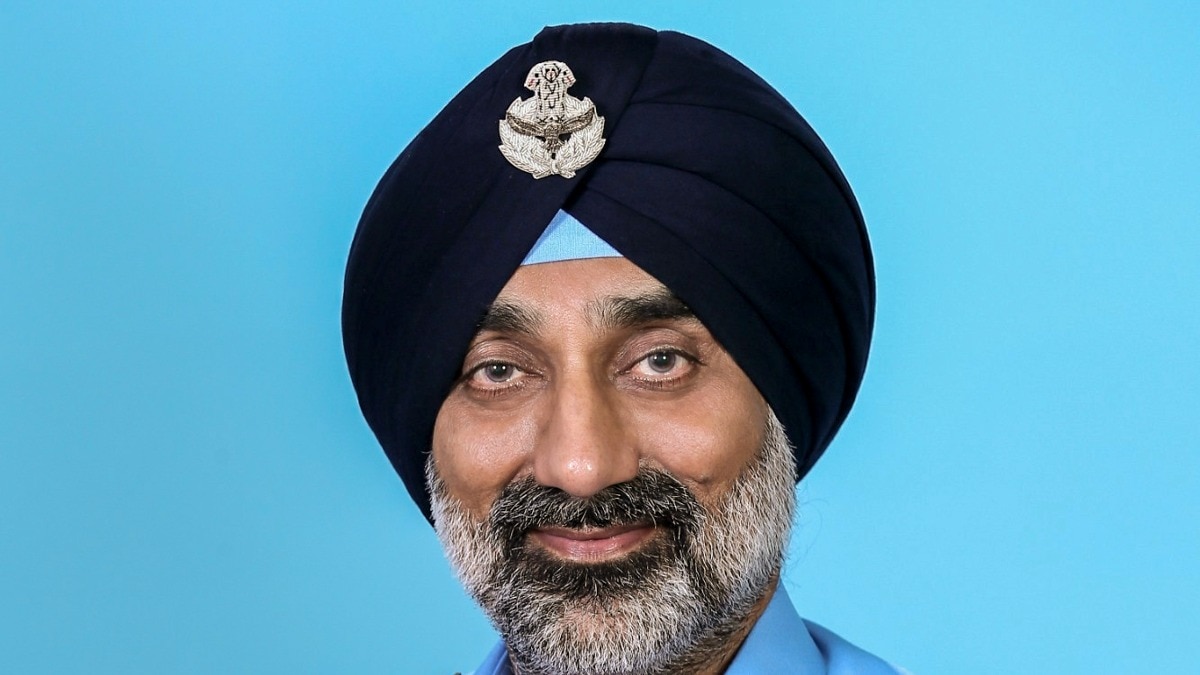
Air Chief Marshal AP Singh said the guiding principle of the proposed military reform should be 'centralised control' where necessary and 'decentralised execution' where appropriate.IAF chief AP Singh made detailed comments on the proposed military reform in a recent interview to PTI. Air Chief Marshal AP Singh has said that the Indian Air Force (IAF) is not viewing the theaterisation plan as an exercise to permanently divide fighter aircraft by geographical area.In his first detailed comments on the proposed military reform, the IAF chief called for a structure based on India's security needs rather than models adopted by other countries.In an exclusive interview with news agency PTI, Singh said the guiding principle should be "centralised control" where necessary and "decentralised execution" where appropriate.He also said the transformation should be introduced in phases to ensure that operational readiness is never compromised.
Announced in 2019 as India’s most ambitious military reform since Independence, the theaterisation plan aims to integrate the Army, Navy and Air Force to improve coordination and make the best use of their resources during wars and other operations.The proposed structure envisaged three integrated commands: a Northern Theatre Command in Lucknow focused on China, a Western Theatre Command in Jaipur to address challenges from Pakistan, and a Maritime Theatre Command in Thiruvananthapuram. However, progress has stalled because of differences among the three services over the proposed command structures.The IAF has cautioned against implementing the plan in a hurry and has reservations about splitting its fighter squadrons among the proposed commands."Recent conflicts around the world have once again underlined how decisively air power can shape military outcomes.
That is precisely why the question of how air power is organised matters so much," the IAF chief told PTI."We are not viewing theaterisation as an exercise to permanently divide fighter assets geographically. The IAF is fully committed to jointness and integration," he said.Singh said the main question was how air power could be used most effectively within an integrated structure.
He said its key strengths were speed, reach, flexibility and the ability to rapidly concentrate combat power where it was needed."An aircraft is not relevant only to the geographical area from which it operates. With aerial refuelling, long-range weapons, networked sensors and appropriate basing, air power can be massed from considerable distances and shifted between sectors as the threat evolves," he said."The guiding principle should, therefore, be centralised control where necessary, and decentralised execution where appropriate.
That way, air power can be concentrated where it is needed most, while commanders retain the agility to act swiftly on the ground,” he added.Referring to Operation Sindoor, Singh said it was conducted under a joint structure established by the Chief of Defence Staff and the three service chiefs."Our own experience bears this out. During Operation Sindoor, under a joint architecture established by the Chief of Defence Staff and the three service chiefs, the centralised allocation and timely reallocation of critical resources proved decisive in the outcome," the IAF chief remarked."The tri-service air picture I described a moment ago is what made such dynamic employment possible," he said.The Air Chief Marshal also warned against trying to predict the future battlefield with "excessive certainty.""As we design future structures, we must also avoid the trap of trying to predict the future battlefield with excessive certainty.
What we can anticipate is that the next conflict will likely be: faster, more autonomous, yet more network-dependent, more transparent, yet more deceptive and more precise in some respects, and characterised by mass in others," he stated.Singh said the proposed structures must be able to adapt to such changes."They should be evaluated against India’s specific security requirements, not built by replicating models from other countries, because each nation operates within its own strategic, geographical, technological and operational environment," he said."A transformation of this scale should also be implemented in phases, so that operational readiness is never compromised," he added.Singh said the IAF was committed to the national effort."We will work hand in hand with our sister Services to build structures that are distinctly Indian, that preserve the inherent flexibility of air power, and that ensure India fights its future wars as one," he told PTI.He added that future conflicts would involve multiple domains and that the three services would plan and operate together "far more closely than ever before."Under the theaterisation model, each theatre command will include units of the Army, Navy and Air Force, which will operate as a single entity to address security challenges in a specified geographical area.At present, the three services have separate commands.Former Chief of Defence Staff, General Anil Chauhan, had submitted a comprehensive proposal on theaterisation to Defence Minister Rajnath Singh.However, it is not immediately known whether the defence ministry is pursuing the plan in line with that report. Current Chief of Defence Staff, General NS Raja Subramani, is learnt to be focusing on key aspects of the overall plan.- Ends(With PTI inputs)