


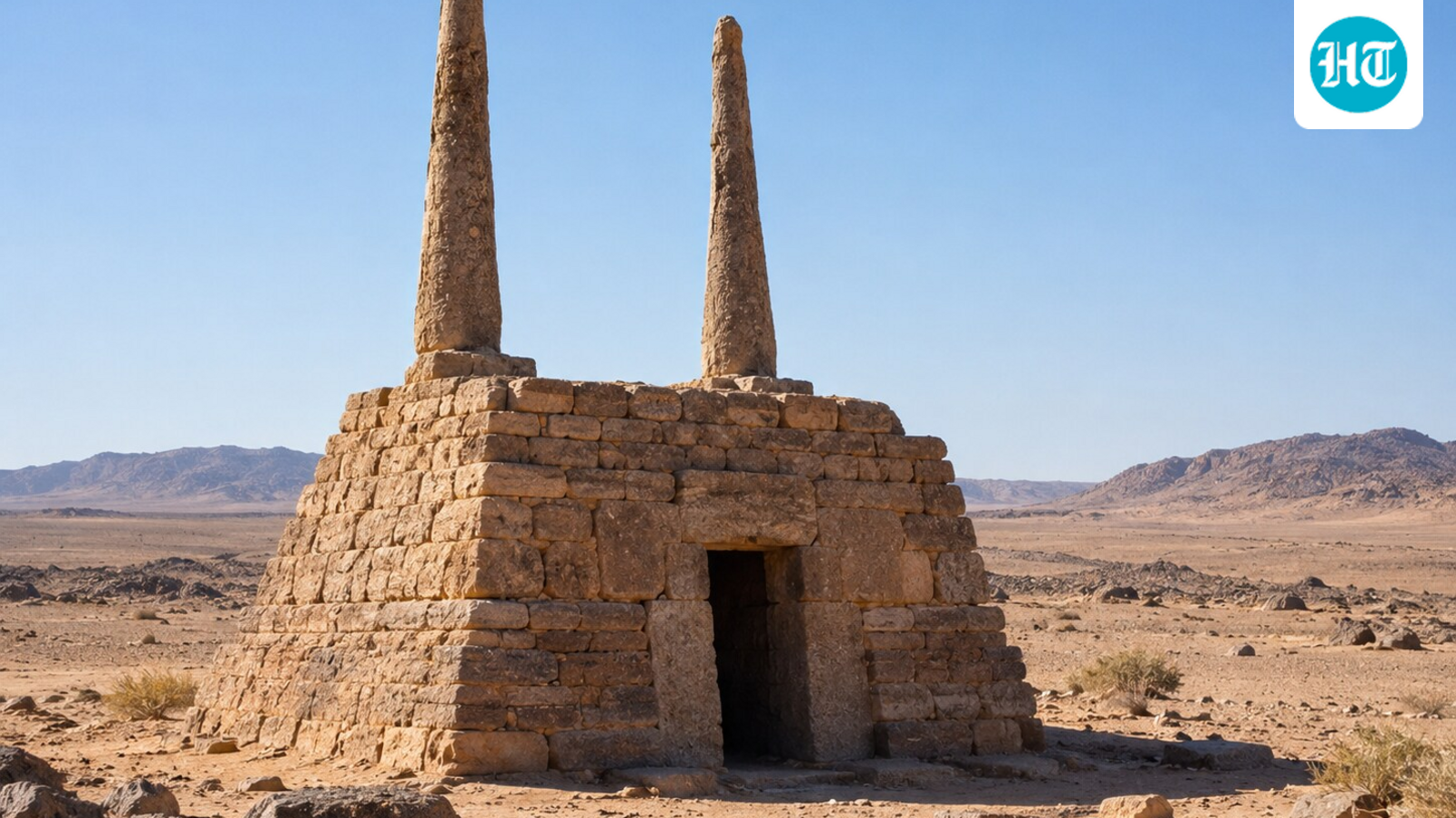
Archaeologists have successfully dated a strange stone structure stretching across the Western Sahara, shedding light on how prehistoric communities buried their dead. Built from local limestone slabs and marked by two long, antenna-like stone extensions, the monument had long resisted precise dating and interpretation. Recent scientific analysis has now established that the structure functioned as a burial site roughly 4,400 years ago.
The monument was discovered at Wadi Lawash el Telli, located on the eastern edge of the Sluguilla Lawash rock-art site in northern Western Sahara. Researchers determined the burial dates to between approximately 4,417 and 4,100 calibrated years before present, marking the first absolute chronology for an antennae tumulus in the Atlantic Sahara region.
Known as an antennae tumulus, the overall structure spans about 54.5 meters in length. It features a central oval mound measuring roughly 12.5 meters long and 10 meters wide, rising less than three meters above the gravel plain. Two elongated lines of stones extend eastward from either side of the mound. The builders used local Devonian limestone laid flat without mortar, meaning a small group could construct it without complex stone-transportation infrastructure.
The two stone lines align at roughly 102 degrees from north, sparking historical theories about potential astronomical connections. However, researchers emphasize that no astronomical purpose has been proven, leaving the funerary role as the most concrete interpretation. The surrounding landscape is rich in prehistoric activity, featuring nearly 1,140 engraved rocks along a 27-kilometer stretch of wadi that depict animals like cattle and ostriches, reflecting a drastically greener Sahara in the past.
Excavations conducted in April 2018 focused on a partial investigation of the central mound to preserve the rest for future study. Beneath loose surface stones, the team uncovered an inner structure made of larger limestone slabs that protected the remains of a single individual. The person was laid out supine with the head pointing south and feet pointing west.
Poor bone preservation prevented determination of the individual's sex, but dental wear patterns suggest the person died between the ages of 25 and 35. Grave goods were sparse, consisting only of four ring-shaped beads crafted from ostrich eggshell alongside two grains of pine pollen found in sediment samples.
Initial radiocarbon dating attempts in 2018 failed because the bones lacked sufficient collagen. However, a return to the remains allowed scientists to analyze the mineral component of the bone fragments. A humerus sample and a femur sample yielded closely matching dates, placing the construction primarily between 4,407 and 4,230 years ago.
This timeline aligns the monument with the later part of the region's Late Neolithic period, showing that antennae tumuli overlapped with other architectural styles, such as crescent-shaped burial monuments. While the exact purpose of the long stone antennae remains unknown, the breakthrough offers a vital chronological anchor for studying prehistoric societies in one of the world's driest environments.