


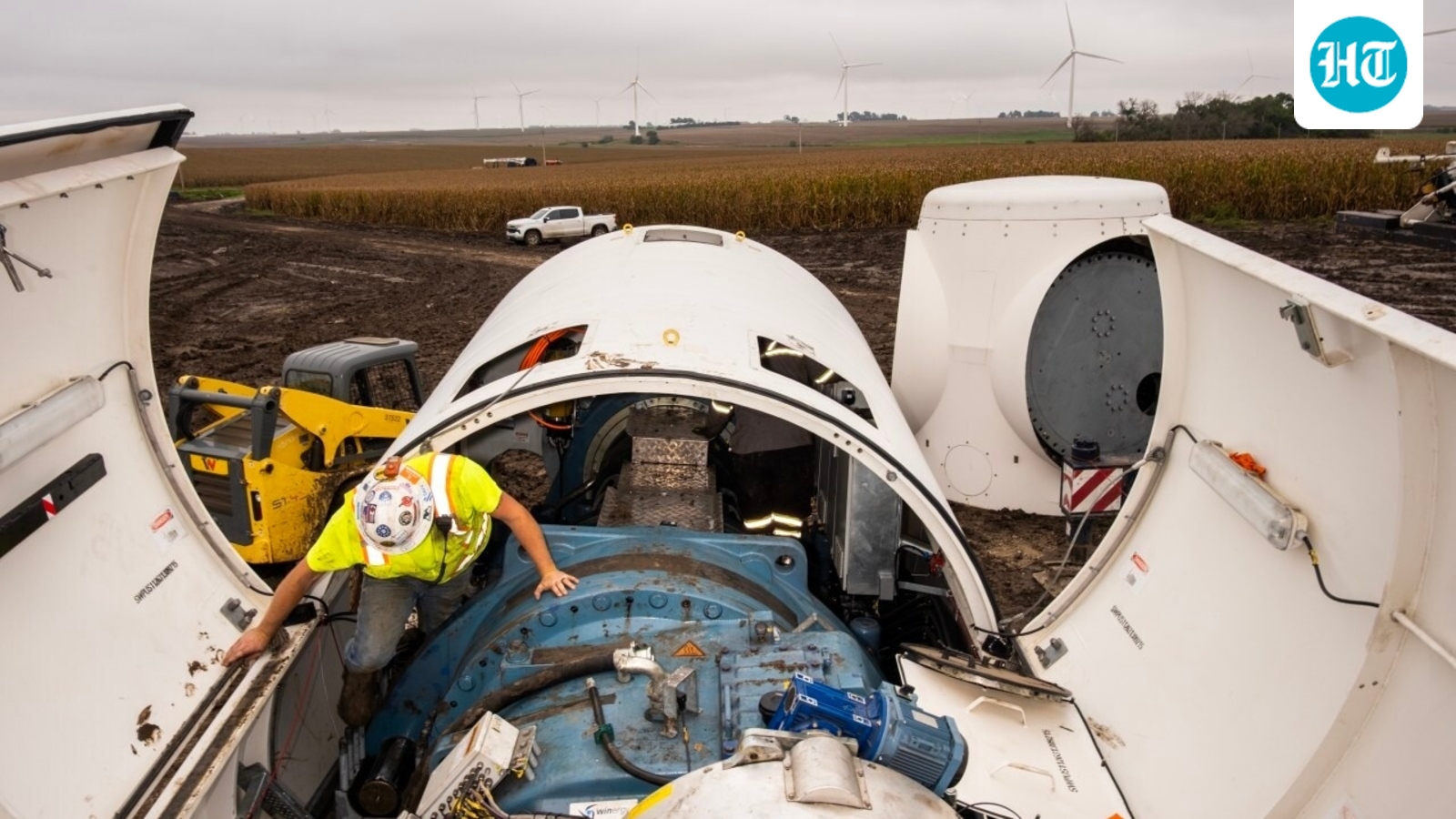
To utility operators, the wind turbines being taken down at sites like the Highland wind farm in O’Brien County, Iowa, are simply junk. To recycling entrepreneurs, however, they represent a potential mother lode of critical minerals.
Brian Diesselhorst serves as the chief executive of Paladin EnviroTech, a recycling venture positioning itself as a domestic supplier of rare-earth metals. As the United States seeks to decrease its heavy reliance on China for materials used in everything from defense drones to medical scanners, a handful of businesses are betting that the quickest path to a new supply chain runs through the junkyard.
Rare-earth elements such as dysprosium and neodymium are vital components in the high-strength magnets used in electric motors. While Diesselhorst sources materials from various expired electronics, retired wind turbines are his primary focus. Newer, more powerful turbine models can house room-size generators containing nearly a ton of rare earths, which Paladin estimates can be worth close to 100,000 dollars.
Thousands of retirement-age turbines are currently waiting to be harvested as America's wind fleet ages. While only a fraction of older models contain these specific rare earths, the materials became commonplace as turbine capacities increased. Those larger units are now reaching the end of their operational cycles, turning industrial waste into a progressively more valuable resource.
China established its dominance in the rare-earth sector over decades through substantial state financial support and aggressive market pricing designed to undercut emerging competitors. Last year, amid a tightening trade conflict with the United States, Beijing imposed export restrictions that highlighted the deep vulnerability of Western manufacturers.
Recycling ventures represent one avenue in a broader push to dismantle that chokehold. Although the federal government has channeled billions of dollars into domestic mineral projects, those large-scale investments will take years to become fully operational.
For the most part, the aging turbines being removed from service are being swapped out for more efficient technology. Units at the Highland wind farm have operated for a decade and could technically function for another ten years, according to MidAmerican Energy. Replacing them with modern models featuring blades twenty percent longer allows each turbine to generate about fifteen percent more power, an important advantage as electricity demand climbs.
MidAmerican has built the largest wind-power portfolio of any U.S. utility, replacing nearly 1,500 of its 3,700 turbines. While metal recyclers previously salvaged basic materials, the rare-earth metals inside many units were routinely wasted until Paladin entered the market.
Significant barriers to entry remain, chief among them the logistical challenge of dismantling massive structures. Cranes must remove the massive blades and room-size nacelles housing the generators, after which heavy equipment slices up the components for transport on heavy-duty flatbed trucks.
Transporting heavy components from rural fields presents distinct hazards, including unstable ground conditions that can threaten heavy machinery. Additional risks stem from unpredictable weather, as strong wind gusts complicate crane operations.
Another major hurdle is the difficulty of separating materials economically to isolate the rare earths. Paladin collaborates with Critical Materials Recycling, an Iowa firm utilizing a leaching technique developed at Ames National Laboratory to extract rare earths from electronic waste. Historically, recyclers focused primarily on copper due to its higher value and abundance in turbine wiring, while rare-earth elements were typically lost alongside steel in industrial slag.
Previous battery-recycling ventures have struggled due to difficulties in securing steady feedstock and managing operational costs. To avoid these pitfalls, Paladin has focused on building a reliable supply pipeline.
Company executives project that wind-turbine magnets will account for roughly forty percent of Paladin's total tonnage next year, with electric vehicle motors and MRI machines contributing twenty-five percent each, and hard drives making up the remaining ten percent. The firm has already lined up a supply chain involving approximately 500 turbines across the country.