


You are what you eat. And if your daily diet includes a generous helping of fruits and vegetables, you would like to believe you are doing your body a favour.
But how much do you really know about the produce on your plate? Where was it grown?
What was used to cultivate it? And when a vendor labels something ‘organic’, how do you know the claim holds up?For urban consumers trying to make more conscious food choices, these questions are not always easy to answer.
Organic labels can offer some reassurance, but consumers still need to know what the label means, whether the produce is certified and how the claims are verified. The result is a growing interest in knowing not just what goes into our food, but where it comes from and how it is grown.There is, however, another way to approach the problem.
What if you could grow your own vegetables, without having to buy agricultural land, learn farming from scratch or take on the responsibility of maintaining a farm?That is the idea behind the rent-a-farm model. Instead of buying land outright, customers pay for access to a plot — or subscribe to a service that grows produce on their behalf.
The arrangements vary: some ventures do the farming and deliver the harvest to your home, while others let customers participate in the process themselves. An there are multiple players at this point across India.
In Punjab, Gill Organics offers the former. In Tamil Nadu, Vaksana Farms is experimenting with the latter.
Both tap into the desire to get closer to the source of one’s food, but they approach it rather differently.A farm plot, without the farming homeworkFor Mantaj Sindhu, founder of Gill Organics, the idea grew out of an observation he made in Dublin, where he came across small patches of land where people could pick produce and pay for what they took. The model stayed with him.
So did a question closer to home: could a more predictable arrangement help farmers, who often invest in cultivation before knowing what the market will pay for their produce? Gill Organics offers customers a dedicated plot of around 150 square yards for a six-month season.
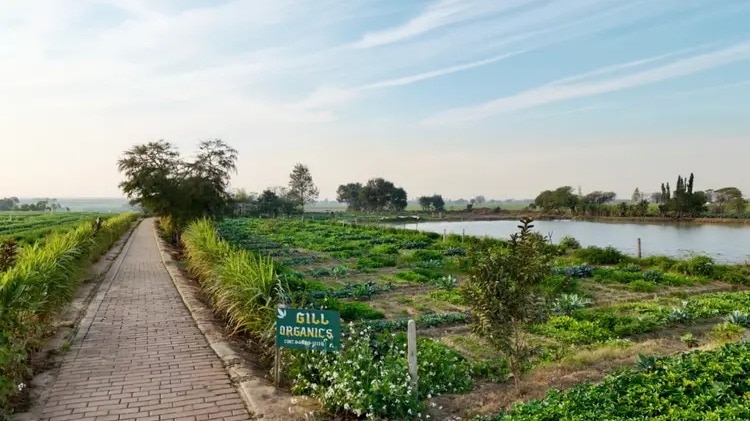
Customers choose the seasonal vegetables they want to grow, while the team takes care of cultivation and maintenance. The harvest is then delivered to their homes every week.
In the patch of land allotted to you, you can grow the vegetable of your choice. What you can see in the picture are the kinds of vegetables that you can choose to grow in your plot.
Guess what, you can even give it a name. The idea is to make home-grown produce accessible without requiring customers to learn how to farm, buy equipment or spend their weekends tending to crops.
A plot can supply around 60–70 per cent of a family of four to five’s weekly vegetable and salad requirements, depending on the season.The subscription model is currently available in Patiala, Chandigarh Tricity and Ludhiana. The company’s website lists six-month subscriptions at Rs 35,000 in Patiala and Rs 40,000 in Chandigarh Tricity and Ludhiana, including weekly home delivery.
However, Mantaj mentions, they have a 90% customer retention rate.Sindhu says the venture has had to grow at a pace dictated by the land itself. Gill Organics operates across six acres, and expanding the model is not simply a matter of acquiring more customers.
Soil quality, maintaining the standards the business has set for itself and the time required to convert land to organic cultivation all influence how quickly it can scale.The demand, he says, has outstripped the company’s capacity. In the exclusive interview, Sindhu said the business could cater to around 200 families, while its waiting list had grown to nearly 3,000.
Consuming fresh and pesticide-free fruits and vegetables is the dream of so many families in urban India. The appeal is easy to understand: customers can have a say in what is grown, while leaving the labour and logistics to someone else.
But this is not necessarily a cheaper way to buy vegetables. It is a subscription to a particular kind of access, with the promise of greater involvement in how the food is produced.What if you want to grow it yourself?While the former takes care of the customer’s pain point of cultivating pesticide-free vegetables themselves, at Vaksana Farms, near Rettanai village in Tamil Nadu, the proposition is different.
Rather than simply receiving a weekly harvest, customers can rent a plot and take part in growing their own food.Co-founded by Kiruba Shankar, Vaksana is a 14-acre permaculture farm with fruit trees, vegetables, greens, paddy and pulses, alongside a farm stay. Its rent-a-farm offering gives customers access to a plot of around 3,000 square feet, with larger areas possible, according to Shankar.
He quoted a price of Rs 15,000 a month for a 3,000-square-foot plot.The farm helps with essentials such as water, electricity and manual labour. But the point, Shankar stresses, is not simply to get a basket of vegetables at a bargain price.
It is to experience what growing food actually involves, from tending to plants to dealing with the uncertainty that comes with farming.Shankar’s own experience has shaped the model. People would visit the farm, enjoy their stay and leave inspired to buy agricultural land of their own.
What they did not always appreciate, he says, was the work involved in running a farm, or the fact that a beautiful patch of land does not automatically become a profitable enterprise.He also runs a workshop called Build Your Profitable Dream Farm, which has held 14 editions. The aim is to help aspiring farm owners understand the realities of the business before committing their savings to land.
Renting, in this sense, offers a trial run. Customers can learn what it takes to grow food and decide whether they want to take the idea further, without making the financial commitment of buying a farm.Could renting a farm be the future of growing your own food?As conversations around nutrition, gut health and the importance of a balanced diet become more mainstream, knowing what goes into our food, and how it is grown, is likely to matter to more consumers.
But wanting fresh produce and having the means to grow it are two very different things.Kitchen gardens offer one way to take control of what ends up on our plates. Herbs on a windowsill, tomatoes in pots on a balcony or a few leafy greens growing on a terrace can bring the idea of home-grown food within reach.
But in cities where many people live in flats and apartments, space is a very real constraint. A few pots can be satisfying, but they cannot always meet a household's vegetable needs.The challenge is not new.
A 2025 study on nutrition gardens in Punjab identified lack of space, time and knowledge as barriers to growing food at home. Research by the Indian Council of Agricultural Research has also explored how kitchen gardens can help households produce a wider variety of vegetables throughout the year.
The desire to grow one's own food, then, is not necessarily the problem; finding the space and time to do it can be.This is where renting a farm could find its place. Not everyone can afford to buy agricultural land, nor does everyone want the responsibility of owning and maintaining it.
A subscription-based model such as Gill Organics offers a way to have seasonal produce grown to one's preferences and delivered home. Vaksana Farms, meanwhile, gives people the opportunity to experience cultivation themselves, without committing to buying a plot.These models are not entirely new, and they are unlikely to replace the neighbourhood vegetable vendor or work for every household.
The cost, distance from the farm and the level of involvement required will determine who finds them worthwhile. But they offer another option for people who want to move beyond simply buying vegetables and get closer to how their food is grown.The larger opportunity may lie in making that connection accessible.
As urban homes become more space-constrained and interest in food, nutrition and its origins grows, the idea of growing your own vegetables need not be limited to people with a garden, a terrace or a patch of land. Sometimes, the garden can be somewhere else — and the harvest can still make its way to your kitchen.- Ends