


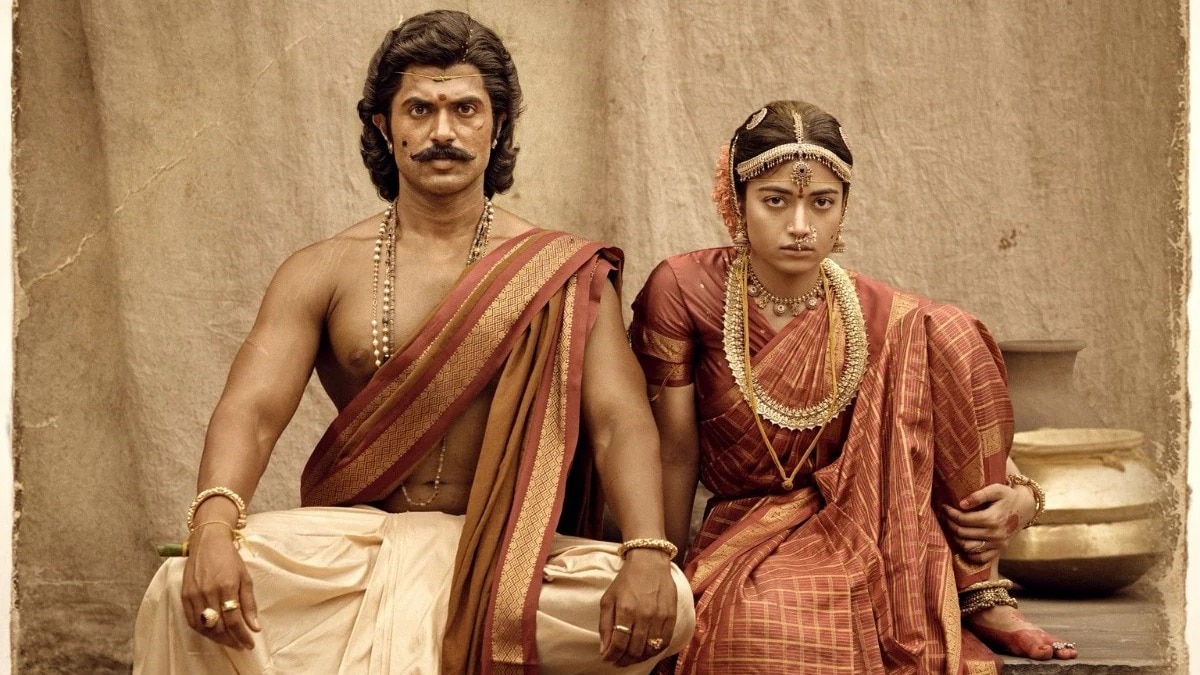
Vijay Deverakonda faces yet another familiar disappointment with his latest theatrical release, continuing a pattern of highly anticipated projects that ultimately fail to deliver on their early promise. Set against the harsh backdrop of the Great Madras Famine spanning from 1876 to 1878, the film casts the lead actor as Singnamala Bobbili Ranabaali, a fierce Rayalaseema warrior fighting British oppression to protect his community. Rashmika Mandanna portrays Jayamma, serving as his emotional anchor, while Arnold Vosloo takes on the role of the ruthless British antagonist, Sir Theodore Hector. Drawing heavy inspiration from the folklore surrounding Bhadramallanna, the production attempts an ambitious blend of historical drama, action, and mythology, though its execution struggles to maintain momentum.
The narrative opens with traditional burra katha narration and the legend of Ranabaali's birth, immediately establishing a grand, epic atmosphere. However, this excitement quickly fades as the screenplay settles into a repetitive cycle of suffering, oppression, and revenge within the first twenty minutes. The rhythm of the film proves to be its most persistent obstacle. Action sequences frequently build toward satisfying peaks only to be cut short prematurely, robbing the audience of anticipated pay-offs. Instead of establishing a balanced cadence between intense action, deep emotion, and quiet reflection, the movie relies on relentless melodrama that eventually exhausts the viewer.
Several narrative turning points fail to achieve their intended emotional resonance. A crucial sequence involving Jayamma and the family of a man killed by the protagonist plays out as a generic dramatic moment rather than a heartbreaking reckoning that reshapes the hero's path. Furthermore, the plot twists remain largely predictable from the outset. Despite these narrative shortcomings, the technical departments excel. Cinematographers Jishnu Bhattacharjee and Nirav Shah deliver striking visuals, which are complemented by Shivam Rao Nagasani's meticulous production design and Archana Rao's period-accurate costumes. The scale and research behind the project are evident in almost every frame, even if the world-building fails to generate genuine emotional investment.
The lead actor commits fully to his physical transformation and mannerisms, yet the weak writing leaves the character lacking inner struggle or meaningful growth. Rashmika Mandanna brings much-needed warmth and humor to her role, sharing engaging chemistry with the lead, while the supporting cast does commendable work within the confines of limited screen time. Reminiscent of other recent period action features, the project draws thematic comparisons to various regional epics, though it struggles to establish a distinct identity of its own. The historical and mythological elements never fully merge, and the folklore-inspired climax feels tacked on rather than serving as a natural conclusion.
The antagonistic forces also present challenges, as the Telugu-dubbed dialogue undercuts the historical authenticity, and Arnold Vosloo's commanding physical presence is underutilized by a screenplay that reduces him to a generic threatening figure. Meanwhile, the musical score by Ajay-Atul fails to elevate the action or heighten emotional tension as required. Director Rahul Sankrityan deserves praise for bringing an overlooked historical chapter to the big screen on a grand scale, supported by strong visuals and committed acting. Ultimately, however, repetitive narration, underwritten characters, and an uneven tone prevent the project from becoming a satisfying cinematic experience, leaving audiences with an epic that lacks a true pulse.