


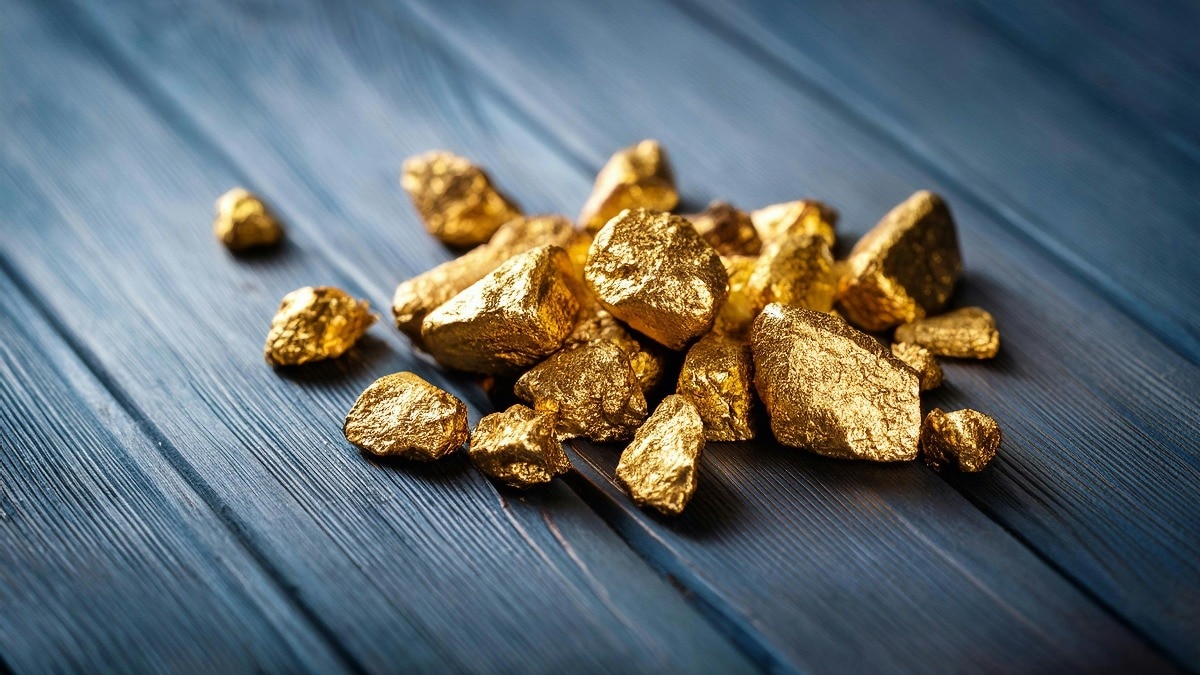
Can mercury be turned into gold?A Rajasthan-based start-up, led by a scientist Lal Bahadur, who was associated with India's Pokhran-II nuclear tests, claims it has done just that, using a method of alchemy inspired by ancient Indian texts.The team recorded 99.04% gold on the sample's surface, equivalent to 23.77-carat purity. But whether mercury was actually transformed into gold remains unproven.The experiment involved a 0.240-gram mercury sample tested at the physics laboratory of Kanodia College in Jaipur, affiliated with the University of Rajasthan.
The report also recorded 0.48% silver and 0.48% copper on the sample's surface. A close-up image of liquid mercury.
Bahadur said the process draws on Rasa Shastra, an ancient Indian tradition involving the processing of mercury and other substances.The team claims to have spent years studying techniques called Parada Samskara, or mercury processing, and Dhatu Parivartana, or metal transformation, described in texts associated with Acharya Nagarjuna. Bahadur, an engineering graduate of BITS Pilani who was associated with India's Pokhran-II nuclear tests, also claims that no radiation was detected during the experiment.HAS IT BEEN PROVEN?The experiment, however, has shown results through a “skin test only”, meaning the finding concerns the sample's surface, not necessarily its entire composition.Although 99.04% gold corresponds mathematically to 23.77 carats, this does not establish that the whole sample has that purity.
Nor does detecting gold on the surface prove that it came from mercury.Further testing must determine whether the gold was already present as an impurity or entered the sample from an external source. That's where another Jaipur institution comes in.
An aerial view of the MNIT Jaipur campus. MNIT JAIPUR TO TEST CLAIMSExperts at Malaviya National Institute of Technology (MNIT), Jaipur, are expected to examine samples alongside the team.Notably, similar experiments have reportedly been conducted at the University of Rajasthan's ECH Centre.The next stage is expected to include repeated experiments under different conditions and tests of the starting materials.
Techniques such as X-ray fluorescence (XRF) and isotope analysis can help identify elements, measure their quantities and examine their isotopic composition.Mercury and gold are different chemical elements, and ordinary chemical reactions cannot turn one into the other; such a transformation requires a nuclear process that changes an atom's nucleus.Until independent testing establishes the sample's composition, the origin of its gold and whether the results can be reproduced, the claim of turning mercury into gold remains scientifically unverified.- Ends