


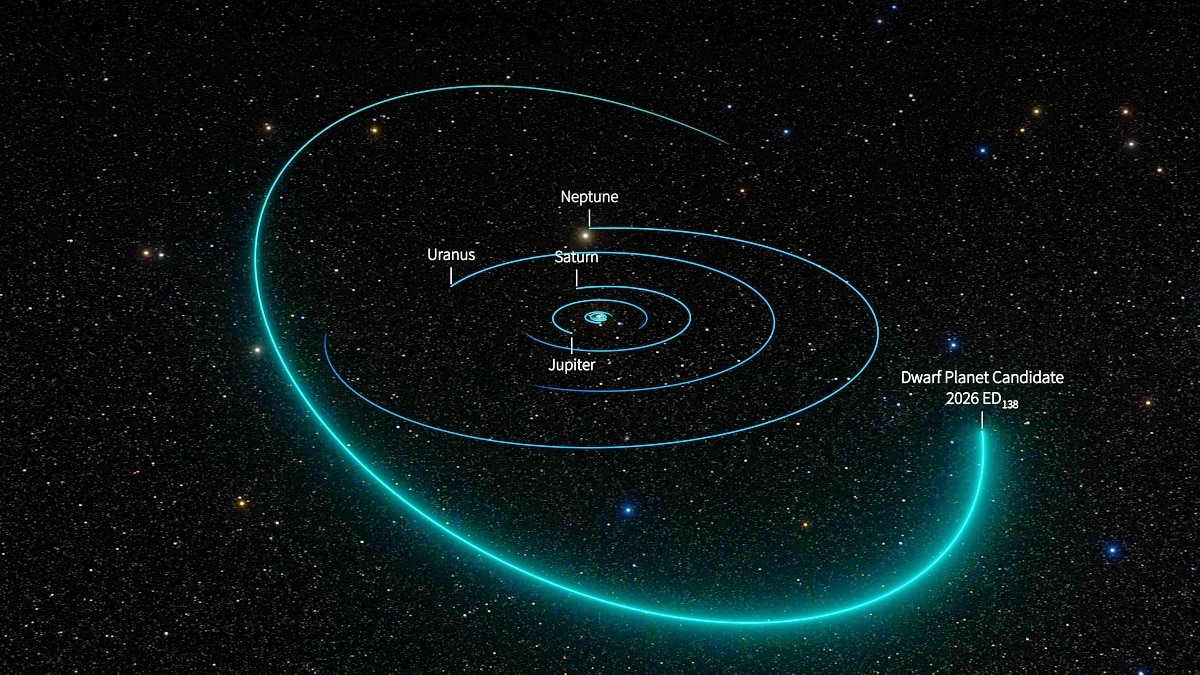
Astronomers have identified 2026 ED138, a large trans-Neptunian object beyond Pluto. Follow-up infrared observations will determine whether it qualifies as a dwarf planet.Its orbit is tilted nearly 25 degrees relative to the plane of the Solar System.
Astronomers have discovered a potentially enormous new world beyond Pluto, raising the possibility that the Solar System may soon have another recognised dwarf planet.But there is a catch: scientists have not yet confirmed that the object qualifies as one.Named 2026 ED138, the object was discovered in data collected by the NSF–DOE Vera C Rubin Observatory. The International Astronomical Union's Minor Planet Center announced the discovery, identifying it as a candidate for dwarf planet status.Initial estimates suggest that ED138 could measure between 600 and 1,500 kilometres across, potentially placing it among the largest objects discovered in the distant outer Solar System.
ED138 remains a candidate rather than a confirmed dwarf planet. If confirmed as a dwarf planet, it could join the five officially recognised worlds in this category: Pluto, Ceres, Eris, Haumea and Makemake.However, ED138 is not a newly confirmed planet.
It is a trans-Neptunian object, meaning it orbits the Sun beyond Neptune, and its classification remains provisional.A WORLD HIDING BEYOND PLUTO ED138 is currently about 46 astronomical units from the Sun, with one astronomical unit representing the average distance between Earth and the Sun. For comparison, Pluto's average distance is around 40 astronomical units.The object was identified by Matthew Holman of the Center for Astrophysics | Harvard & Smithsonian, who was analysing Rubin Observatory data using software designed to identify moving objects among billions of detections.Initially, Holman was surprised by the object's brightness and distance, prompting him to check whether the detection was genuine.
Further analysis uncovered additional observations, allowing researchers to trace its orbit across more than a decade.Rubin Observatory recorded ED138 30 times on 20 nights between March 4 and July 11, 2026. The dwarf planet candidate orbits the Sun beyond Pluto.
Archival images from the Dark Energy Camera and observations recovered through the Asteroid Institute's ADAM Precovery service extended the record back to 2016.The discovery is particularly notable because ED138 lies in a crowded region of the sky near the plane of the Milky Way, where background stars can make faint Solar System objects difficult to identify.WHY SCIENTISTS HAVE NOT CALLED IT A DWARF PLANET YETTo qualify as a dwarf planet, an object must orbit the Sun, possess enough gravity to become approximately round, and not have cleared its orbital neighbourhood of other objects.Based on its estimated size, brightness and surface reflectivity, scientists believe ED138 is likely to be round. However, infrared observations are needed to establish its size more precisely and confirm its nature.Its orbit is tilted nearly 25 degrees relative to the plane of the Solar System, suggesting that gravitational interactions, including those involving Neptune, may have altered its original trajectory.RUBIN COULD UNCOVER MORE HIDDEN WORLDSThe discovery offers a glimpse of what the Vera C.
Rubin Observatory could reveal as it repeatedly surveys the southern sky over the coming decade.By combining deep imaging, repeated observations and powerful data-processing algorithms, the observatory can detect objects that earlier surveys may have missed.For now, ED138 remains a candidate rather than a confirmed dwarf planet. But if follow-up observations establish its size and shape, this distant icy world could become the next member of the Solar System's small family of recognised dwarf planets.- Ends