


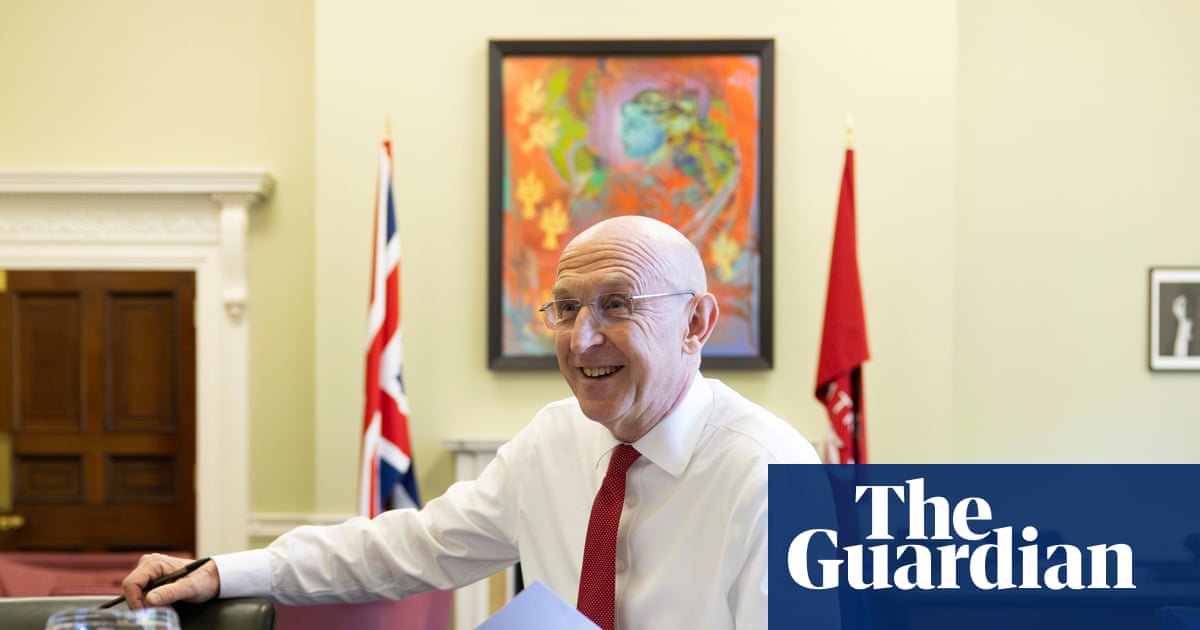
Good morning. Don’t expect anything radical.
This, the Treasury has been at pains to tell us, will be a very “low-key” budget. After weeks of speculation from journalists, a flurry of press releases from thinktanks, and a photoshoot with an obligatory red box, the chancellor, John Healey, will announce the details of the Burnham government’s first budget in the Commons today at 12:30pm.Healey has been selling this as a series of measures designed to relieve pressure on low- and middle-income households under the mangled tagline of “breathing space for today, fresh hope for the future”.
Many of the proposals have already been briefed, and their modesty is a sign of the constraints – both real and self-imposed – that his government faces. He has rejected calls to raise capital gains tax or lower the mansion tax and has promised to stick to Labour’s fiscal rules, while the Iran war has increased the cost of borrowing and eroded his spending power.Voters might be hoping for something transformative from a government that risks presiding over the worst parliament for living standards on record.
That’s the impression I got from First Edition readers and people struggling with the cost of living, who I spoke to for this morning’s newsletter about what they’d like to see from today’s budget. First, here are the headlines.Five big stories Israeli elections | Israel could be in for weeks of political haggling after exit polls and partial official results showed neither Benjamin Netanyahu’s coalition nor the opposition bloc led by former general Gadi Eisenkot had won enough seats to form a government.
Energy | The government’s plan to fund a multibillion-pound nuclear plant at the Sizewell site in Suffolk represents a “terrible deal” for the UK taxpayer over the rest of the century, according to the government’s spending watchdog. Middle East | A multipronged peace deal to reopen the strait of Hormuz within four days of sanctions being lifted and for the Houthis to withdraw substantial forces inside Yemen are at the heart of Gulf states’ plans to avert what they regard as a disastrous renewal of war between Iran and the US.
UK news | A 78-year-old volunteer has claimed a Reform UK councillor accused her of “facilitating the invasion” and being akin to a Nazi collaborator during the second world war because she has helped asylum seekers learn English. Brazil | The far-right senator Flávio Bolsonaro has reportedly fled Brazil and is on his way to the United States after losing Sunday’s presidential election to the leftwing incumbent, Luiz Inácio Lula da Silva.
In depth: ‘It’s not going to be ending 40 years of neoliberalism’A shop advertises a mid season sale in Wolverhampton, United Kingdom. Photograph: Christopher Furlong/Getty ImagesThere was some detectable grumbling earlier this week over the lack of information about this budget compared with those of Rachel Reeves, and Healey has made much of the “military-style protocols” that have allegedly stopped the Treasury’s secrets from leaking out.
But it seems more likely that there hasn’t been much to leak. “It’s going to be a far smaller budget than last year,” Kiran Stacey, the Guardian’s policy editor, told me on Monday. “It’s not going to be ending 40 years of neoliberalism.”We’ve already covered some of its content: Patrick Butler and Pippa Crerar wrote yesterday on the government’s plan to abolish the detested rule that has plunged unpaid carers into debt (which the Guardian exposed last year). The government was criticised yesterday for pausing the process of equalising the lower national minimum wage, paid to people under 21, with the more generous “national living wage” for older workers, and has also announced a series of “everyday fixes” to ease the cost of living pressures facing UK households.
That is expected to include support for poorer families with energy bills this winter and to pledge energy market reforms aimed at bringing down bills for all households in the longer term.The extent of those pressures is remarkable. StepChange, the UK’s largest debt advice charity, pulled together some figures for this morning’s First Edition that show the average household arrears debt for their clients increased from £2,833 to £4,345 between 2022 and 2025. “In the late 2000s, people would primarily come to us with consumer credit debt,” a spokesperson from the charity told me. “But one in two people who come to us now have energy debt.
These pressures are completely new.” *** What could the government do to address energy bills?A number of readers told First Edition that energy bills are their major concern. Michael works for a small property company, and rents a three-bedroom bungalow in Winchester where he lives with his three children.
It’s draughty, and he spends about £165 a month on electricity and gas, which will increase this winter. “I think about the cost of everything now,” he tells me. “Will I get enough money to be able to afford this? Will I have enough when the rent is due?”Healey has been considering making the warm homes discount, a £150 annual reduction to electricity bills for people in receipt of benefits, more generous.
But Michael doesn’t qualify for this, since he doesn’t receive benefits. After tax, his monthly income is between £2,500 and £3,000, and his rent is £1,800 a month, leaving him at most £300 each week (in a good month) to cover the living costs of four people.
The warm homes discount is targeted at the most needy and does nothing for people further up the income spectrum who are still struggling.“Alongside funded measures to provide immediate relief, the government needs a structural plan to reduce energy bills over the medium term,” Mathew Lawrence, the director of Common Wealth, a thinktank that has been cited as an influence on Burnham’s government, tells me. One idea would be an “energy guarantee”, a protected bloc of energy priced at pre-crisis levels (as Kiran reported earlier this month, energy officials are working up more radical changes that could be introduced after the budget).
But Healey has ruled out some of the tax changes that could help fund this type of policy. “So decisions on tax have limited the government’s scope for action on bills,” Mathew says.What about food bills?A persistent causes of stress for Michael is the rising cost of food. “Once something goes up in price, it never comes down again,” he says. This is well evidenced: one report from the Energy and Climate Intelligence Unit, published in May, observed that when food prices in the UK have risen during crises such as the pandemic, they have either fallen slowly or incompletely, or have stayed the same indefinitely.One of the proposals the government announced on Monday is the removal of import tariffs on products including baked beans, chocolate and gherkins.
But the impact on household budgets will be pretty minimal; the Treasury estimates it will save £21 on the average yearly food shop. For Michael, who tries to limit his weekly food shop in Aldi to £80, this will barely make a dent.What will the government do about housing costs?This was another concern that cropped up among First Edition readers.
Sue, from west Kent, wants the chancellor to announce more council housing. Burnham has committed Labour to the biggest council housebuilding programme since the postwar decade, and Healey is expected to announce a further £1bn in funding for this.
He’ll also likely provide more details of the Your First Home scheme designed to help first-time buyers get on the property ladder, a new version of the Help to Buy scheme, which pushed up house prices and made property developers inordinately rich.The impact of both of these measures will only be felt in the longer term. A more immediate solution would be linking local housing allowance, which has been frozen since 2024, to rents.
The Resolution Foundation finds that more than 900,000 private rented households on universal credit face a shortfall between their rent and their housing allowance, averaging £158 a month for a family renting a two-bedroom home.Finally, what about fuel prices?Pat, from Aberdeen, told us that she’d like to see the government reduce fuel prices. The rising cost of petrol is penalising people who rely on their cars to get around, and the government has announced that it will be continuing the freeze on fuel duty, the tax levied on every litre of petrol or diesel, which Rishi Sunak announced in 2022.But maintaining the freeze on fuel duty will largely help higher-income households, who drive more, while depriving the government of a revenue source. “Obviously some people on low incomes have to drive a lot.
But they’re also struggling with the cost of living at large,” says Jonny Marshall, an economist at the Resolution Foundation. “So instead of using this rather blunt instrument, it would be better to find other ways to help poorer households, particularly with more action on energy bills.”What else we’ve been readingStudents celebrate after Aleksandar Vučić conceded defeat in Belgrade, Serbia, 26 October 2026. Photograph: Uros Arsic/Reuters After writing about the Serbian elections last week, I was glad to read Aleksandar Matković’s thoughtful analysis of their outcome and what weary European democracies can learn from the triumphant ‘bunch of students’.
Libby I found Zoe Williams’ column hilarious and self-knowing – on how the people who see you least may just know you best. Poppy Noor, newsletters team Our Caribbean correspondent, Natricia Duncan, has been following calls for a full apology for Britain’s role in the slave trade from King Charles – this thorough piece sets out what’s a stake as he begins his tour of the region.
Libby Why won’t MPs tax the rich? This incredibly insightful piece by Faiza Shaheen asked politicians that exact question – and their answers provided useful insight on how to push the dial.
Well worth a read. Poppy After his Orwell prize-winning book Poverty Safari was referenced by Andy Burnham in his first speech in Scotland as Labour leader, writer and activist Darren McGarvey doesn’t pull punches in this interview with the National.
Libby skip past newsletter promotionafter newsletter promotionSport Photograph: Jon Super/ReutersFootball | Conor Haughey scored the winning penalty in Fleetwood’s 5-3 shootout win against 10-man Arsenal, after the Carabao Cup fourth round tie finished 1-1.Football | Michael Carrick has been given the chance to save his job by turning Manchester United’s results around, with the head coach remaining in place for Saturday’s visit to Chelsea.Cricket | Australia fought back in a rollercoaster start to the deciding Test against South Africa, as hosts all out for 329.The front pagesfrontpage29oct Photograph: The Guardian“Healey targets cost of living crisis in budget for a ‘difficult moment’”, is the Guardian’s splash today. The Times leads on “Healey to cut energy bills by scrapping green levies”, the i Paper has “Burnham to target rising energy bills in high-stakes first Budget”, and the FT’s take is “Healey puts energy reform at centre of Budget aimed at steadying nerves”.
Still on the budget, the Mail has £6 billion budget benefits bonanza”, the Mirror writes “A budget for workers”, and the Express says “Kemi: Labour is coming for your pay packets”.Elsewhere, the Telegraph leads on “King: Slavery was a ‘great suffering’”, the Sun says “Arise Sir Harry”, and Metro has “Wife ‘victim of a sick fantasy’”.The Latest Photograph: The GuardianHarry Kane triumphs with historic Ballon d’Or winHarry Kane is the men’s Ballon d’Or winner for 2026, the first Englishman to win the trophy in 25 years. At a lavish ceremony at the Palladium Theatre in London, Kane unexpectedly won ahead of co-favourites Lamine Yamal of Barcelona and Kylian Mbappé of Real Madrid.
In a contest that has been critiqued for promoting individualism and celebrity in sport, Lucy Hough speaks to the Guardian’s chief sports writer, Barney Ronay, about the symbolism of Kane’s win.Cartoon of the day | Ella Baron Illustration: Ella Baron/The GuardianThe UpsideA bit of good news to remind you that the world’s not all badYounger users have become increasingly aware of the downsides of social media. Photograph: Iryna Khabliuk/AlamyAmid the unrelenting tales of woe regarding social media’s impact on young minds, some enterprising gen-Z’s are working on fixes for their peers.
As younger users become increasingly wearied by the attention-splicing, joy-sapping demands of social media, a growing number of companies are offering means to digitally detox while individuals are likewise getting creative.Nineteen-year-old Shreya Nallamothu, for example, a computer science student at Duke University, has invented her own DIY Brick device to block selected apps.“Everyone deserves to have a good relationship with technology, and it shouldn’t be cost-prohibitive,” Nallamothu says. “Often the tech companies’ best interests aren’t in the users’ best interests. Social media has gotten away from what good technology can do, and people have noticed.”Bored at work?And finally, the Guardian’s puzzles are here to keep you entertained throughout the day.
Until tomorrow. Quick crossword Cryptic crossword Wordiply