


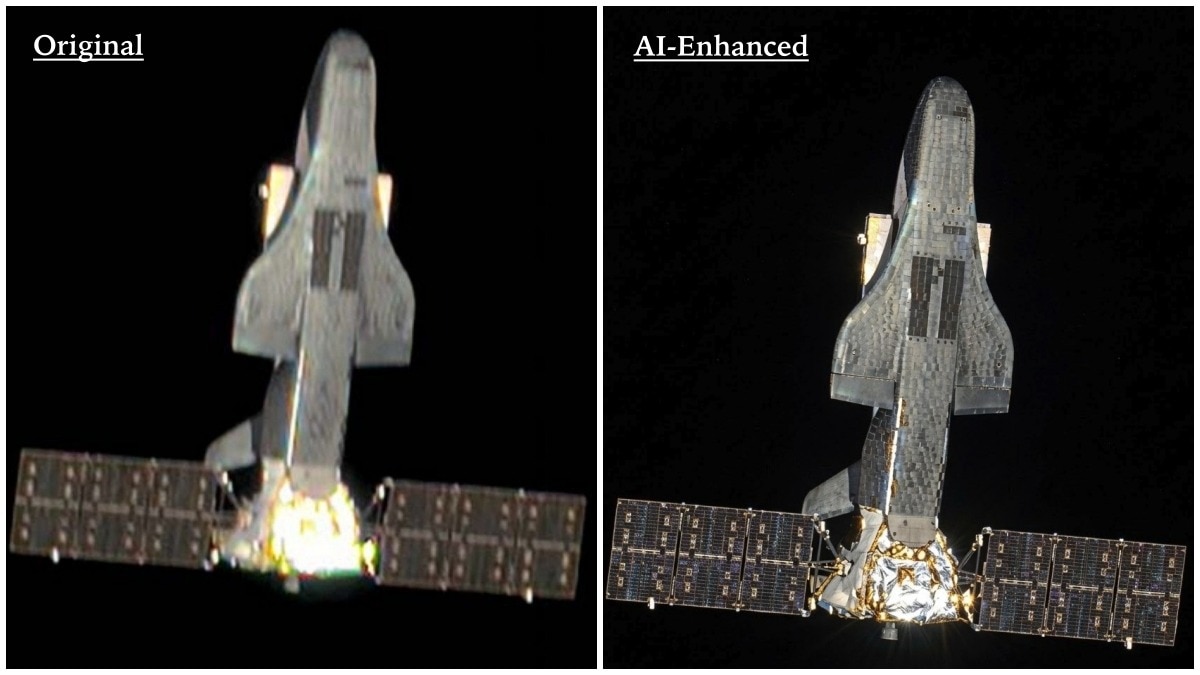
The US has released a rare orbital image of China's secretive reusable spaceplane. The disclosure highlights intensifying competition and growing security concerns in space.The spacecraft's activities have included releasing and interacting with objects in orbit.
The United States has released a previously unseen image of China's secretive reusable spaceplane, offering a rare glimpse of Beijing's growing capabilities in space as military competition in Earth's orbit intensifies.The image, captured by commercial satellite imagery company Maxar in 2024, was included in a new assessment by the US Defence Intelligence Agency (DIA) examining the challenges facing American space security.The report, Challenges to Security in Space 2026, assesses the military space programmes of China and Russia, alongside emerging capabilities in Iran and North Korea.The photograph shows a spacecraft resembling a miniature space shuttle, with a blunt nose, swept wings and dark thermal-protection tiles covering its body. Two large solar-array panels extend from the spacecraft's payload section, suggesting the image was captured while the vehicle was operating in orbit.
China has disclosed limited details about the spacecraft, which is believed to be part of its experimental reusable spaceplane programme. Its precise mission, onboard payloads and operational capabilities remain unclear.WHY CHINA'S SPACEPLANE MATTERSReusable spaceplanes are designed to operate in orbit before returning to Earth, potentially allowing spacecraft to be recovered, inspected and flown again.
Such vehicles could support experiments, technology demonstrations and satellite-related operations. The photograph shows a spacecraft resembling a miniature space shuttle.
The image has been enhanced to fix better the resolution. However, the ability to manoeuvre in orbit and return to Earth also creates potential military applications.
Depending on their design and payloads, spaceplanes could be used to test technologies for future spacecraft, conduct experiments or support missions that are difficult to carry out with conventional satellites.China has conducted multiple missions involving its experimental reusable spacecraft, but the Chinese government has not publicly disclosed the full range of activities performed during these flights.The image does not, by itself, establish that the vehicle is carrying weapons or conducting a military operation. Its significance lies in providing a rare visual record of a spacecraft whose activities remain largely opaque.A SPACECRAFT RESEMBLING AMERICA'S X-37BThe Chinese vehicle bears a striking resemblance to the US Space Force's X-37B, an uncrewed reusable spaceplane that has conducted multiple classified orbital missions.Both spacecraft are launched atop conventional rockets, operate in orbit and are designed to return to Earth for potential reuse.Western reports commonly refer to China's vehicle as Shenlong, although the DIA report identifies it more generally as a Chinese spaceplane.
Beijing has disclosed little about its precise design, payload or mission objectives.China's reusable spacecraft programme has conducted multiple orbital missions since 2020. Its second mission reportedly remained in orbit for 276 days, while the third lasted 268 days.The spacecraft's activities have included releasing and interacting with objects in orbit, according to the DIA assessment.
Such manoeuvres demonstrate capabilities relevant to satellite deployment and proximity operations, although they do not establish a specific military purpose.The newly released image forms part of a broader US assessment warning that competition in space is intensifying.The DIA identifies China's expanding satellite fleet and counterspace capabilities as growing challenges to American military operations and space infrastructure.The report also examines Russia's anti-satellite capabilities and the development of electronic warfare, cyber operations and directed-energy technologies that could disrupt satellite services. It warns that space is increasingly being treated as a potential warfighting domain.- Ends