


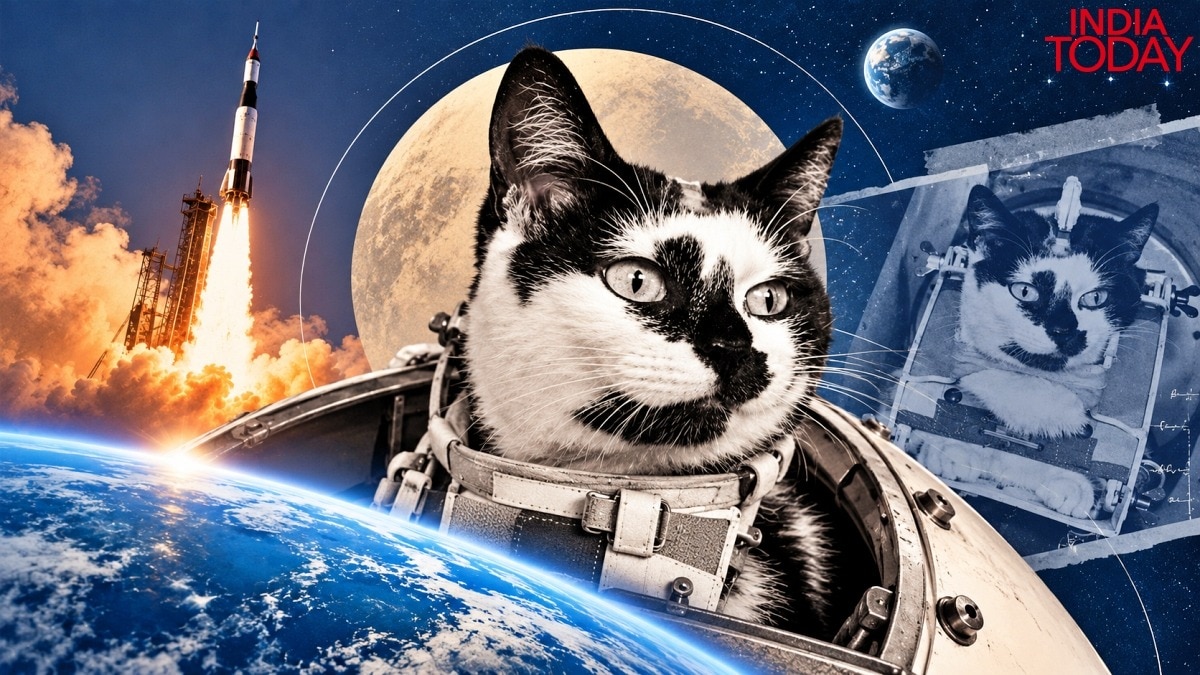
New Delhi: On a chilly October morning in 1963, a small black-and-white cat made history by traveling farther from Earth than most living creatures at the time. She returned alive, having crossed the boundary of space and experienced a brief period of weightlessness, but the stray cat known as Felicette could not have anticipated the tragic conclusion waiting for her back on Earth.
Felicette became the first and to date the only cat to travel to space and return alive. Her flight formed part of France's pioneering efforts to understand how living organisms respond to spaceflight, an era when scientists raced to determine whether humans could safely venture beyond the atmosphere.
Originally gathered from the streets of Paris alongside other stray cats for France's space research program, Felicette underwent selection and training to prepare for the stresses of launch. On October 18, 1963, she launched aboard a Veronique AGI sounding rocket from a site in the Sahara Desert located in then-French Algeria.
The rocket carried her to an altitude of roughly 157 kilometers, crossing the internationally recognized boundary of space. For approximately five minutes, she experienced weightlessness while electrodes implanted in her skull transmitted data regarding her brain activity back to researchers.
Her capsule was successfully recovered about 13 minutes after launch, making her a survivor of a journey that claimed the lives of numerous other animal pioneers. However, her survival did not guarantee a peaceful retirement.
Roughly two months after her historic flight, researchers euthanized Felicette to examine her brain and study the neurological impacts of the mission. Although the procedure aimed to gather vital data, it ultimately yielded limited useful insights.
A subsequent feline space mission launched on October 24, 1963, ended in failure with the loss of the animal. For decades, Felicette received minimal public recognition compared to other celebrated space animals, though her legacy was later honored with a bronze statue unveiled at the International Space University in Strasbourg, France, in 2019.