


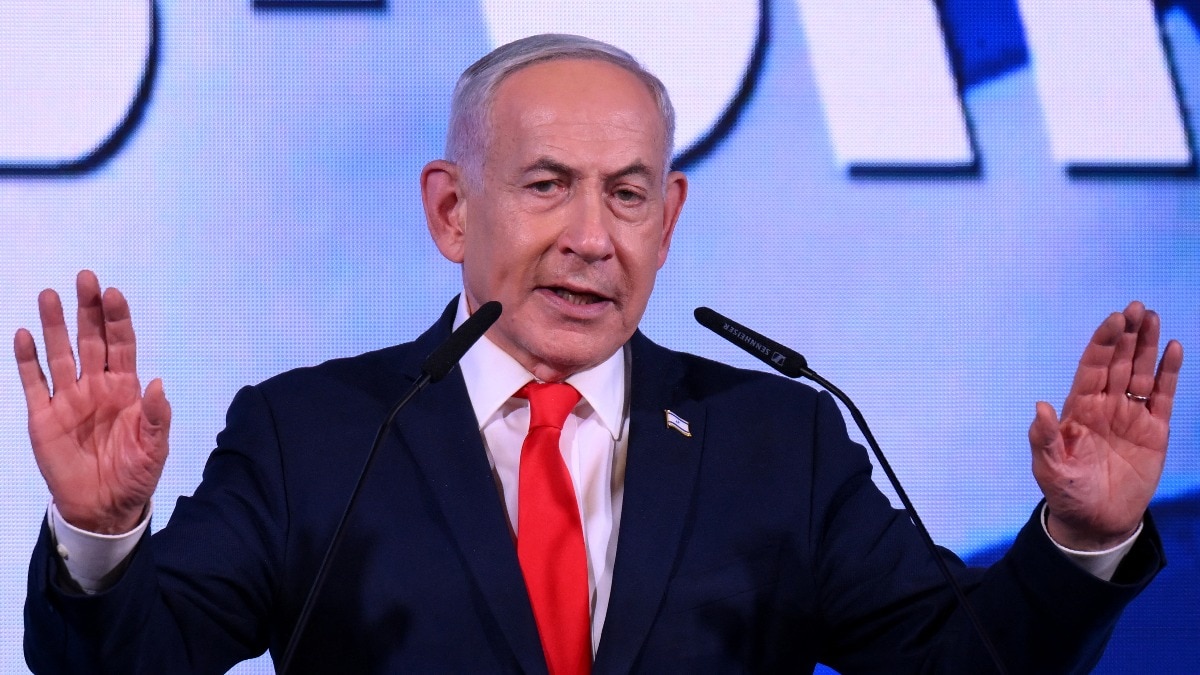
As a strong Arab turnout threatens Netanyahu's government, he stepped up attacks on Ra'am and the Joint List. He also hit out at main rival Gadi Eisenkot's bloc, which may need their support to form the government.Israel election will determine Benjamin Netanyahu's political future (AFP) Israeli Prime Minister Benjamin Netanyahu has ruled out joining hands with Arab parties after exit polls showed no clear winner in the country’s first elections since the October 7, 2023 Hamas attack, leaving both his alliance and the opposition short of a parliamentary majority.Netanyahu’s remarks came amid speculation that two leading Arab parties could emerge as kingmakers after an unexpectedly strong showing in Tuesday’s high-stakes polls.
He accused them of serving Israel’s enemies and declared that an alliance with them was out of the question."It is simply forbidden to endanger Israel and form a government that rests on anti-Zionist Arab parties. Parties that oppose our very existence, that see Hamas as a charitable organisation, that call our soldiers war criminals," he said during a late-night address at his Likud party headquarters.Exit polls showed that the United Arab List, or Ra’am, and the Joint List are likely to nearly double their combined representation in parliament to 18 seats.
Their leaders had rallied supporters to help oust the country’s longest-serving prime minister. Israelis voted in the largest numbers in a generation on Tuesday.
Exit polls suggested that the opposition bloc was roughly even with Netanyahu’s alliance in what many described as a make-or-break moment for the country.Neither Netanyahu nor his main rival, Gadi Eisenkot, appeared close to the 61 seats needed for a majority in the 120-seat parliament, the Knesset. With his government facing the possibility of being brought down by a result shaped by strong Arab turnout, Netanyahu stepped up his attacks on Ra’am and the Joint List.
He also targeted Eisenkot’s bloc, which may seek an alliance with the parties to secure a majority."How can you talk about an alliance of those who serve while you join hands with those who attack the very people who serve, the soldiers of the IDF? This is the Islamic Movement -- anti-Zionist parties that still advocate the elimination of the state.
And you talk about an alliance of those who serve -- with them? A shame and a disgrace," Netanyahu said."This thing must not be allowed to take shape," he warned.Despite the lack of a clear winner, Netanyahu struck a triumphant tone, asserting that Likud remained Israel’s largest party.Vote counting in Israel is expected to continue for days, and likely followed by drawn-out haggling to form the government.
But entering a coalition with Arab participation is a fraught prospect.Of the two Arab parties, only Ra’am has previously joined a coalition government. It did so in 2021, becoming part of the short-lived anti-Netanyahu coalition led by then-Prime Minister Naftali Bennett.If Eisenkot falls short of a majority, he may need to negotiate with both Arab parties.
Talks with the Joint List, projected to win at least 10 seats, could prove more difficult.Eisenkot has set four conditions for cooperation: recognition of Israel as a Jewish and democratic state, acceptance of the values of its Declaration of Independence, support for conscripting Arab citizens currently exempt from military service, and condemnation of Hamas as a terrorist organisation.Amjad Shbita, general secretary of Hadash, the socialist party that forms the largest faction within the Joint List, said Eisenkot would not be in a position to dictate terms.- Ends