


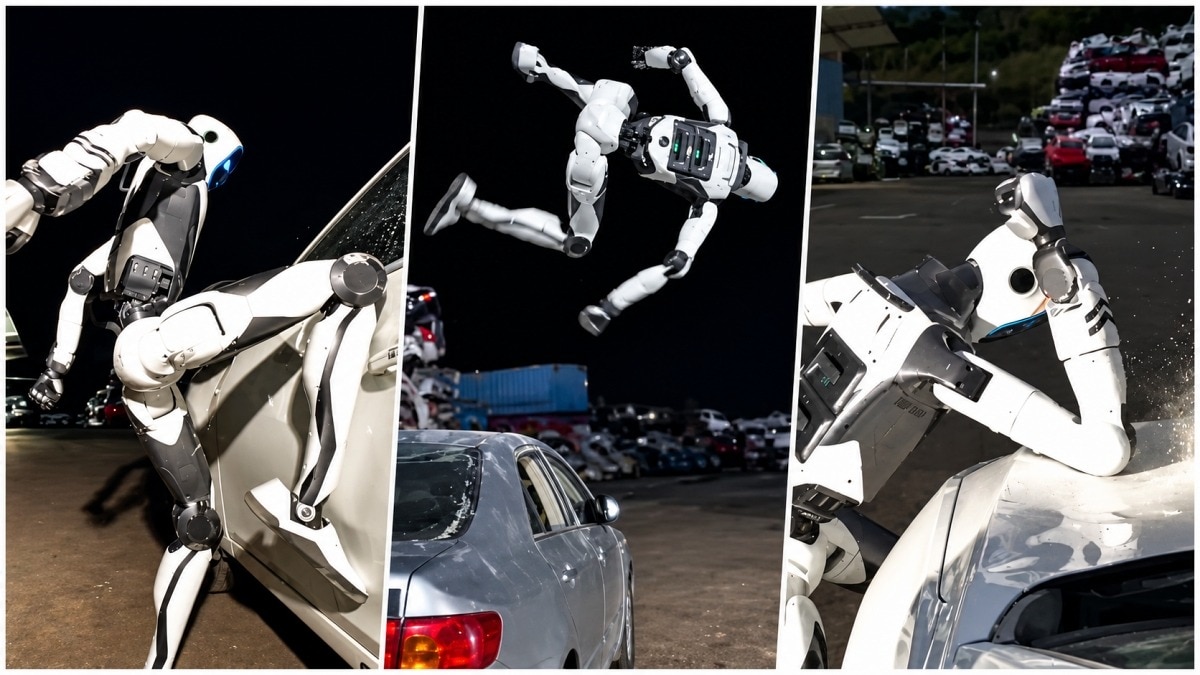
China's Unitree has unveiled the H2-X humanoid robot performing kicks, flips, drops and vehicle-lifting feats. The demonstration highlights advances in dynamic control while underscoring the need for strict safety measures.Videos showcasing its capabilities feature martial-arts-inspired movements, high-impact manoeuvres and impressive displays of physical force.
Imagine a robot that can deliver spinning kicks, perform acrobatic flips, survive a four-metre drop and even lift the front of a car. It sounds like a scene straight out of a science-fiction film, but China's robotics company Unitree is showcasing just how far humanoid robots are pushing the limits of physical performance.The company has introduced the H2-X Kung Fu Legend Guardian, a robot presented as a powerful machine designed to demonstrate strength, agility and endurance.Videos showcasing its capabilities feature martial-arts-inspired movements, high-impact manoeuvres and impressive displays of physical force.Unitree Introducing: H2-X Kung Fu Legend Guardian Powerful performance to serve and guard you, with a maximum endurance of approximately 8 hours.
Please use the robot safely and in a friendly manner. https://t.co/5RU5kDzSUK— Unitree (@UnitreeRobotics) October 21, 2026From spinning kicks and flips to withstanding drops from significant heights, the robot appears designed to show how advanced robotic systems can combine balance, coordination and power. Demonstrations also show it delivering enough force to dent car doors and lifting the front end of a vehicle.
Unitree describes the machine as a powerful performer intended to serve and guard people, claiming a maximum endurance of approximately eight hours.However, the company has also urged users to operate the robot safely and in a friendly manner, an important reminder as increasingly powerful machines move beyond controlled laboratory environments.CHINA'S HUMANOID ROBOT RACE The unveiling comes amid China's growing push to develop humanoid robots capable of performing increasingly complex physical tasks.Companies are working to improve robotic balance, movement, manipulation and the ability to operate in environments designed for humans.Humanoid robots require a combination of sophisticated hardware and software to perform such manoeuvres. Electric motors and actuators generate movement, while sensors and control systems help maintain balance, coordinate limbs and respond to changes in position.Performing a spinning kick or recovering from a landing is particularly challenging because the robot must manage its centre of mass and distribute forces across its body without losing stability.Such demonstrations can help showcase advances in locomotion and dynamic control.
However, impressive physical stunts alone do not establish how well a robot would perform in everyday settings or real-world security operations.The capabilities displayed by machines such as the H2-X raise questions about how humanoid robots could eventually be deployed in industrial work, hazardous environments, inspection and security-related roles.But powerful robots also present safety challenges. High-force movements, heavy components and unpredictable interactions with people or objects require strict operating controls.- Ends