


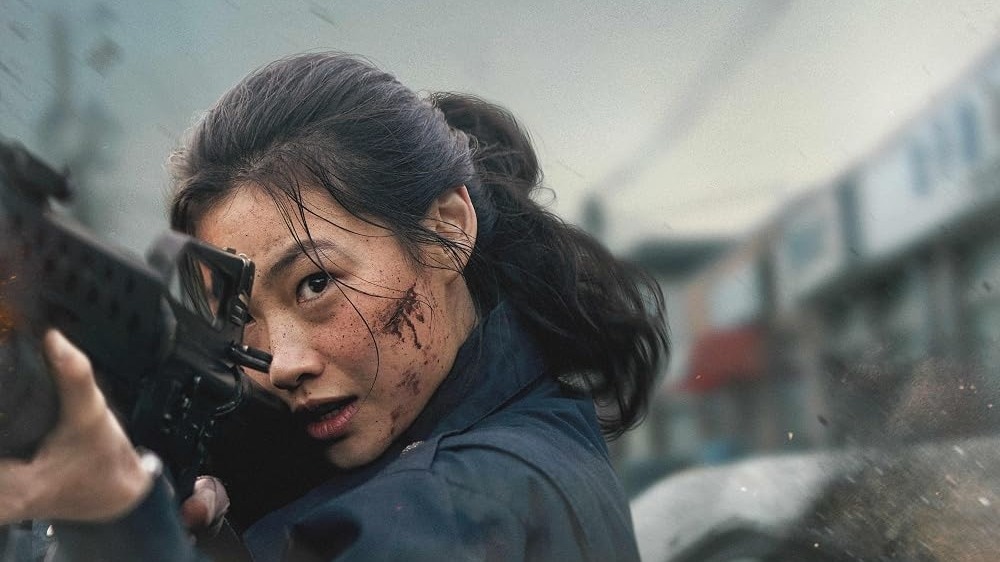
Na Hong-jin is notorious for pushing audiences to the edge with his storytelling. With Hope, he takes that impulse to delirious extremes, beginning with the sort of rural mystery that thrives on dread and steadily mutating into something altogether more outlandish.
A monster movie, an alien-invasion thriller, a dark comedy about masculine posturing — the film is all these things and more, sometimes encapsulating them all in a single scene. It is also a film of maddening contradictions: audacious yet overindulgent, genuinely unnerving yet frequently ridiculous, and so determined to surprise that it occasionally loses sight of what made it compelling in the first place.Set in a remote South Korean town near the Demilitarised Zone, Hope opens with an image of brutal violence: a mutilated bull, a community on edge, and a growing sense that something inexplicable has descended upon this otherwise unremarkable place.
Police chief Bum-seok (Hwang Jung-min) attempts to make sense of the mounting destruction, aided by his deputy Sung-ae (Hoyeon), while hunter Sung-ki (Zo In-sung) and his companions venture into the surrounding woods to confront the threat. What follows is less a straightforward investigation than a gradual unravelling of the community’s assumptions about the nature of the danger and its own capacity — or inability — to deal with it.Na, whose The Wailing remains a formidable exercise in sustained paranoia, knows that the most effective horror often lies in the space between what is seen and what is imagined.
Hence, for much of Hope’s first hour, the threat announces itself through its aftermath: ravaged landscapes, bodies, bewildered witnesses, and violence that seems to erupt from nowhere. The camera navigates this mounting disorder with terrific fluidity, keeping us close to Bum-seok as he attempts to impose logic on events that stubbornly refuse to cooperate.
The tension comes not simply from the prospect of another attack, but from the uncomfortable suspicion that nobody — least of all those tasked with protecting the town — has any real understanding of what is happening.It is a superbly calibrated opening, one that makes uncertainty feel like a narrative engine rather than a temporary inconvenience. Na allows the mystery to build before delivering a revelation that radically alters the film’s terms.
The shift is startling, and it is here that Hope reveals both its greatest strength and its most persistent weakness: an almost childlike delight in breaking things apart without always knowing what to build in their place. What distinguishes the film from a more conventional creature feature is its scepticism towards the humans at its centre.
Faced with a threat they cannot comprehend, the townspeople reach for the familiar comforts of aggression, authority, and weaponry. Understanding is harder; violence, at least, offers the reassuring illusion of control.
Na finds a rich vein of satire in this reflex, exposing the absurdity of men who mistake bluster for courage and firepower for competence. The monster may be the most immediately visible danger, but the collective response to it is hardly reassuring.
Hwang plays Bum-seok as a man whose instinct for command routinely exceeds his ability to control the situation. Zo brings the requisite swagger to Sung-ki, although the character’s increasingly shaky grip on events makes that bravado an object of amusement as much as admiration.
Hoyeon, meanwhile, provides the film with a welcome counterpoint. Her Sung-ae is composed and resourceful without being sanctified by the narrative, and the actor brings a dry, understated humour to a film that might otherwise become exhausting in its insistence on escalation.Indeed, humour is what gives Hope much of its peculiar charge.
Na is perfectly willing to follow a gruesome encounter with a moment of near-slapstick, allowing his characters to look spectacularly foolish just when they seem most convinced of their own heroism. These tonal collisions can be exhilarating.
They puncture the familiar cinematic fantasy of the competent, gun-toting man who will restore order through sheer force of will. In Na’s world, authority is often theatrical, bravery is frequently indistinguishable from stupidity, and the people most eager to declare war on the unknown are rarely the ones best equipped to understand it.But a film can be gloriously unpredictable and still be dramatically undisciplined.
Running close to two hours and 40 minutes, Hope gradually begins to confuse escalation with progression. Its second half stretches confrontations and chases long after their initial impact has worn off, while the increasingly elaborate science-fiction mythology offers diminishing returns.
The more the film explains, the less mysterious it becomes; the more it insists on raising the stakes, the less invested one feels in the outcome. What initially seemed like a carefully controlled descent into chaos begins to resemble chaos for its own sake.This is particularly frustrating because Na has already established how effective restraint can be.
The film’s early passages draw their power from incomplete information and the characters’ inability to make sense of their surroundings. As the narrative grows more explicit, that uncertainty is replaced by a succession of increasingly extravagant developments.
Not all of them are without interest, but the accumulation of ideas comes at the expense of emotional and dramatic momentum. The film seems reluctant to leave any possibility unexplored, even when doing so would have made the central conflict sharper.The uneven visual effects compound the problem.
There are flashes of genuinely striking creature design, but other sequences struggle to convince, undermining the scale and ferocity that the filmmaking demands. The presence of Michael Fassbender, Alicia Vikander, and Taylor Russell adds an intriguing international dimension, although their characters are not afforded enough room to register as substantial dramatic presences.
Their casting suggests a wider canvas than the film ultimately manages to fill. And yet, Hope remains difficult to dismiss, precisely because its excesses are inseparable from its appeal.
Na is at his most incisive when the creature becomes less important than the human behaviour it exposes — when panic hardens into prejudice, bravado masquerades as leadership, and the impulse to destroy arrives long before the effort to understand.The title, Hope, feels almost mischievous in this context. There is little comfort to be found in a film where survival depends as much on human folly as on the nature of the threat itself.Hope has now been released in India in English- and Hindi-dubbed versions.- Ends