


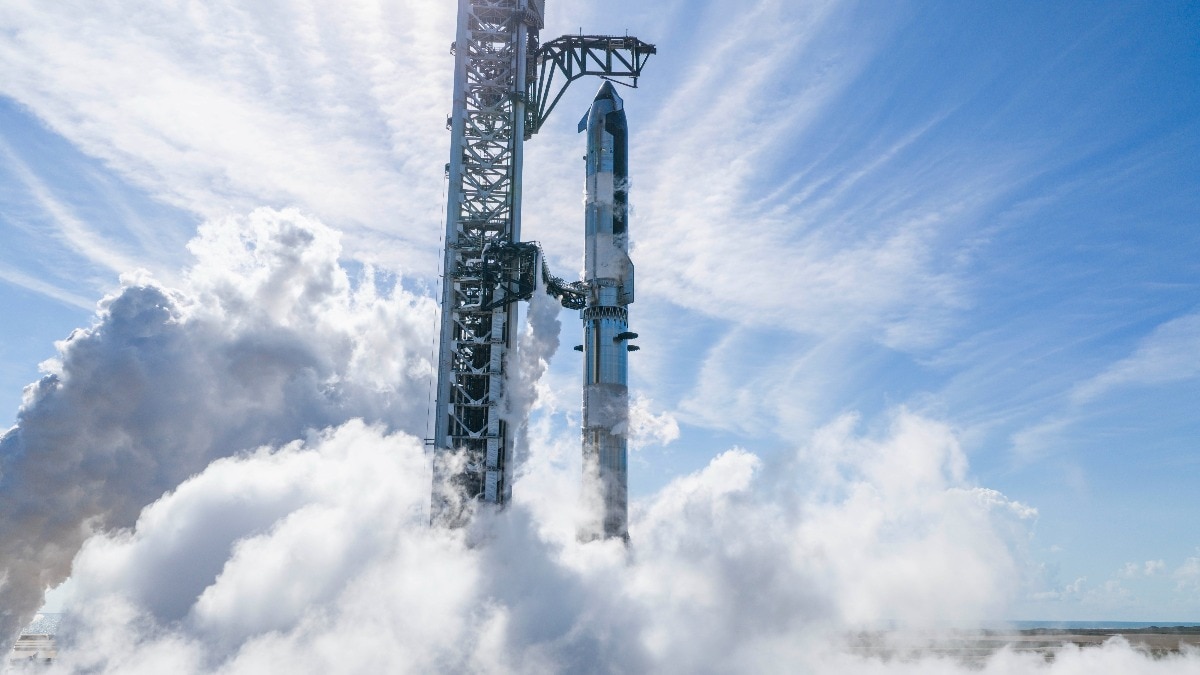
SpaceX is preparing to launch its massive Starship rocket for a test flight that could represent a significant turning point in the company's drive toward fully reusable space transportation. The upcoming mission aims to accomplish an unprecedented feat by bringing both primary stages of an orbital rocket back to the launch facility to be secured by large mechanical arms.
The 75-minute launch window is set to open from the Starbase facility in Texas, though the exact timing remains contingent upon final regulatory clearance. SpaceX typically begins its public streaming coverage approximately 30 minutes prior to liftoff.
The Starship vehicle is comprised of two distinct components. The Super Heavy booster provides initial propulsion for the journey into space, while the upper-stage spacecraft, known as Ship, handles the remainder of the orbital transit. Both hardware pieces are built to be reusable.
Following stage separation, the Super Heavy booster is scheduled to orient itself and fly back to the launch mount, where engineers hope to capture it using the launch tower's mechanical arms, affectionately nicknamed chopsticks. This maneuver is projected to take place roughly six and a half minutes after the rocket leaves the pad.
Meanwhile, the upper-stage Ship is expected to climb to an altitude of approximately 275 kilometers and complete about 14 orbits around the globe across a flight duration exceeding 22 hours. During this journey, it will deploy 26 next-generation Starlink V3 satellites before initiating its own return sequence and landing attempt.
While SpaceX has successfully caught returning Super Heavy boosters on three prior occasions, the company has never before attempted to catch the upper-stage Ship. If both recovery efforts succeed, it will mark the initial full recovery of an entire orbital launch system. The attempt will automatically be aborted if the vehicle fails to clear mandatory safety protocols.
Because of the extended orbital profile, Starship's flight path will also carry it over parts of India multiple times as the planet rotates underneath it. Operating in low Earth orbit at an altitude of about 275 kilometers, the spacecraft will not travel through the atmosphere like a conventional airplane, though its passage may provide viewing opportunities for skywatchers depending on local visibility and timing.
This mission builds directly on the achievements of Flight 14, which launched earlier in the year and successfully completed Starship's first orbital flight while deploying 26 Starlink V3 satellites. During that previous test, the booster splashed down in the Gulf of Mexico while the Ship returned toward the Pacific Ocean.
By attempting to bring both structures back to Starbase for Flight 15, SpaceX hopes to gather critical telemetry data regarding full system recovery and rapid reusability. These capabilities remain foundational to the company's long-term objectives for future lunar and Martian exploration.