


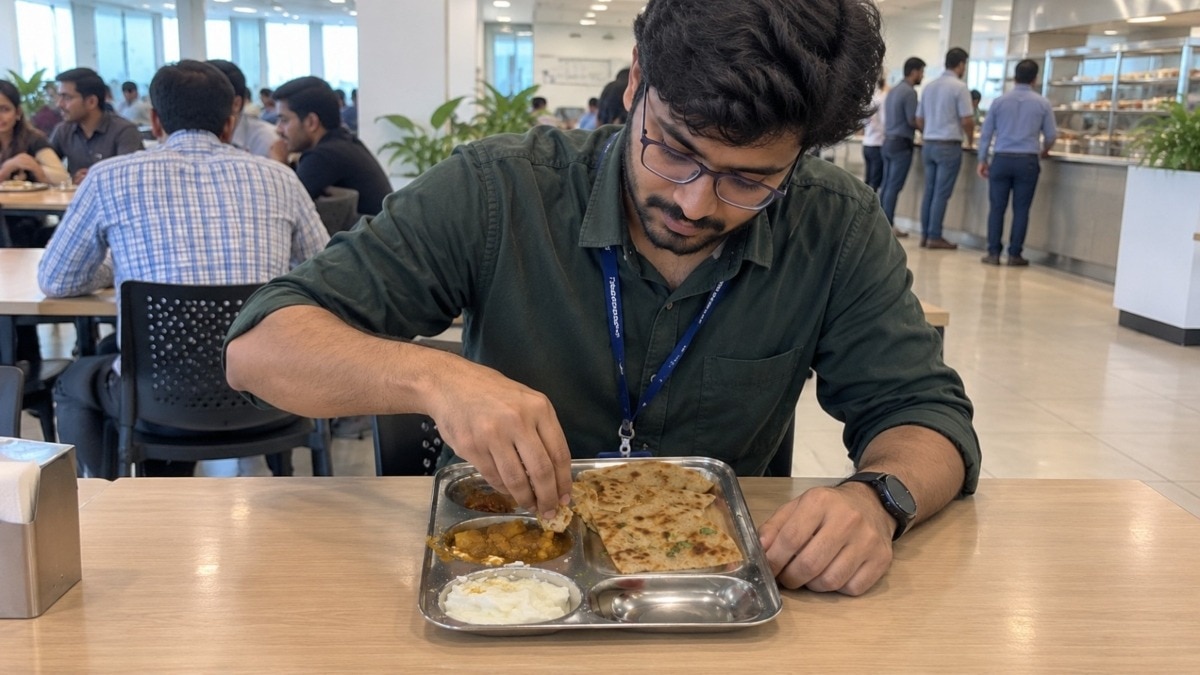
From samosas and bread pakodas to oily curries and carb-heavy breakfasts, the everyday office canteen menu in many Indian offices is increasingly at odds with employees' growing focus on nutrition, protein and healthier eating.Many Indian employees struggle to find healthy, nutritious, and affordable meal options at their workplaces.For many employees, the workday begins with a familiar dilemma: what can I eat at the office that is filling, affordable and actually good for me?The options at office canteens are often predictable. Samosas, bread pakodas, bun maskas and vada pavs occupy prime counter space.
Breakfast menus feature poha, upma and aloo-pyaaz parathas. Lunch is usually a choice between a thali, a rice preparation or a couple of curries with rotis.
There is rarely a shortage of food. The real question is whether there is enough of the right kind of food.For employees trying to eat better, meet their daily protein requirements, manage their weight or simply avoid the afternoon energy slump, the everyday canteen menu can be a challenge.A new survey by Compass Group India, Global Eating at Work, based on 2,000 responses, highlights this growing disconnect.
It finds that 90% of employees across generations want healthier food options at work. The finding reflects a larger shift in how people view workplace wellbeing: food is no longer just about keeping employees fed during working hours.
It is increasingly being seen as an important part of how they feel, think and perform through the day. Several multinational companies have invested in elaborate workplace cafeterias, offering multiple cuisines, salad bars, live counters, fresh fruit, lean proteins and customised meals.
But this experience is far from mainstream. In many offices, particularly those with smaller or outsourced canteen facilities, healthier eating remains an expensive or inconvenient proposition.When the affordable option isn't the healthy oneConsider the employee who depends almost entirely on the office canteen for breakfast and lunch.
Carrying home-cooked food may not be practical for someone with a long commute, an early start, limited time in the morning or no access to refrigeration and reheating facilities. For such employees, the canteen is not an occasional convenience.
It is their everyday food source."For me, the safest bet that is also cheap is boiled eggs with toasted bread for breakfast. But even I get bored of eating that every morning," says an advertising employee trying to make more conscious food choices.The alternatives aren't particularly encouraging.
Poha is readily available, but can be predominantly carbohydrate-heavy, depending on how it is prepared. Upma may work as a light breakfast, but doesn't always keep someone full until lunchtime.
Aloo-pyaaz parathas are comforting, but eating them every day is hardly ideal for someone trying to balance their diet.The problem is not that these foods are inherently unhealthy. It is that the menu often lacks balance and variety.
Where are the egg bhurji options, sprouts, Greek yoghurt, low-oil besan chillas, or paneer preparations (not just curries with two measly pieces of paneer)? Where are the affordable, protein-rich alternatives that employees can actually include in their everyday meals?Lunch presents another challenge.
Traditional thalis can offer a good mix of food groups, but their nutritional value depends heavily on portion sizes and preparation. Dal and vegetable curries may be cooked with generous amounts of oil, while protein portions can be modest.
Employees are often left guessing how much protein a meal actually contains.The healthy meal comes with a premium price tagThe irony is that healthier options are not entirely missing from office cafeterias. Some canteens have introduced falafel wraps, grilled chicken with rice and vegetables, low-fat paneer chillas, salads and protein bowls.But there is another catch: affordability.A regular samosa or a plate of poha may cost a fraction of what a grilled chicken bowl or a paneer wrap does.
For someone buying breakfast and lunch five days a week, that difference adds up quickly."A paratha, a plate of aloo puri, or a plate of macaroni costs me under Rs 50, but a paneer sandwich is priced at Rs 90 in my office canteen," a Noida-based professional tells us talking about the breakfast woes.An employee may be happy to spend extra on a nutritious meal occasionally, but making it a daily habit is a different proposition. If a healthier lunch costs significantly more than a standard thali, it is hardly surprising that people return to the cheaper option.The question, then, is not simply whether offices offer healthy food.
It is whether they offer healthy food that employees can afford to eat regularly.And for those working in offices that don't have cafeterias at all, the conversation is an entirely different one. Employees on modest salaries, who have to step out to find affordable meals or depend on roadside eateries and nearby food stalls, may not even have the luxury of choosing between a plate of roadside rajma-chawal and a balanced thali.
For them, the challenge is finding a reasonably priced, hygienic and filling meal within a limited lunch break. Asking them to prioritise nutrition without addressing access and affordability would be missing the point altogether.The samosa-and-chai culture of office celebrationsThere is another aspect of workplace eating that often escapes the conversation around nutrition: food at office celebrations.A team completes a project, someone gets promoted, a colleague celebrates a birthday or a festival brings everyone together.
What is the default order? Samosas and chai.
Samosa party! Image for representation purpose.
Credit: Getty The familiar samosa-and-chai party has become almost synonymous with office celebrations. Sometimes it is followed by biscuits, cake or other fried snacks.
While there is nothing wrong with enjoying these foods occasionally, the fact that they are often the automatic choice says something about workplace food culture.Even celebrations could offer greater variety. A combination of sandwiches, fruit platters, dhokla, sprouts chaat, baked snacks and yoghurt-based options could provide alternatives without taking away the social element.
The idea is not to eliminate samosas from the workplace. It is to ensure that they aren't the only option employees are offered.Small changes could make a big differenceEmployees spend a significant part of their waking hours at work, and the food available during that time inevitably influences their eating habits.
The workplace can therefore become an important platform for building healthier routines.This does not necessarily require a gourmet cafeteria or a completely redesigned kitchen. For starters, office canteens could ensure that every meal category has at least one affordable, protein-rich option.
Breakfast menus could include boiled eggs, egg bhurji, besan chilla, sprouts and curd alongside the regulars.Lunch counters could offer dal prepared with less oil, adequate portions of paneer, eggs or chicken, and vegetable preparations that are not excessively greasy. Nutritional information, particularly protein content, could help employees make better choices.Snack counters could move beyond fried foods and include roasted chana, makhana, nuts, fruit, yoghurt and sandwiches with balanced fillings.
Employers could also work with cafeteria vendors to ensure healthier dishes are priced competitively.The larger point is that workplace wellness cannot be limited to gym memberships, step-count challenges or annual health check-ups. It has to extend to the everyday decisions employees make, including what they eat between meetings and during their lunch breaks.If 90% of employees want healthier food choices at work, the message is fairly clear.
The demand exists. The challenge is to make nutritious food accessible, affordable and appealing enough to become part of the everyday office menu.After all, employees shouldn't have to choose between eating within their budget and eating well.
And a workplace that talks about employee wellbeing must also ask a rather basic question: what are we serving them for lunch?- Ends