


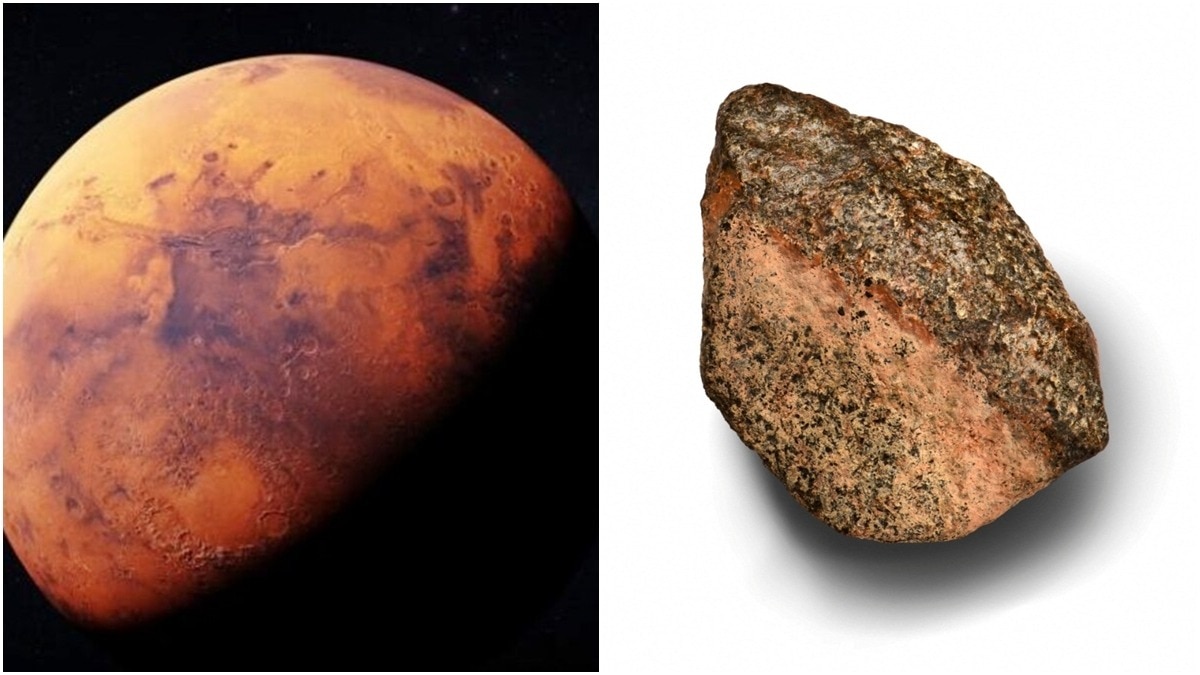
Named Teghaza 001, the 4.1-billion-year-old Martian meteorite provides evidence of water interacting with rocks deep beneath the planet's surface.Named Teghaza 001, the meteorite was found in 2022 in eight pieces. A meteorite discovered in the Sahara Desert has been dated to at least 4.1 billion years ago, making it potentially the oldest known piece of Mars ever found on Earth.More than just an ancient rock, the discovery provides evidence that water once reached deep beneath the Martian surface, strengthening the possibility that the planet may once have had conditions suitable for life.Named Teghaza 001, the meteorite was found in 2022 in eight pieces in Mali, about 34 km from the village of Bir Chali, with its largest fragment roughly the size of a human fist.The findings were published in the journal Science.
Teghaza 001, a rose-colored rock that is among the oldest Martian meteorites ever found on Earth. WHAT DOES THE ANCIENT ROCK FROM MARS TELL US?Scientists found that the rock, a type formed when molten material cools slowly beneath a planet's surface, had interacted with water as it formed.The clues that led to the discovery came from different forms of hydrogen and oxygen preserved in the rock's minerals.
The evidence suggests water was moving down through Mars' outer rocky layer more than 4.1 billion years ago, mixing with hot molten rock from deeper inside the planet. Researchers studied tiny zircon crystals in the rock.
Nasa planetary scientist Yang Liu, who led the study, described the meteorite to news agency Reuters as “a snapshot in time” of an early Mars that was likely warmer and wetter than the planet has been for much of its history.Researchers worked out its age by studying tiny zircon crystals in the rock. These contain uranium, which slowly changes into lead over time, allowing scientists to estimate when the minerals formed.WAS THERE LIFE ON MARS?Water is considered essential for life as we know it, but finding evidence of ancient water does not establish that living organisms ever existed on Mars.Study co-author Lee Saper said the findings support the idea that early Mars had the ingredients and conditions needed to support life, but do not answer whether life actually existed there.Today, Mars is cold, dry and largely barren.
However, evidence from its surface points to a very different past, when rivers and lakes flowed and an ocean may have existed in its Northern Hemisphere.IS THE DISCOVERY IMPORTANT?Of the 435 meteorites from Mars known on Earth, only three date to the planet's earliest history.Teghaza 001 may be the oldest of them, offering scientists a rare opportunity to study what Mars was like in its infancy.The rock was blasted off Mars by an impact, travelled through space and eventually entered Earth's atmosphere before landing in the Sahara.Scientists do not know when it reached Earth.Such meteorites provide rare physical samples that can be studied in laboratories, adding to what spacecraft, landers and rovers have revealed about the Red Planet.- Ends