


Jaipur, the pink city has been front and centre of India's ever evolving tryst with culture, we go looking for all stories that make it interesting.Exploring Jaipur’s rich heritage, historic landmarks and vibrant culture behind the wheel of the VinFast VF 7.Jaipur,Oct 30, 2026 17:02 ISTThe dashboard of the VinFast VF 7 glowed a soft, electric blue, casting a muted light over the interior as we glided through the pre-dawn hush of Jaipur. It was 5 AM, Dr.
Chandni Choudhary had promised, the city wakes up differently. “Heritage,” Chandni said, her voice cutting through the quiet hum of the EV’s motor, “is the most democratic thing we have. You buy a ticket, and for a brief time, you walk the exact same steps as kings.” We were heading toward the Govind Dev Ji Temple, the spiritual epicenter from which the entire grid of Jaipur originally unfurled.
By 5:30am, the temple courtyard was alive. At 5:30 AM, morning hymns fill the Govind Dev Ji Temple, marking the beginning of another day in Jaipur.
At 5:30 AM, morning hymns fill the Govind Dev Ji Temple, marking the beginning of another day in Jaipur. It wasn’t a jarring commotion, but a gradual crescendo of morning hymns that felt less like an alarm clock and more like a natural awakening.
Chandni explained that for three centuries, this was how a true Jaipuraite started their day—harnessing the cool, early hours to beat the fierce desert sun. It was an ancient blueprint for work-life balance that felt entirely foreign to my modern, chaotic sensibilities.
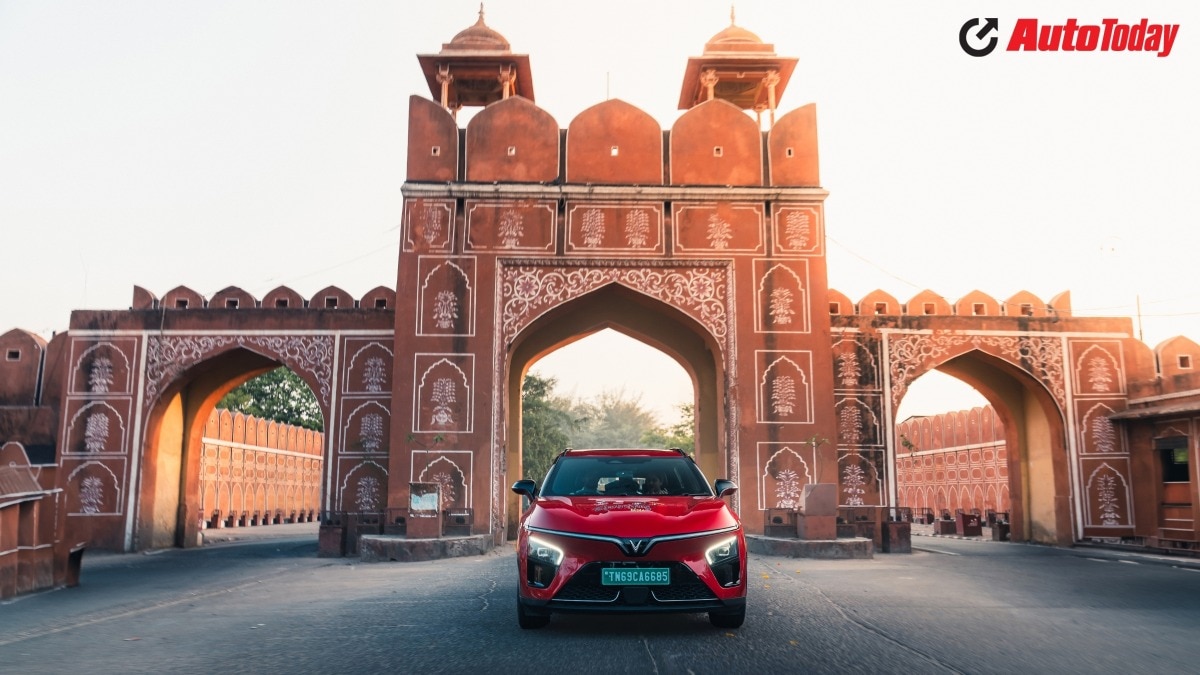
Leaving the temple, the VF 7 handled the ancient corridors of the city with an almost ghostly quietness. We passed under the towering arches of the Zorawar Singh Gate—originally called Dhruv Pole, one of the seven original entry points built by Maharaja Sawai Jai Singh II.
Looking out at the uniform facades flanking the streets, I asked the question every outsider harbors: Why pink? Chandni smiled.
Leaving the temple, the VF 7 handled the ancient corridors of the city with an almost ghostly quietness. Leaving the temple, the VF 7 handled the ancient corridors of the city with an almost ghostly quietness. “Think about the desert sun.
If you paint the city in white or light colors, the glare is blinding. The dark terracotta absorbs the harsh light, soothing the eyes.
Plus, it gave the glorious illusion that the entire city was built from expensive red sandstone.” As the first rays of the sun cut through the morning haze, we pulled up beside a massive, still body of water. Rising from its center like a mirage was the Jal Mahal.
Most people don’t associate Jaipur with vast lakes, but this low-lying valley was designed to catch mountain runoff. The palace itself, a pleasure pavilion built for royal waterfowl shooting, appeared to float.
Chandni pointed out the stylistic blend of Mughal domes and arches, a testament to builders trained in the grand traditions of Fatehpur Sikri. We pushed the EV further into the hills, transitioning from the wide, motorable roads built less than a century ago for modern cars to the older, steeper pathways.
Our destination was Amer Fort, a colossal structure cradled by the Aravalli range. Standing before its pale yellow walls, the sheer scale of time hit me.
The oldest sections dated back to the 11th century. By the 18th century, Sawai Jai Singh II realized the kingdom had outgrown the valley’s natural defenses.
He needed space, a grander vision, and so, he looked to the plains below and conceptualized Jaipur. But you cannot truly understand Jaipur without visiting its heart.
We drove back into the walled city, the terracotta walls closing back in around us, until we stood before the breathtaking facade of the Hawa Mahal. Built in 1799 by Sawai Pratap Singh—a man who patronized sublime art and poetry even while Maratha armies threatened his gates the five-story structure resembled the delicate crown of Shri Krishna. “Why is it called the palace of winds?” I asked, looking up at the hundreds of tiny, latticed windows (jalis).“Science,” Chandni replied simply. “It’s the Venturi effect.
When hot air is forced through these tiny openings, it compresses and cools down. Even in the scorching heat of June, a cool breeze flows through here.” It was a magnificent contradiction: a structure built to shield royal women from public view, yet engineered to let the entire world breathe through it.
Our final stop was Badi Chaupar, a massive square intersection inspired by the ancient Chaupar board game from the Mahabharata. Chandni pointed down at the asphalt. “In 1727, this was a step-well.
You couldn’t build a city without a public water network.” She paused, letting the noise of the traffic wash over us. “Today, that same network doesn’t move water—it moves people. The Jaipur Metro runs directly underneath us.” We wrapped up the morning with hot Pyaaz ki Kachoris, sweet Lassi and golden Jalebis at Jaipur's iconic Samrat.
We wrapped up the morning with hot Pyaaz ki Kachoris, sweet Lassi and golden Jalebis at Jaipur's iconic Samrat. We ended our journey at Samrat, a legendary local spot, nursing the adrenaline of the morning with piping hot Pyaaz ki Kachoris, thick sweet Lassi, and loops of golden Jalebis.
Sitting there, watching the bustling energy of a city built for 5,000 that now seamlessly holds hundreds of thousands.