


New Delhi: On Saturday, all roads leading to central Delhi were deserted, save for a heavy presence of police officers, paramilitary personnel, and reporters. Strict vehicle checks at Delhi's borders and hundreds of preventive detentions over the preceding 48 hours ensured that anyone managing to reach near Jantar Mantar to protest against Chief Election Commissioner Gyanesh Kumar was met with a massive wall of security. The sweeping measures effectively prevented the demonstration from taking off, though its impacts resonated far beyond the capital.
The clampdown followed intense memories of the chaos and violence during the July paper leak protests, which internal assessments by the Delhi Police attributed to a lack of precise prior intelligence regarding numbers and mobilisation. Anticipating a repeat, security agencies prepared thoroughly for the momentum building up around Jantar Mantar 2.0, which followed peaceful agitations by the Cockroach Janta Party in Mumbai and Bengaluru.
Well before October 10, approximately 221 companies of Central Armed Police Forces, translating to roughly 23,000 personnel, were deployed across Delhi, supplemented by additional forces brought in from Jammu and Kashmir and Chhattisgarh. This deployment significantly exceeded the scale seen during the CJP's July agitation and the 2020-21 farmers' protests.
All approaches to Jantar Mantar were sealed off using layers of barricades linked by metal chains. Barricades were erected at 37 points across a two-kilometre perimeter to prevent infiltration, while spike strips were laid out on roads to restrict vehicle movement. Additionally, 45 metro stations were shut down, rendering central Delhi and surrounding areas virtually inaccessible to potential protesters.
Commuters faced severe travel restrictions as operating stations forced long walks to central locations, and auto-rickshaws largely refused to ferry passengers toward Connaught Place. Buses and vehicles carrying young passengers were frequently stopped and questioned about their destinations.
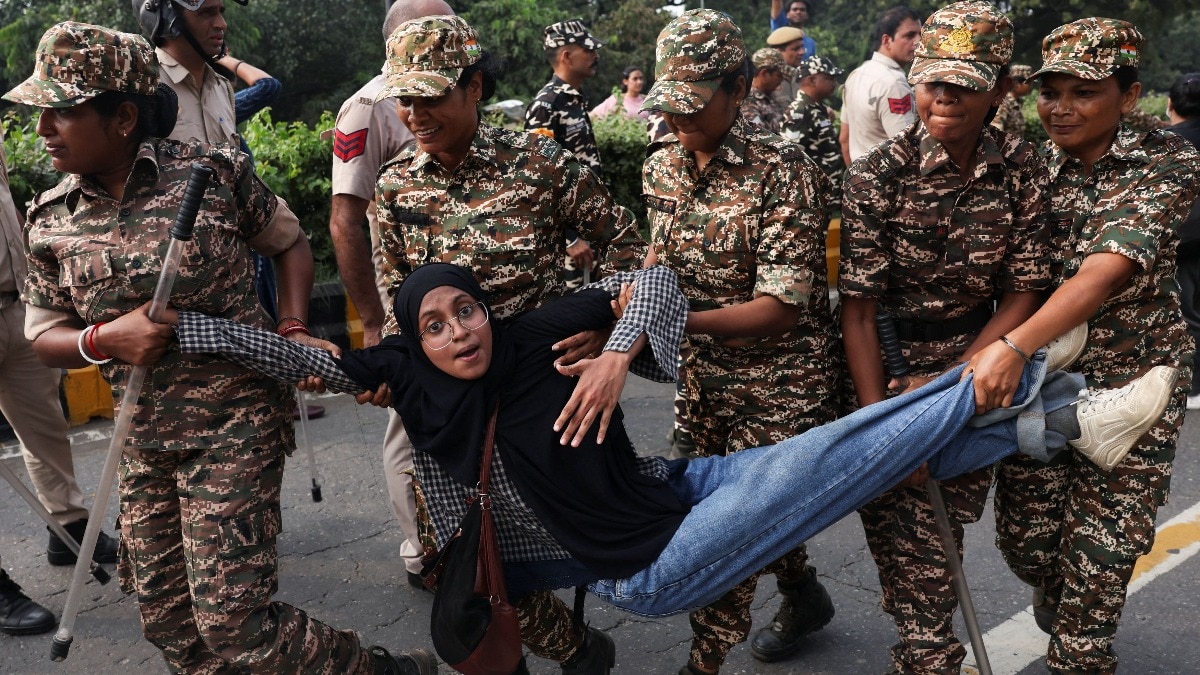
Because of the heavy security blanket, the protest struggled for ground momentum. Visuals showed security personnel vastly outnumbering the few demonstrators who attempted to march, with teams of six to eight officers surrounding single protesters and dragging them toward waiting buses. Authorities detained over 3,000 people from across Delhi on Saturday alone, while the CJP estimated the detained figure to be above 10,000.
Key figures associated with the movement were targeted early. YouTuber Dhruv Rathee was detained from his Gurugram residence on Saturday morning, and CJP legal team head Ratna Singh alleged that she and three other lawyers were surrounded by more than 25 police officers to prevent them from leaving.
Meanwhile, CJP leaders Abhijeet Dipke, Saurav Das, and Ashutosh Ranka were detained by women police officers directly from their Air India flight after landing at Indira Gandhi International Airport from Mumbai. The choice of deploying female officers inside the aircraft may have been calculated to avoid the escalation risks associated with male personnel in a confined space. The leaders were subsequently transported to separate undisclosed locations.
The crackdown extended far beyond Delhi's boundaries, intercepting suspected participants at various transit points. On Friday, at least 14 students travelling from Pune were detained at Madhya Pradesh's Itarsi station after being removed from the Goa Express, while a group of CJP volunteers from Telangana was intercepted at the Bhopal railway station.
Ultimately, the aggressive preventive strategy nipped the July-style demonstration in the bud. Jantar Mantar 2.0 failed to gain traction as security forces heavily outnumbered the few who reached the site, constrained by strict restrictions implemented since Friday night.