


"So sorry, Dilli ka show kar diya. Bada important tha Dilli ka show hona, kyuki bohot saare logon ka zor laga tha ki show naa ho...
Hum toh kar diye hain." ("So sorry, we went ahead and did the Delhi show. It was very important that the Delhi show happened because a lot of people were trying very hard to ensure that it did not.
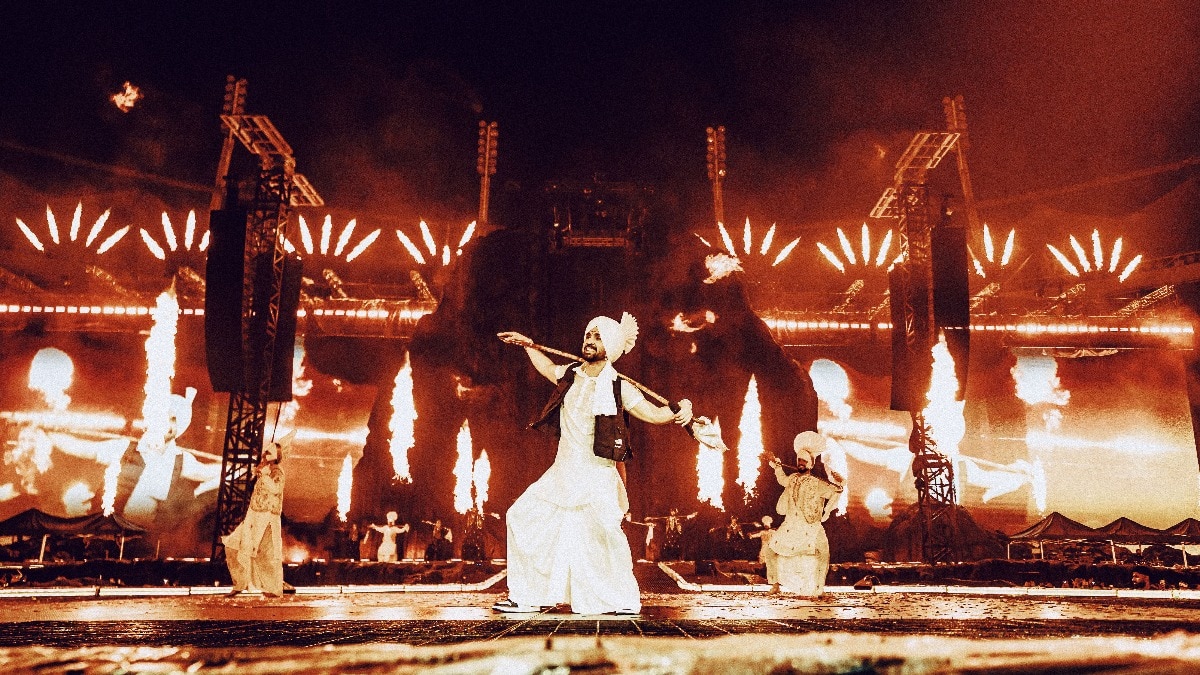
But we have gone ahead and done it.")That was Diljit Dosanjh, speaking on Instagram Live about an hour after his concert at New Delhi's Jawaharlal Nehru Stadium on Friday. The remark was cheeky, but it offered a glimpse into the attitude that had defined his two-hour-and-20-minute performance.
If there was one theme running through the evening, beyond the music and spectacle, it was rebellion.The first fan invited on stage during the opening show of his Aura India Tour was a child dressed in an outfit inspired by the one Dosanjh wore at the 2025 Met Gala. The singer had arrived at fashion's biggest night dressed as Maharaja Bhupinder Singh of Patiala, in an ensemble featuring a turban, a cape embroidered with the map of Punjab and jewellery inspired by the former ruler's collection.
The look had become so popular that children across the world began recreating it. But they were not called miniature versions of the Maharaja of Patiala.
They were labelled "mini Diljits".The outfit also has a story of its own. Dosanjh later revealed that he had managed to take his kirpan onto the Met Gala's blue carpet despite being told that it could not be carried inside as it was considered a weapon.
With Shakira walking ahead of him, her heavily embellished dress setting off the metal detector, he walked through with the kirpan concealed beneath his cape. He was reluctant to part with it because it was an integral part of his look and, more importantly, his Sikh identity.
A kirpan is one of the five physical articles of faith of Sikhism (Panj Kakke), alongside kesh (uncut hair), kangha (comb), kara (steel bracelet) and kachhera (a garment). Dosanjh's decision to carry it, and his insistence on retaining it as part of his appearance, said something about the importance he attaches to representing his identity, even on a global platform.A concert attendee, Sehaj Gill, told India Today Digital, "I think what makes Diljit stand out is that he never leaves his identity behind.
He can be on the biggest stages in the world, but still remains proudly Punjabi. That's why his concerts feel personal." Later, in the Delhi concert on Friday, two more children came on stage wearing dummy bullet belts, another recognisable element of Dosanjh's concert styling.
Pointing out their outfits, he spoke about their "rebel attitude". These interactions lasted barely a few seconds in a show that ran for more than two hours.
But they captured something essential about the global Punjabi icon. Diljit Dosanjh poses with fans on stage during the opening show of his Aura Tour at Delhi's Jawaharlal Nehru Stadium.
THE FANS WHO TURNED UP, TICKETS OR NO TICKETSThis was my fourth concert evening in 2026, after two days at the Lollapalooza festival and a John Mayer concert, both in Mumbai. Having attended concerts regularly over the past four years, I found the audience at Dosanjh's Delhi show among the most unusual and interesting I have encountered.
It, too, had a rebel attitude, albeit in a different way.Concerts are expensive. That often determines the kind of audience that can afford to attend them.
There is a certain section of concert-goers who plan their outings weeks or months in advance, book tickets as soon as sales open and organise their day around the event. Some save up specifically to see their favourite artistes.
Others have the disposable income to make the experience a regular part of their social calendar.That was not the picture outside JLN Stadium on Friday. There were fans who had arrived without tickets, hoping to find someone willing to sell an extra one or get one at a lower price.
Some were trying their luck for a last-minute deal, others, depending on the generosity of strangers. The priority was clearly not a planned concert experience.Aishwarya Singh, a Bengaluru-based entrepreneur who travelled to Delhi for the concert to watch the opening show of Aura Tour, said this kind of crowd was different from what he had generally seen at other music events across India."Be it festivals like the NH7 Weekender or Bandland or Echoes of Earth, or even independent artistes who tour India, what I have seen across the country is that fans at least buy the tickets first, even before they're sure that their tribe will turn up to the shows eventually.
Having the tickets is the first priority. That's why there is generally a 30-minute window to book the tickets to any major show that's happening."At JLN Stadium, however, it was a gamble, one that could have ended with a long journey home without seeing the singer.
But the fans had turned up anyway.India Today Digital met fans who had travelled from Agra, Khurja, Alwar, Lucknow and Jaipur, among other places. The audience was not restricted to one age group or economic background.
There were families, young fans from college, and groups of friends.A student, who turned up to see Dosanjh without tickets, summed up that mood by saying, "Ticket nahi hai taan ki hoya? Diljit paaji nu roz-roz thodi vekhan nu milda hai!" ("What if I don't have a ticket?
It's not every day that you get to see Diljit paaji!") A packed Jawaharlal Nehru Stadium during Diljit Dosanjh's opening concert of his India tour. The singer's team said 80,000 people attended the show.
A DESI POPSTAR WHO DOES NOT LEAVE HIS ROOTS BEHINDDosanjh's insistence on carrying his identity unapologetically is not new. His appearance at Coachella Valley Music and Arts Festival, California, in April 2023, where he became the first Indian artiste to perform at the show, was an early example of how he could take Punjabi music to an international audience without diluting its language or character.His Dil-Luminati India Tour in 2024 also demonstrated that the singer was not particularly interested in allowing controversies to dictate the terms of his performances.
Ahead of his Hyderabad concert in November that year, Telangana authorities issued a notice directing him not to sing songs promoting alcohol, drugs or violence.Back in 2024, Dosanjh had responded by modifying lyrics to songs such as "Lemonade" and "5 Taara", replacing references to alcohol with alternatives. But he did not let the occasion pass without making his displeasure known.
Taking a dig at what he saw as unequal treatment of Indian and international performers, he told the audience that foreign artistes could perform without facing similar restrictions, while Indian artistes encountered obstacles when they came home. He also questioned why some people found it difficult to accept the scale of his concerts and the speed at which tickets sold out.The 2024 show also drew attention after authorities sought to restrict the use of children on stage.Around two years later, at Dosanjh's Friday concert, around a dozen children made it to the stage, and danced and sang with him.There is a certain contradiction here that makes Dosanjh an interesting cultural figure.
He is a mainstream entertainer with an enormous commercial following, but he has repeatedly found himself at the centre of debates about what an artiste can say, sing or represent. His response is not always confrontation.
Sometimes it is humour, sometimes a change in lyrics, sometimes an Instagram post. But he rarely appears willing to surrender the larger point.The Delhi concert offered another illustration of this, when he was handed a hoodie by a woman in the audience.
She wanted him to wear it. Dosanjh initially pointed out that pulling it over his head could spoil his distinctive white turban, complete with its plume.
Eventually, however, he wore the hoodie without removing his turban, even though the exercise disturbed some of his turban's carefully arranged pleats.It was a small gesture, but an interesting one. He accommodated his fan without abandoning the visual identity that has become central to his persona.Around 15 minutes later, he returned to the stage wearing a tactical vest with magazine holders strapped across his torso, drawing on the visual language of hip-hop and rap performances.
It was yet another portrayal of his rebellious side, one that has become a recurring feature of his stage persona.WHEN MUSIC TURNS POLITICALThe more consequential moment came when Dosanjh addressed the controversy surrounding a film based on Jaswant Singh Khalra, which had faced intense scrutiny over its release. Referring to the criticism it had drawn, he said, "Don't teach Punjabis how to fight battles.
The film you stood on stage and mocked — Jaswant Singh Khalra Ji's film. We fought for a very long time for that film.
I stay quiet, I love everyone. If someone hates us, no problem, from our side, it's only love for everyone!"A few hours after the concert, an earlier disagreement between Dosanjh and Cockroach Janata Party (CJP) leader Abhijeet Dipke in June surfaced.
At the time, Dosanjh had distanced himself from the party's protest at Jantar Mantar over alleged examination irregularities and the NEET paper-leak controversy. Asked whether he would join the protest, the singer said he was an artiste, not a politician, and did not want to be drawn into the matter.
Dipke later said the response had hurt him because he had always viewed Dosanjh as someone who stood up for causes.Dipke returned to the episode on Saturday in a social media post, making it clear that his admiration for the singer remained intact. Recalling that he had attended Dosanjh's Chicago concert, he said he continued to respect his courage, authenticity and contribution to taking Punjabi music to a global audience.There is a reason these moments matter beyond the immediate excitement of a concert.
The familiar idea that art should "comfort the disturbed and disturb the comfortable", a line by Mexican-American poet Cesar A Cruz, captures something of what a performer can do when the stage becomes more than a platform for entertainment.It can challenge expectations, create a sense of belonging, and make audiences confront identities and experiences they might otherwise overlook.Dosanjh's appeal is not just that he sings Punjabi songs to audiences around the world. It is that he has made Punjabi identity central to his success, rather than something to be toned down for a wider market.
His turban, language, humour, cultural references and stage aesthetics travel with him. They are all part of the act itself.And perhaps that is what explains the unusual mix of people at JLN Stadium.
For a Desi superstar of his stature, that kind of cultural assertion, without turning every performance into a political sermon and yet being vocal, is relatively rare.Dosanjh is back in India with the Aura Tour, bringing a production built for international stadiums to audiences across the country. But the most interesting thing about his Delhi opening show was the reminder that a superstar can be commercially successful, globally recognisable, and unapologetically rooted at the same time.- Ends