


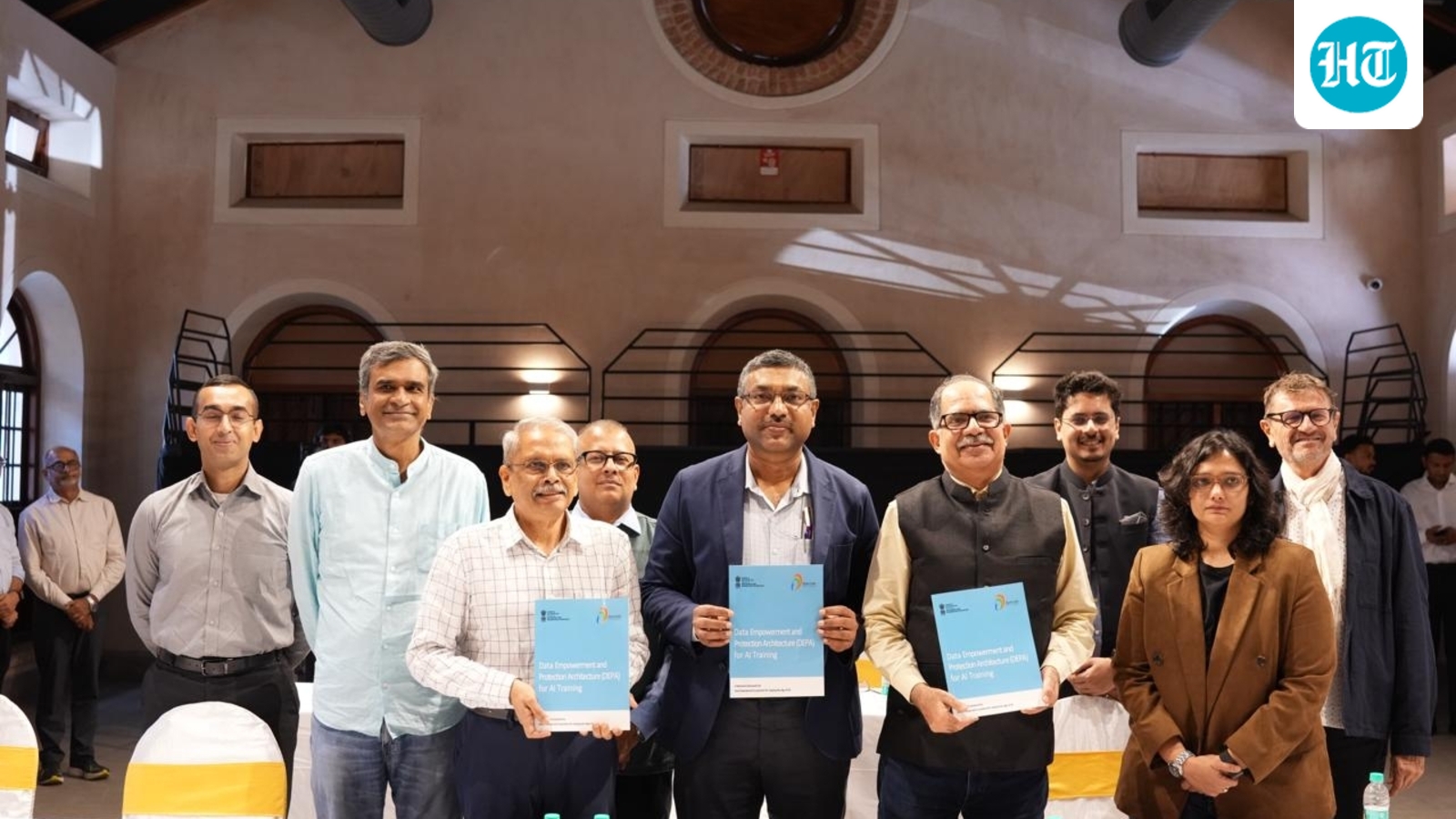
The Union Ministry of Electronics and Information Technology (MeitY) on Saturday launched a handbook to enable secure data sharing for artificial intelligence (AI) training while protecting privacy, intellectual property and institutional control.The Ministry of Electronics and Information Technology (MeitY), Government of India, convened a roundtable today to launch the DEPA for AI Training Handbook. (X/ @GoI_MeitY)The Handbook on Data Empowerment and Protection Architecture (DEPA) for AI Training was unveiled by MeitY secretary S Krishnan at a high-level roundtable in Bengaluru, news agency ANI reported. The launch was supported by the iSPIRT Foundation.The DEPA framework aims to address concerns that often prevent institutions from sharing data, including privacy, confidentiality, intellectual property and control over information.
It provides a techno-legal structure for purpose-bound data collaboration, allowing institutions to share datasets for AI training without giving up control of the information.The framework combines contractual permissions, controlled computing environments and privacy-enhancing safeguards. It also incorporates data provenance mechanisms to track the origin of data, the permissions governing its use and how it is used during AI training, ensuring accountability and transparency.Also Read: Sarvam AI co-founder warns India risks becoming a 'digital colony' over dependence on foreign AI‘Model travels to the data’"India's AI ambitions must be matched by the ability to use data responsibly and securely.
The DEPA Training Framework enables trusted data collaboration at scale, unlocking access to large-scale datasets for AI training while safeguarding privacy, commercial confidentiality and institutional control," Krishnan said.Principal Scientific Adviser to the Government of India Ajay Kumar Sood said the framework would allow AI models to access datasets without requiring institutions to transfer the underlying information."Under DEPA, the model travels to the data, rather than the data travelling to the model," Sood said.He added that the approach could enable trusted collaboration among multiple institutions and across national borders, while accelerating scientific discovery. Sood described the framework as India's contribution to global science diplomacy and efforts to develop an inclusive and responsible global AI ecosystem.Sharad Sharma, co-founder of the iSPIRT Foundation, described the launch as a significant milestone for India's data economy, comparing its importance with the announcement of the Unified Payments Interface (UPI) in February 2016.Kris Gopalakrishnan, co-founder of Infosys and chairman of Axilor Ventures, said the framework could help researchers access diverse datasets to develop more robust AI models while protecting the rights of data custodians and contributors.