


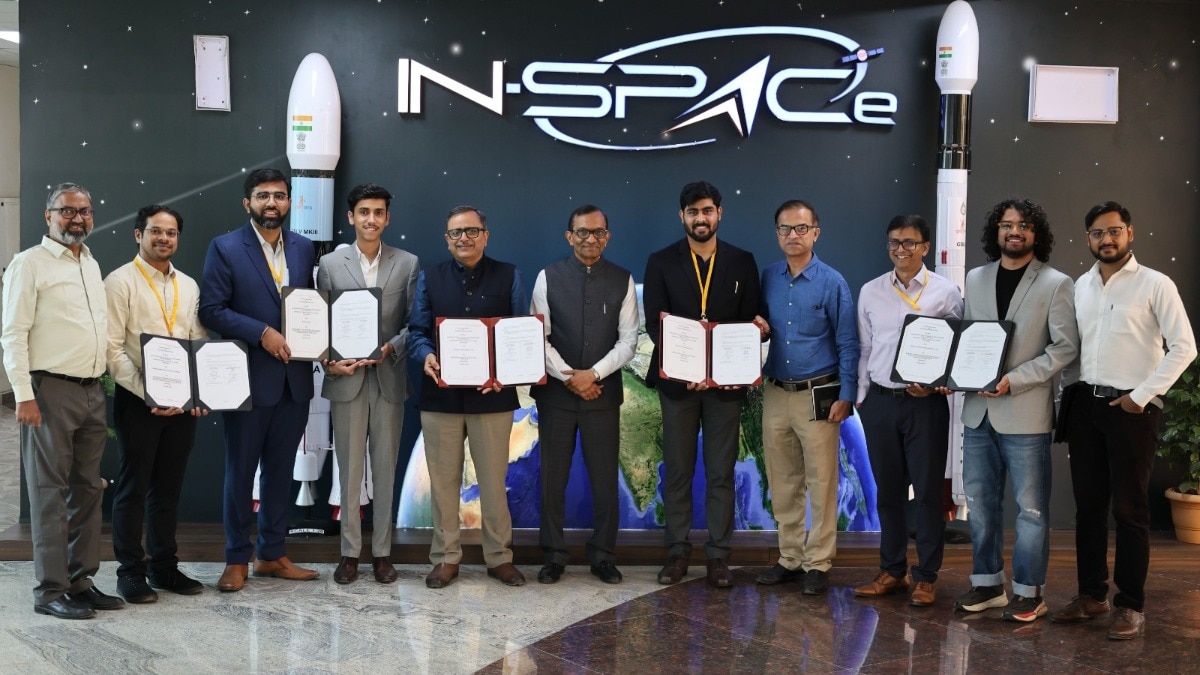
From iodine-powered satellite engines to chips compatible with GPS and NavIC, four Indian firms will be developing technologies after receiving significant funding.IM-SPACe officials are pictured with founders of startups selected for funding. India’s space industry is set to get a boost, with the Indian National Space Promotion and Authorisation Centre (IN-SPACe) offering funding worth Rs 67.15 crore to four more domestic companies developing technologies for satellites and space missions.The latest offers take the number of companies selected under IN-SPACe’s Technology Adoption Fund to seven.
The first three companies were selected in June 2026 for projects involving rocket engines, satellite navigation and Earth observation.The four latest selections are working on technologies ranging from new engines for small satellites to precision clocks and navigation chips."Through these technologies, India can build a more complete domestic space ecosystem, expand industry participation and create export opportunities for Indian companies,” said IN-SPACe Chairman Dr Pawan Goenka. Every launch vehicle upper stage faces the same decision: how to perform the final, precise burns that place a payload exactly where it belongs.
For decades, that meant hydrazine - toxic, hazardous and slower ground-operations. Here's where our 'Green Propellant Liquid Apogee Module' changes the equation.
Manastu Space's GP-LAM delivers 300 N of reliable, restartable thrust with our proprietary MS-289; a non-toxic novel green propellant built to retire toxic fuels and provides enhanced performance with cost-efficiency. Purpose-built for sustainable missions, putting safety first and non-negotiable for: - Kick-stages of launch vehicles - Orbital transfer vehicles (OTVs) - Micro-GEO spacecraft/satellites What it enables: - High specific impulse with multi-restart capability for complex orbital burns - GEO circularization, precise orbit-raising and collision avoidance - Faster turnarounds and safer launch-site operations The next generation of launch vehicles is being designed right now.
The question is whether their upper stages will still run on 60-year-old chemistry or something cleaner, safer and mission-ready. For launch vehicle manufacturers evaluating an Auxiliary Propulsion System, this is the reliable and agile, high-performance choice.
Building an upper stage? Let's talk: business@manastuspace.com #GreenPropulsion #LaunchVehicles #UpperStage #OrbitalTransferVehicle #ManastuSpace— Manastu Space (@ManastuSpace) October 1, 2026 NEW ENGINES FOR SMALL SATELLITESMumbai-based Manastu Space has been offered Rs 22.08 crore to develop an engine for small satellites that uses solid iodine instead of xenon as fuel.Iodine can be stored without the heavy, high-pressure tanks needed for conventional fuels, making the system easier to handle and potentially less expensive.
A picture of a small navigational satellite built by VyomIC. The technology is still being developed by only a handful of companies globally, and the project would mark its first development in India.Inspecity Space Laboratories has been offered Rs 21.18 crore to develop a refillable engine for tiny satellites.
The system will have a fuel port that allows satellites to manoeuvre in space and could eventually make refuelling and servicing possible.HOMEGROWN CLOCKS AND NAVIGATION CHIPSBengaluru-based VyomIC has been offered Rs 12.55 crore to develop highly accurate and secure clocks, as precise timekeeping is essential for satellite navigation, and such clocks could also be used in satellite groups and deep-space missions. Members of the MumbaiSemi team are pictured while holding pictures of satellite chips.
MumbaiSemi has been offered Rs 11.34 crore to develop a chip that can read signals from both GPS and NavIC, India's satellite navigation system.NavIC, developed by Isro, provides coverage across India and around 1,500 km beyond the country's borders.Goenka also highlighted the importance of building indigenous clocks and navigation chips to reduce dependence on foreign technology and strengthen India's ability to develop and export space systems.The funding will be released in stages against project milestones, with progress monitored as the companies work towards developing their technologies.- Ends