


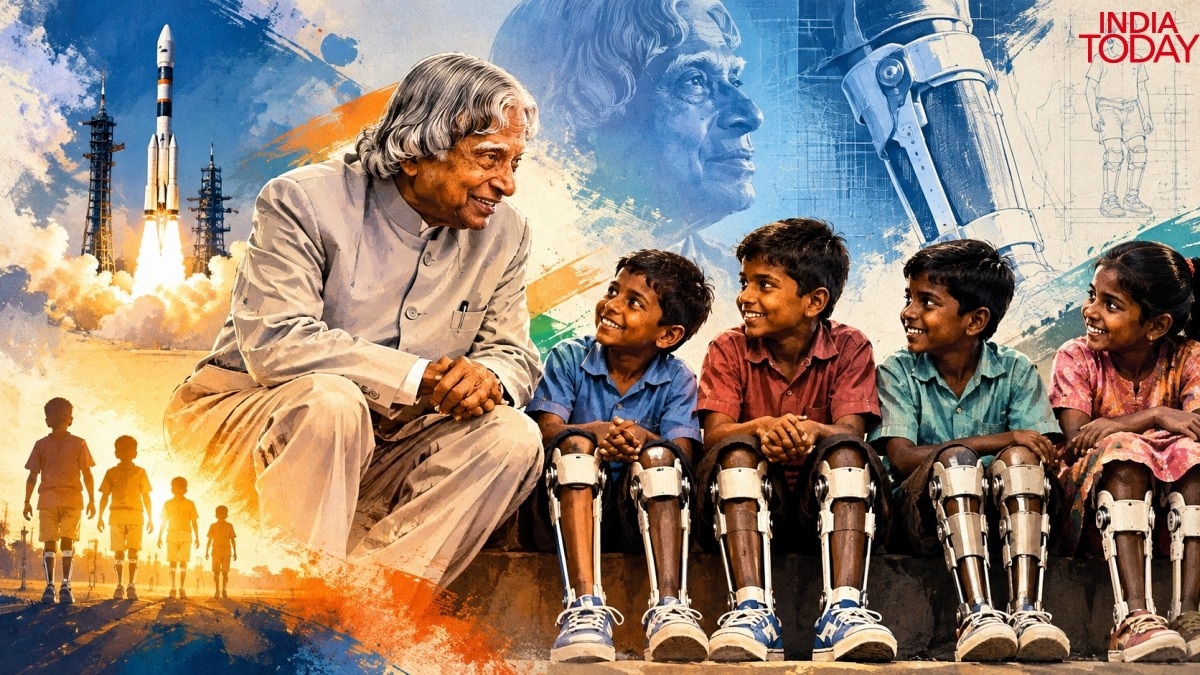
New Delhi: While APJ Abdul Kalam is widely celebrated as India's Missile Man and its eleventh president, one of his most profound scientific legacies involves a very different kind of innovation. In the mid-1990s, Kalam helped bridge the gap between advanced aerospace engineering and medical rehabilitation by championing the development of ultra-lightweight leg braces for children with mobility impairments.
Traditionally, children dealing with conditions such as polio required heavy metal calipers to support their limbs and stabilize their joints. These conventional orthotic devices often weighed around three kilograms, making physical movement exhausting for children with weakened muscles. Recognizing an opportunity to repurpose high-performance defense materials, Kalam collaborated with medical professionals and defense researchers to harness carbon-based composites designed to withstand extreme forces.
Working alongside specialists from the Defence Research and Development Organisation and doctors at Hyderabad's Nizam's Institute of Medical Sciences, the team successfully engineered a revolutionary alternative. The new composite calipers weighed a mere 300 grams, cutting the weight down to roughly one-tenth of traditional devices and making everyday ambulation significantly less strenuous for young users.
The initiative brought together a diverse multidisciplinary team that included doctors, orthotists, and various engineering disciplines. Production and distribution were later expanded through organizations like the Artificial Limbs Manufacturing Corporation of India, with historical accounts indicating that more than 50,000 children ultimately benefited from the devices.
Kalam frequently reflected on the project as a prime example of how scientific progress should directly improve human lives. In a 2005 address, he described the technology as a valuable spin-off from defence research and shared that witnessing children walk with ease using the lighter braces brought him immense joy, leaving parents moved to tears by the transformation.