


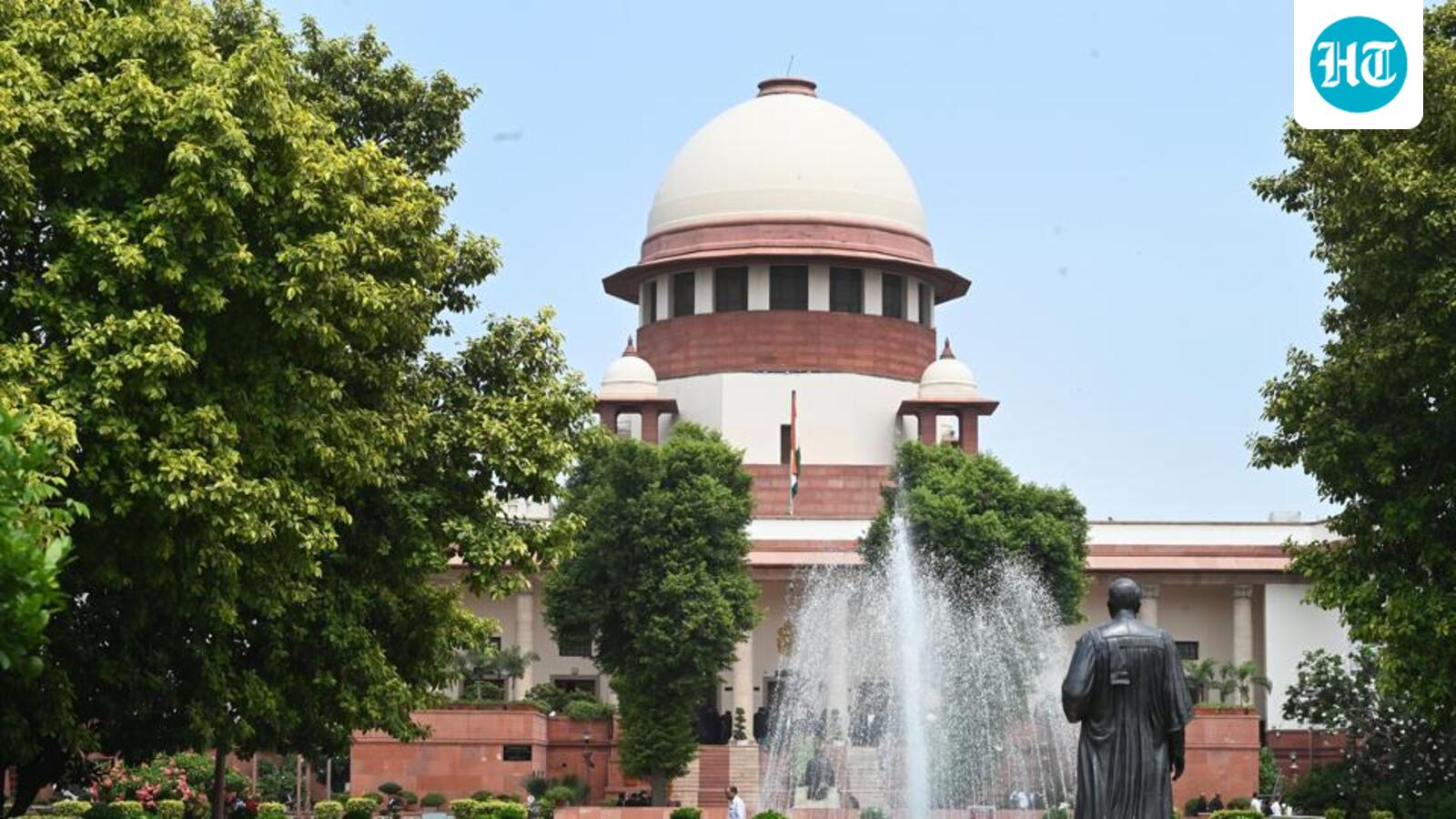
The Supreme Court has ruled that once the prosecution establishes that a public servant possesses assets disproportionate to known sources of income, the burden shifts to the accused to explain how the excess wealth was acquired, making it clear that investigating agencies are not required to embark on an “endless search” for every conceivable source of income that an accused may subsequently claim.The court clarified that the prosecution must first establish the foundational facts. (HT PHOTO)The court said the law places the responsibility on the accused to establish, through credible and verifiable material, that the assets were acquired from lawful sources, as the origin and mode of acquisition of undisclosed wealth are matters within the public servant’s special knowledge.“The prosecution is not required to undertake an open-ended, limitless, or roving enquiry obliging the investigating agency to explore every possible avenue of income that may be imagined or claimed by the accused,” a bench of Justices Sanjay Kumar and Sanjeev Sachdeva said in a judgment delivered on Wednesday.The ruling came while dismissing an appeal by V Gopalakrishnan, a former Kerala government official convicted of possessing assets disproportionate to his known sources of income under the Prevention of Corruption Act. The court upheld his conviction and directed him to surrender within two weeks to serve the remainder of his sentence.“The law does not require the investigating agency to embark upon inquiries into sources which were never disclosed, never reflected in any record, and never brought to the notice of the authorities during the relevant period,” the bench said.The court clarified that the prosecution must first establish the foundational facts of the case, including a public servant’s known sources of income and the assets, financial resources and expenditure attributable to him during the relevant period.
Once the prosecution demonstrates a disproportion between the assets and the known income, a prima facie case is established and the evidentiary burden shifts to the accused.The bench said the expression “known sources of income” refers to lawful sources known to the prosecution through a proper investigation, and not every source of income that an accused may claim to possess. The statutory framework does not require investigators to negate every hypothetical source of income or pursue undisclosed claims that surface only after the disproportionate assets have been detected.“Once the prosecution establishes the disproportion between the assets possessed and the known sources of income, the burden squarely rests upon the accused to demonstrate, through cogent and reliable material, that the assets in question were acquired from lawful and legitimate sources,” said the bench, adding that failure to provide a satisfactory explanation would entitle the court to draw an adverse inference against the accused.In the case before it, Gopalakrishnan had joined government service as a lower division clerk in May 1971 and was promoted to sub-registrar in September 1993.
The prosecution alleged that he accumulated assets disproportionate to his known income between January 1993 and January 2001. After accounting for the increase in assets, the prosecution calculated disproportionate assets to be about 51.88% of the family’s income.The accused challenged, among other things, the valuation of a commercial-cum-residential building he constructed during the period and the estimate of household expenditure.
He maintained that the prosecution had relied on estimates rather than actual expenditure and disputed the construction cost assessed by the investigating agency.The Supreme Court found no merit in these arguments. It noted that the accused had failed to produce cogent material to substantiate his claim that the building had cost substantially less than the prosecution’s estimate.
A notebook containing sporadic entries of construction expenses was insufficient, particularly as he could not substantiate those entries in his testimony.The court relied on its earlier rulings to highlight the distinction between the prosecution’s initial burden of establishing disproportionate assets and the accused’s obligation to account for the excess. It also referred to the court’s decision in State of Madhya Pradesh v Awadh Kishore Gupta (2004), which emphasised that the accused must not merely offer a plausible explanation for the wealth but satisfy the court that the explanation is worthy of acceptance.Upholding the conviction under Section 13(2) read with Section 13(1)(e) of the Prevention of Corruption Act, the court dismissed the appeal.The Kerala High Court reduced Gopalakrishnan’s sentence in view of the delay in concluding the proceedings, his age and the trauma he had undergone, retaining a one-year jail term and a fine of ₹2 lakh.
The top court has now asked him to surrender and undergo the remaining sentence.