


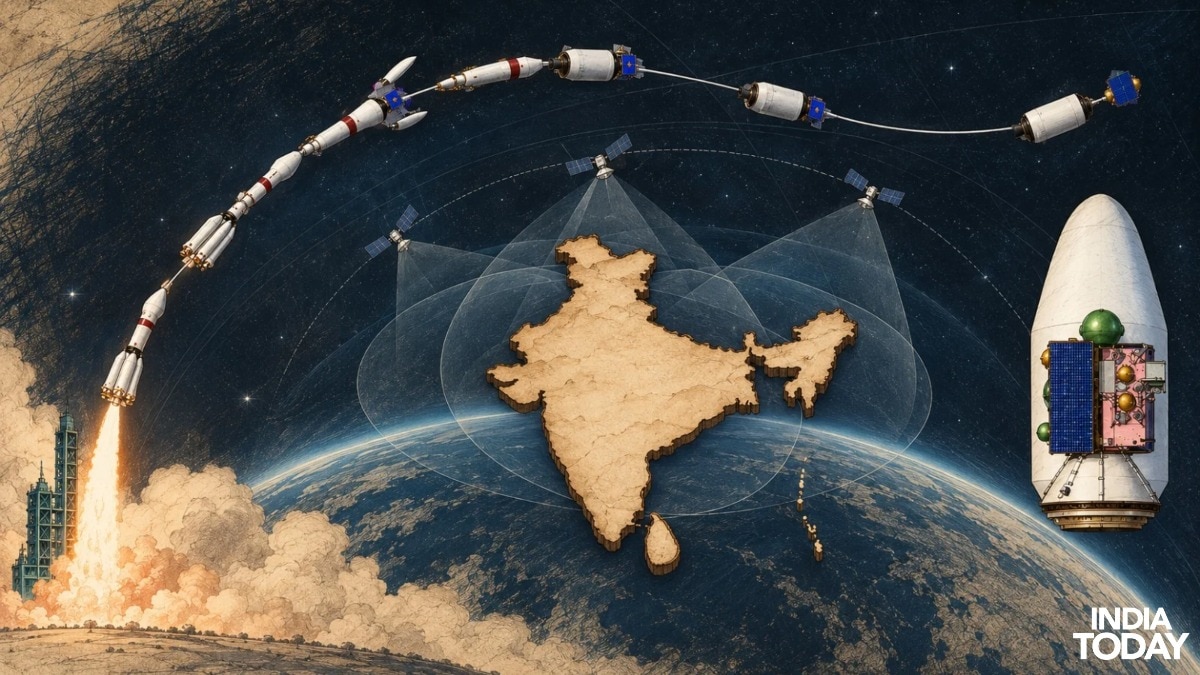
Take a look at the visual explainer below as India Today’s OSINT team takes you through the story of NavIC: what went wrong, and how ISRO is trying to bring India’s own GPS back on track.During the 1999 Kargil War, India learnt an important lesson: depending on another country's satellite navigation system could leave it vulnerable. This experience pushed India's decision to develop its own navigation system, NavIC.More than two decades later, that very system is now in need of repair.WHY IS NAVIC STRUGGLING?NavIC was designed as a seven-satellite constellation, but a minimum of 4 is required for it to function independently.
However, ageing satellites and atomic clock failures have weakened the system. And even a tiny timing error can affect your location.
We will explain both the how and why. One of the ageing satellites is IRNSS-1F (Indian Regional Navigation Satellite System), launched in March 2016.
It completed its 10-year design life on March 10, 2026. Three days later, its last functioning atomic clock stopped working.To replace the ageing constellation, Isro launched NVS-02 (Navigation with Indian Constellation), a second-generation NavIC satellite, in January 2025.
But it failed to reach its final operational orbit. Its February 2026 report of Isro, the likely cause was "the disengagement of at least one contact (in each of the main and redundant paths) of the connector".
In simple terms, an electrical connection had come loose in both the main and backup circuits, preventing the signal from reaching the oxidiser valve and the engine from firing.WHAT IS DIFFERENT TONIGHT?At 11:51 pm, GSLV-F18 is scheduled to lift off from Sriharikota carrying NVS-03.This time, Isro hopes to avoid the technical failure that left NVS-02 stranded in the wrong orbit. But NVS-03 also brings an important upgrade: an indigenously developed atomic clock alongside imported ones.So, why does a navigation satellite need such a precise clock, and what happens if it gets the timing wrong?Think of it this way: your phone calculates its location by measuring how long a signal takes to travel from a satellite to your device.
Since these signals travel at the speed of light, even a tiny mistake in time can create a huge difference in distance.A timing error of just one microsecond (one-millionth of a second) can translate into a distance error of roughly 300 metres. That is why satellites need extremely accurate clocks.
Atomic clocks use the highly stable natural frequency of atoms to keep time far more precisely than ordinary clocks.The indigenous rubidium atomic clock is an important step for India because it reduces dependence on foreign technology for a critical part of its navigation system.NVS-03 also introduces the L1 navigation signal alongside the existing L5 and S-band signals. So, what is L1?
Simply put, it is a radio frequency band used to transmit navigation signals. GPS already uses this band, and adding it to NavIC makes the Indian system compatible with a wider range of existing navigation receivers, including supported smartphones and wearables.But a successful launch is only the beginning.
NVS-03 must first reach its designated orbit and become operational.The original timeline was ambitious. In a July 2025 reply to the Lok Sabha, Jitendra Singh said, "NVS-03 is planned to be launched by the end of 2025.
Subsequently, with a gap of six months, NVS-04 & NVS-05 are planned to be launched".NVS-03's launch has now slipped by nearly a year from that original target. The six-month gap for NVS-04 and NVS-05 was part of the same schedule.
However, the government has not announced fresh launch dates for these satellites or officially explained the change in timeline.- Ends