


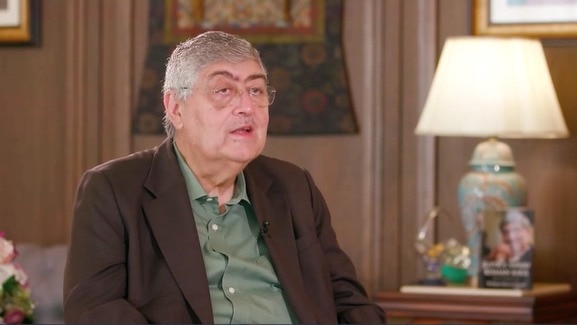
Justice Sanjay Kishan Kaul said the collegium must deliberate independently on candidates before consulting the government, rather than seek prior approval. He also recounted disagreements over proposed appointments and flagged delays in filling vacancies in the Supreme Court and high courts.Former Supreme Court Justice Sanjay Kishan Kaul Former Supreme Court judge Justice Sanjay Kishan Kaul has clarified that his criticism of former Chief Justice of India DY Chandrachud was limited to the judicial appointments process and did not concern his judicial record.
In an interview with India Today, Kaul said he believed the collegium should deliberate independently on candidates before discussing its recommendations with the government, rather than seek its approval in advance.“I have not said that he was deferential to the government. I've said he's deferential of the government in the appointment process,” Kaul told India Today, explaining the distinction between Chandrachud’s judicial work and his approach to administrative matters.The former judge’s remarks come amid a controversy surrounding his forthcoming memoir, Without Fear or Favour, in which he has questioned Chandrachud’s handling of judicial appointments and recounted differences between them over the extent of consultation with the government.‘WE SHOULD BE DEBATING THE NAMES ONLY’Explaining his criticism, Kaul said the collegium must first discuss and decide on candidates independently, with consultations with the government taking place after its deliberations. “It was my belief that the Collegium must debate the names and send it to the government.
And that's the stage where a discussion with the government should take place. We should not have some kind of a pre-approvals from the government,” he said.Kaul stressed that his concerns were not about Chandrachud’s judicial capabilities.
He said he had complimented the former CJI on his judicial work and believed judges remained largely independent when deciding cases involving the government. “Judges are still largely independent and are capable of taking on the government in judicial matters. But on administrative matters, there are issues arising,” he said, identifying judicial appointments as a particular area of concern.KAUL RECOUNTS DIFFERENCES OVER JUDICIAL APPOINTMENTSDuring the interview, Kaul also explained the circumstances behind the differences described in his memoir.
He said that three stages of discussions on judicial appointments took place during his tenure on the collegium.The first involved five names that had been agreed upon, followed by a proposal to introduce a sixth name at the last minute, which, according to Kaul, did not receive the approval of the other members.Subsequently, two more names were proposed while the original five recommendations were still pending. Kaul said he agreed to the two additional names but insisted that the seniority of the earlier five candidates be maintained.He said the disagreement became more pronounced in July, when another candidate was discussed and reservations emerged from the government's side.“It's at that stage I said that well, if this is how the appointment processes to go on, I closed my files,” Kaul said, describing his decision to stop participating in the process at that point.
He added that the next meeting was held only in November.Kaul's account in the memoir has drawn attention to the relationship between the judiciary and the executive, particularly over appointments to constitutional courts.‘APPOINTMENTS ARE TAKING TOO MUCH TIME’Asked whether the higher judiciary was losing its independence and ceding too much space to the political executive, Kaul distinguished between judicial decision-making and administrative functioning.He said his concerns centred on the appointment process, pointing to delays in filling vacancies in the Supreme Court and high courts, including cases in which recommendations had been reiterated but remained pending.“Appointments in the High Court are stuck, appointments in the Supreme Court are stuck, reiterated appointments are stuck, recommendations are stuck. They are taking too much of time,” he said.Kaul, who retired from the Supreme Court in December 2023, served on the collegium under Chandrachud from June 2022.
His memoir has brought renewed scrutiny to the process through which judges are appointed and the extent to which the executive should be involved.The former judge has argued that excessive prior consultation with the government risks becoming an established practice, making it harder for future chief justices to resist similar expectations, particularly when they have shorter tenures.- Ends