


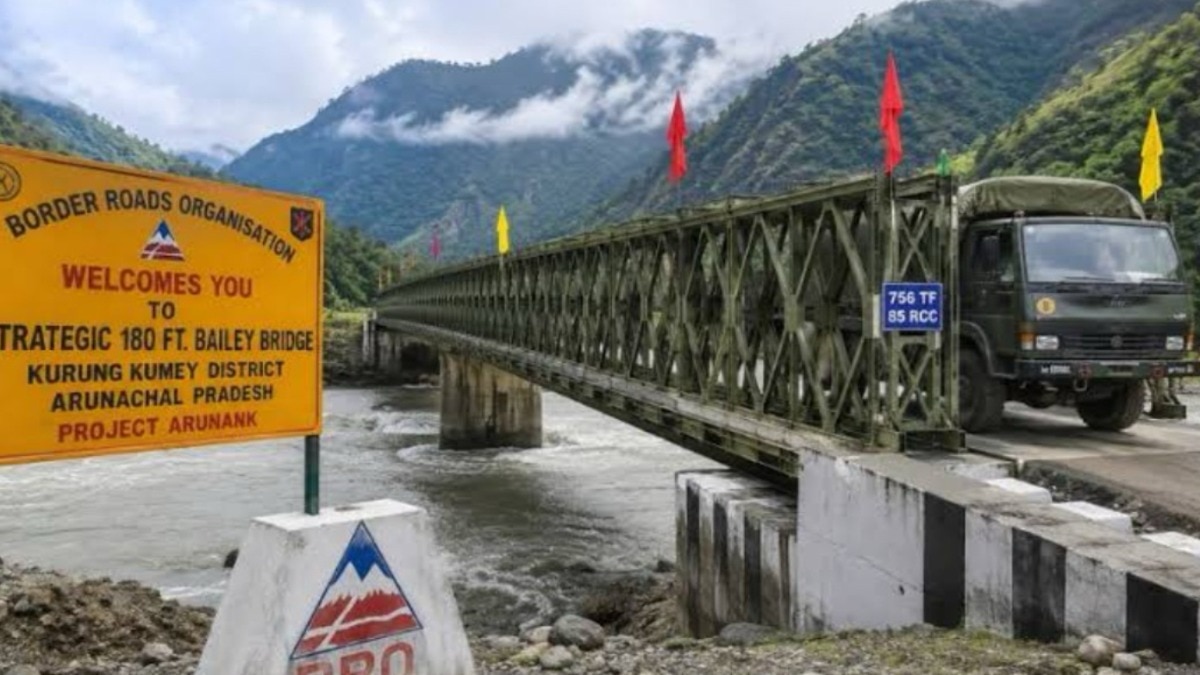
As the Border Roads Organisation’s (BRO) Project Arunank marked its 19th Raising Day in Arunachal Pradesh on October 24, the occasion highlighted a critical element of India’s border strategy: strengthening military mobility, logistics and last-mile connectivity along the Line of Actual Control (LAC) with China.Established in October 2008, Project Arunank has been developing and maintaining strategic infrastructure across Arunachal Pradesh, where steep mountains, dense forests, heavy rainfall and difficult climatic conditions pose persistent challenges to road construction and maintenance. Its work contributes to India’s efforts to improve connectivity along the eastern frontier, where reliable roads are essential for moving troops, equipment and supplies to forward areas.INFRASTRUCTURE AS A STRATEGIC NECESSITY ALONG LACChina’s infrastructure development across the Tibetan plateau and in areas close to the disputed boundary has underscored the importance of strengthening India’s own border connectivity.
For New Delhi, the challenge extends beyond building roads to ensuring that strategically important routes remain usable in difficult terrain and adverse weather.Roads and bridges directly affect the Armed Forces’ ability to mobilise personnel, transport equipment and sustain deployments in remote areas. Better connectivity can help ease logistical constraints and improve access to forward locations, although operational preparedness also depends on supporting infrastructure, equipment, manpower and maintenance.
The scale of India’s infrastructure effort in Arunachal Pradesh is reflected in a Ministry of Defence update from 2022, which reported that the BRO had undertaken work on 64 roads spanning 3,097.15 km in the state over the preceding five years. The figures illustrate the scale of road development in a strategically significant region, although they reflect an earlier reporting period rather than the current total.LAST-MILE CONNECTIVITY AND OPERATIONAL READINESSFor India, the strategic value of border infrastructure lies not only in constructing major routes but also in improving last-mile connectivity to remote settlements and strategically important areas.
Roads linking forward locations, supported by bridges and reliable maintenance, can improve the movement of personnel and supplies while reducing the isolation of communities in difficult-to-access regions. A key example of Project Arunank’s work is the 278-km Hapoli–Sarli–Huri Road, which the BRO reported in 2025 had been blacktopped for the first time since Independence.
The project illustrates how improved road surfaces can strengthen all-weather connectivity and link remote parts of Arunachal Pradesh with wider transport networks.The development of such routes is particularly relevant in a region where geographical constraints can increase the time, cost and complexity of transporting essential supplies. Reliable connectivity is therefore an important component of both military logistics and civilian access.ENGINEERING FOR THE HIMALAYAN TERRAINProject Arunank continues to focus on engineering solutions designed to improve the durability and resilience of infrastructure in challenging conditions.
These include alternative construction materials, geocells and slope-protection measures.Such techniques are important in Arunachal Pradesh, where landslides, erosion, heavy rainfall and seasonal disruptions can damage roads and interrupt movement. In this terrain, maintaining existing infrastructure is as important as constructing new roads.
Regular upkeep, resilient engineering and the timely restoration of damaged stretches are essential to keeping routes functional.The effectiveness of border infrastructure depends not simply on the length of roads built but also on their reliability, accessibility and ability to withstand local environmental conditions.BORDER DEVELOPMENT BEYOND MILITARY REQUIREMENTSThe strategic importance of infrastructure also extends to the civilian population. Improved road connectivity can help residents of remote border settlements access healthcare, education, markets and government services while creating opportunities for local economic activity.Project Arunank has also undertaken welfare measures for Casual Paid Labourers (CPLs), including improved shelters, protective clothing, sanitation facilities and regular medical camps.
Its community and environmental initiatives include cleanliness drives, cyber-awareness programmes, cycling and yoga events, and the planting of 25,815 trees under the ‘Ek Ped Maa Ke Naam’ campaign, according to information released for its Raising Day.Development in border areas is an important complement to infrastructure expansion. Better connectivity can support local livelihoods and improve the delivery of essential services while helping communities remain connected to the wider state and country.THE ROAD AHEADAs Project Arunank enters its 19th year, its work underscores a central requirement of India’s eastern border strategy: infrastructure must combine strategic utility, resilience in difficult terrain and benefits for local communities.Along the LAC, dependable roads and bridges are essential for military mobility and sustained logistics.
At the same time, connectivity to remote settlements remains a key development priority. The challenge ahead is to continue expanding access, strengthen the durability of existing routes and ensure that infrastructure remains functional under demanding conditions.For India, strengthening border infrastructure in Arunachal Pradesh is therefore not merely a construction exercise.
It is a long-term investment in operational preparedness, reliable connectivity and the development of communities living along the country’s sensitive eastern frontier.- Ends