


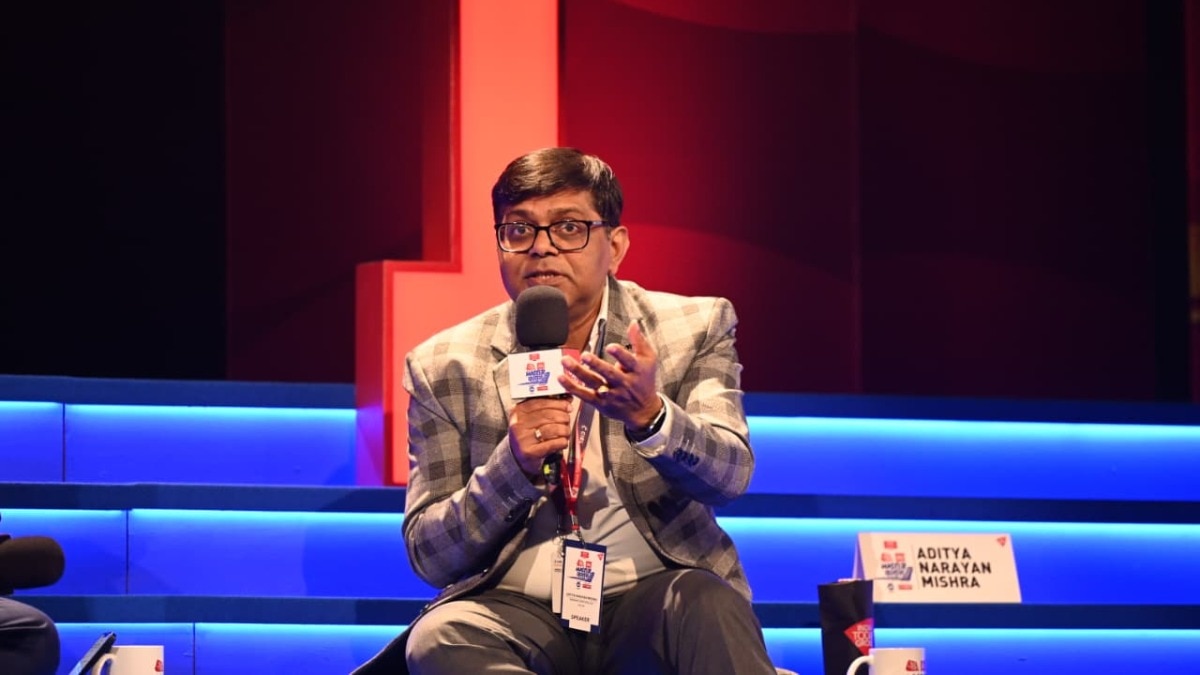
At the Aaj Tak Masterclass, Aditya Narayan Mishra said curiosity, problem-solving and human interaction matter as much as academic qualifications, urging young professionals to prepare for a world of constant disruption.Aditya Narayan Mishra, Managing Director and CEO of CIEL HRNew Delhi,Nov 20, 2026 15:34 ISTWhat if the biggest lesson young professionals need to learn is something they must first unlearn? Life, as Aditya Narayan Mishra, Managing Director and CEO of CIEL HR, puts it, does not follow a prescribed syllabus or a carefully drawn-up plan.“Life will continuously throw unknown challenges and unprecedented events at you.
We have to deal with such situations,” Mishra said during a session titled Company Ko Aap Mein Kya Chahiye? at the Aaj Tak Masterclass.Speaking about the changing employment landscape, Mishra urged young people to shed the mindset they develop through years of formal education, where questions are expected to come from a defined syllabus and outcomes are largely predictable.“While we are in school, college or university, we prepare for examinations. The questions generally come from what has been taught.
But life doesn't work that way,” he said, adding that adaptability and the ability to navigate uncertainty would be critical to professional success. JOBS ARE THERE, BUT THE RIGHT SKILLS ARE MISSINGAddressing the perennial concern about job availability in India, Mishra said the problem was not necessarily a shortage of opportunities but a mismatch between what employers seek and what candidates bring to the table.“There are plenty of jobs.
We recruit every day. There are so many open positions that come to us.
But the question is whether we are finding the right people for those positions. That is the biggest challenge,” he said.
Drawing from his experience in recruitment, he explained that several candidates fail to clear even the initial screening interviews because their skills do not match the requirements of employers.He also pointed to a mismatch in expectations around salaries and working conditions. While companies have openings across sectors, including manufacturing, construction and sales, many young candidates prefer air-conditioned office environments and are reluctant to take up field-based or factory jobs.“There is nothing wrong with having aspirations.
But if too many people have the same preferences, there will naturally be a demand-and-supply gap. If nobody wants to join manufacturing, construction or engineering industries, how will things get made?” he asked.AI WILL DISRUPT JOBS, BUT IT WILL ALSO CREATE NEW ONESMishra also challenged the growing narrative around artificial intelligence and large-scale job losses, calling the doom-and-gloom discourse a major misconception about the future of work.He compared the current technological transition with earlier disruptions, including industrialisation and the arrival of the internet, arguing that economies have consistently adapted to technological change.“Disruption is already happening, and it will continue to happen.
But we have to learn how to deal with it. We have to acquire new skills and find new jobs.
At the same time, new jobs are also being created,” he said.Pointing to the emergence of AI engineers and machine-learning specialists, he said roles that were not prominent in recruitment requirements a few years ago had now become important.Even traditional functions such as customer service are evolving, with employees increasingly expected to use AI tools in their everyday work.The message, he said, was not to fear disruption but to adapt to it.THREE QUALITIES THAT MAKE A CANDIDATE EMPLOYABLEWhen asked what makes a candidate employable beyond educational qualifications and professional experience, Mishra identified three qualities: curiosity, problem-solving and human interaction.“Curiosity is a very important quality. You cannot get a certificate or qualification specifically for curiosity.
It is a human quality. People who are naturally curious are more likely to progress,” he said.On problem-solving, he cautioned that many people fail to identify the actual problem before attempting to solve it.“They may be solving symptoms or addressing some secondary issues while completely missing the core problem.
You need to understand what the actual problem is before attempting to solve it,” he explained.His third essential quality was the ability to interact with people.High academic scores, he pointed out, do not necessarily reflect how well a person can collaborate, listen to colleagues or speak up when required.“When you enter the workplace, these skills become extremely critical,” he said.‘DON'T LIE ON YOUR RESUME’Mishra also identified unrealistic information and exaggerated achievements in resumes as major red flags during recruitment.“Sometimes candidates provide information that is exaggerated or simply not accurate. When we come across such information, it raises concerns,” he said.His advice to job seekers was straightforward: do not misrepresent your experience or project yourself as someone you are not.He also stressed the importance of practical exposure, encouraging students to take up internships, learn from senior professionals and move beyond textbook knowledge to understand real-world workplace challenges.FROM ENGINEERING TO HR: THE IMPORTANCE OF CONNECTING THE DOTSReflecting on his own career journey, Mishra spoke about how his seven years at Larsen & Toubro (L&T) as an engineer helped shape his understanding of human resources.After graduating as an engineer, he worked across sales, quality, project management and engineering before moving into the human capital industry in January 1999.His technical background, he said, proved particularly useful when he began recruiting engineers for Haldia Petrochemicals.
Unlike recruiters without technical exposure, he could understand the domain-specific requirements of the roles and assess candidates more accurately.The experience reinforced a lesson he continues to follow: no learning is ever wasted.“You have to learn how to connect the dots. People who are good at connecting the dots continue to progress,” he said.He added that professionals should not treat every assignment as an isolated task but should look for larger patterns and lessons emerging from their experiences.Even after 27 years in the human capital industry, Mishra said he continues to learn from colleagues, clients and people across professions.HR: CAUGHT BETWEEN EMPLOYERS AND EMPLOYEESAddressing the popular perception of HR as a department that often frustrates employees, Mishra acknowledged that the function comes with considerable pressure.HR professionals, he said, are expected to balance competing demands from management and employees.While management wants higher productivity, lower costs and better talent retention, employees expect better salaries, benefits and working conditions.“HR is caught between these two competing expectations.
HR professionals have to manage the stress coming from both sides,” he said.He also emphasised the importance of professionalism in recruitment, particularly when communicating with candidates.Sharing his company's approach, he said that if an HR professional promises to get back to a candidate, they must honour that commitment.“If you have said, ‘I will get back to you,’ you must genuinely mean it. You should mean what you say,” he said.Mishra's larger message to young job seekers was clear: a degree may get you started, but curiosity, adaptability and the ability to navigate unpredictable situations will determine how far you go.- Ends