


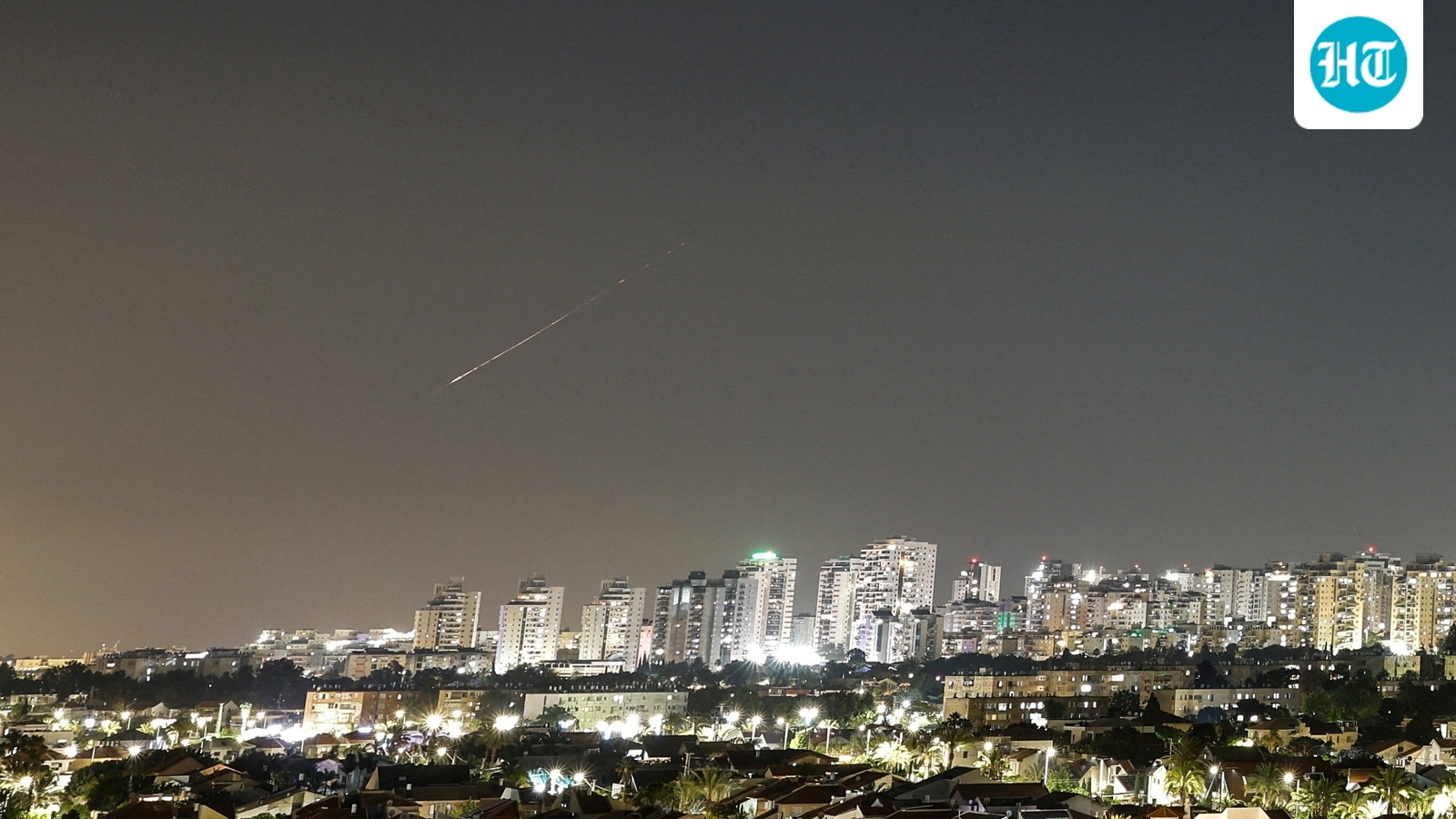
Israel has upgraded a cheaper tier of its missile defense after the war with Iran exposed the country’s reliance on expensive interceptors that are hard to mass produce. The biggest advantages of David’s Sling, which uses Stunner interceptors and is now roughly equivalent to the Patriot system, are price and production volume. (Retuers/Representational)The changes boost the range of David’s Sling, a system designed to target heavy missiles and drones, according to the chief air defense investigator in the Israeli Air Force.
Israel can now counter a wider variety of ballistic threats and withstand weeks of sustained attacks, the investigator said, asking not to be identified by name due to air force policy. With the revamp, Israel is attempting to solve a growing problem among US allies: Precision strikes are becoming cheaper and easier for more adversaries while prolonged wars in Ukraine and the Middle East have exhausted stocks of pricey interceptors.The strategy differs from Washington’s approach, which is to offer long-term commitments in order to stimulate production of expensive interceptors like the Patriot PAC-3.
Allies in Europe, Asia Pacific and the Middle East remain largely dependent on foreign systems. The biggest advantages of David’s Sling, which uses Stunner interceptors and is now roughly equivalent to the Patriot system, are price and production volume.
The Stunner, co-developed by Rafael Advanced Defense Systems Ltd. and RTX Corp., costs about $1 million. That’s about a third the cost of an Arrow 3, the highest-tier interceptor in Israel’s air-defense system, according to Bloomberg Intelligence analyst Wayne Sanders.
A PAC-3 interceptor can cost over $4 million. Israel was forced to adjust its approach after some Iranian ballistic missiles evaded air defenses during recurring clashes starting in 2024, killing dozens of civilians.
During the fighting, it has also leaned on US anti-ballistic missile defense systems for protection. Still, its improvements to David’s Sling give it a domestic solution available in higher quantities as Iran uses a lull in fighting to rebuild its missile arsenal. “When we developed the first generations of kinetic technical missile defense, the notion was that you’re dealing with a few threats, not with hundreds or thousands,” said Uzi Rubin, an analyst at the Jerusalem Institute for Strategy and Security who oversaw the development of Israel’s first national defense shield. “Now we have to come up with cheap kinetic kill missiles.”US tensions with Iran have flared recently with tit-for-tat attacks that fall short of large-scale fighting.
President Donald Trump is weighing plans to join Israel in more extensive strikes on Iran, the New York Times reported this week, citing US and Israeli officials.Israel’s shield includes the Iron Dome for short-range threats, David’s Sling for medium-range threats, and the Arrow family, including the Arrow 3 that can intercept targets in space. It also relies on US-operated THAAD batteries and ship-based interceptors to bolster its defenses.
More US interceptors were used in the war than Israeli ones, according to The Washington Post. The intense barrages Israel faced earlier this year exposed gaps in its defense shield but also gave the military huge amounts of data to upgrade systems, sometimes within days, according to the investigator.
Over 90% of Iranian missiles launched at Israel were intercepted in the first three weeks of the war, according to Haaretz newspaper. Missile attacks killed 20 people and injured thousands in Israel during the conflict.
Countries still need capabilities like the Arrow 3 to defend against threats, but a strong and cheaper mid-tier defense offers more room to maneuver, according to Sanders. “Israel, in my opinion, is in the best position in the entire world to figure this part out on their own,” he said. Rafael and RTX, formerly known as Raytheon, can produce thousands of interceptors a year in Israel and another 2,500 in the US for the Iron Dome and David’s Sling, according to a person familiar with the industry, who spoke on condition of anonymity because he was not authorized to speak publicly.
The Israel Aerospace Industries Ltd., the developer of the Arrow systems, does not disclose its manufacturing capacity.A spokesperson for the Israel Defense Forces referred the matter to Rafael, which declined to comment. A spokesperson for RTX declined to comment.
Israel also exports its missile defense, including to some countries in Europe that are spending more to upgrade their arsenals after Russia’s invasion of Ukraine. Finland and Greece have ordered David’s Sling systems, while Germany relies in part on the Arrow 3.
At the same time, the US is struggling to meet demand for Patriot PAC-3 interceptors. Ukrainian President Volodymyr Zelenskyy says his country alone needs 350 a month to fend off Russian attacks.
That amounts to several times more than are produced annually. Interceptor supplies are also part of Trump’s calculus on whether to resume fighting in Iran.
Iran still retains a formidable ballistic missile arsenal and can bombard Gulf nations, US bases in the Middle East, and Israel. Despite US and Israeli airstrikes, Iran is likely to have at least 1,700 ballistic missiles and is building about 50 a month, Bloomberg News reported last week, citing a western intelligence estimate. “If you’re waiting for PAC-3s, what’ll most likely happen is you’re going to be waiting until at least 2029,” Bloomberg Intelligence’s Sanders said.